
Close Menu
Fund Focus News
    Facebook X (Twitter) Instagram
    Trending
    • Sebi revamps mutual fund categories: Experts explain changes for investors | Personal Finance
    • Use lifecycle funds separately for planning bigger expenses – Mutual Funds News
    • Balanced funds edge out others in Nigeria’s 2026 mutual fund leaderboard
    • RBC Global Asset Management Inc. announces February 2026 cash distributions for ETF Series of RBC Funds
    • 3 Small-Cap ETFs to Buy Before the Great Rotation Leaves Large Caps Behind
    • life cycle mutual funds India | Sebi proposes life cycle mutual funds and tighter disclosure norms framework
    • Understanding the Money Market Mutual Fund Liquidity Facility
    • SEBI’s new category with 5–30 year tenure
    Facebook X (Twitter) Instagram
    Fund Focus News
    • Home
    • Bonds
    • ETFs
    • Funds
    • Investments
    • Mutual Funds
    • Property Investments
    • SIP
    Fund Focus News
    Home»ETFs»How rising retail ETF trading can benefit institutional investors
    ETFs

    How rising retail ETF trading can benefit institutional investors

    August 14, 2024


    Institutional investors can benefit from increased retail ETF trading when market makers “increase the interaction” between the two order flows, according to Peter Whitaker, head of EMEA market structure and regulation at Jane Street.

    In a report, titled Retail Trading in European Listed ETFs, Jane Street said market makers can help bridge the liquidity gap between retail and institutional investors by providing and unwinding risks based on their trading characteristics.

    Retail traders tend to trade most on Mondays and Fridays and have a lower trading share in mid-week, according to data from UK RSP, a dedicated retail trading platform.

    Chart 1: Average daily non-retail venues’ turnover versus retail venues’ share in European-listed ETFs

    Jane street retail chart 1

    Source: big xyt

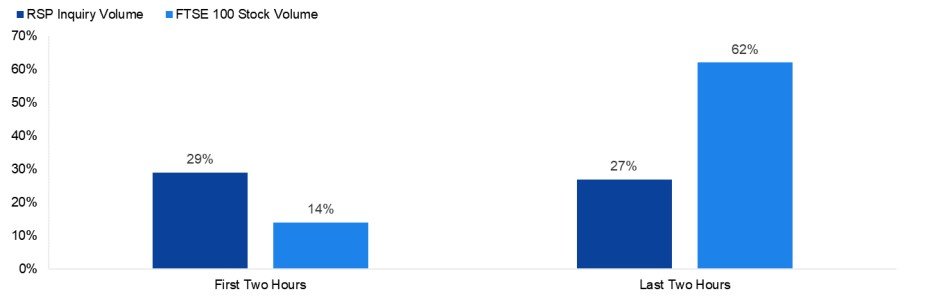
    Furthermore, almost a third of retail trades look to execute in the first two hours of trading, versus just 14% of the turnover of the stocks in the FTSE 100.

    Chart 2: Percentage turnover at start and end of day – RSP inquiry vs FSTE 100 stocks
    Jane street retail chart 2

    Source: big xyt

    “While generally institutional investors’ orders may not be able to interact directly with these retail focused models, institutions can get the benefit of the subsequent hedging and unwind of risk by market makers,” Whitaker said.

    “Providing risk to retail orders at the time it is demanded and then unwinding risk during the institutional trading day, can help that liquidity become more accessible.

    “This interaction may contribute to the relationship between the retail share of ETF trading and the share of on-order book trading in ETFs.”

    It added the “recycling of liquidity” can also extend across products.

    For example, risk provided by market makers to retail in one ETF may make prices tighter across other correlated ETFs, “enabling the wider risk appetite from retail trading to be transferred in part to institutions’ trading across asset classes”.

    Which ETFs are retail investors trading?

    While retail investors tend to use a more concentrated range of ETFs than institutional investors, there is still a large amount of correlation across which the benefits can be felt.

    The top 50 ETFs account for 43.5% of retail investor turnover, versus just 28% for the remaining flow for institutional investors, however market makers can transfer this risk across asset classes, according to Jane Street.

    Chart 3: Turnover by ETFs underlying asset class

    Jane street retail chart 3

    Source: big xyt

    Retail investors are less concerned with ETF size and market-wide turnover than institutional investors.

    “Retail customers likely prefer ETFs listed in their local currency and may have preferences for different dividend structures, for example accumulating over distributing, further focussing retail activity into these particular trading lines,” Whitaker said.

    Retail ETF trading growth

    Retail ETF trading is growing, driven in part by the uptake of German retail investors using ETF savings plans.

    ETF usage among retail investors is now higher than cash equities, accounting for 7% of all ETF trading on retail venues versus 3-4% for cash equities, according to Jane Street analysis.

    “Exchanges and market infrastructure providers more broadly are looking to build new, innovative solutions to support ETF and retail trading given the strong tailwinds supporting these segments of the market,” Whitaker added.

    Despite this, he added differences in execution timing and the ETFs being traded will remain, meaning “the role of market makers will remain of the utmost importance to provide liquidity and enhance institutions’ execution performance”.

    Innovation among retail platforms has also been tipped as the catalyst for driving ETF liquidity onto exchanges in Europe.

    On exchange liquidity has been touted as a major issue for a fragmented European ETF ecosystem currently dominated by request-for-quote (RFQ), which accounted for 55% of ETF execution at the end of 2022.


    Source link

    Share. Facebook Twitter Pinterest LinkedIn Tumblr Telegram Email

    Related Posts

    3 Small-Cap ETFs to Buy Before the Great Rotation Leaves Large Caps Behind

    February 27, 2026

    CME Futures vs. Spot Bitcoin ETFs: Who Sets the Price? (2026)

    February 27, 2026

    Do Leveraged ETFs Belong in a Long-Term Investment Portfolio?

    February 27, 2026
    Leave A Reply Cancel Reply

    Top Posts

    The Shifting Landscape of Art Investment and the Rise of Accessibility: The London Art Exchange

    September 11, 2023

    Sebi revamps mutual fund categories: Experts explain changes for investors | Personal Finance

    February 28, 2026

    Charlie Cobham: The Art Broker Extraordinaire Maximizing Returns for High Net Worth Clients

    February 12, 2024

    The Unyielding Resilience of the Art Market: A Historical and Contemporary Perspective

    November 19, 2023
    Don't Miss
    Mutual Funds

    Sebi revamps mutual fund categories: Experts explain changes for investors | Personal Finance

    February 28, 2026

    The mutual fund industry is set for structural changes after the capital markets regulator…

    Use lifecycle funds separately for planning bigger expenses – Mutual Funds News

    February 27, 2026

    Balanced funds edge out others in Nigeria’s 2026 mutual fund leaderboard

    February 27, 2026

    RBC Global Asset Management Inc. announces February 2026 cash distributions for ETF Series of RBC Funds

    February 27, 2026
    Stay In Touch
    • Facebook
    • Twitter
    • Pinterest
    • Instagram
    • YouTube
    • Vimeo
    EDITOR'S PICK

    How Trump’s 25% tariff on auto imports would impact mutual funds holding auto stocks – Money News

    April 10, 2025

    AllianceBernstein Launches Two Bond ETFs As Investors Hunt For Safer Yields – AB Active ETFs, Inc. AB Core Bond ETF (ARCA:CORB), AB Active ETFs, Inc. AB New York Intermediate Municipal ETF (ARCA:NYM)

    November 11, 2025

    Education organizations, Sen. Linehan at odds over NE school funding, property tax proposals • Nebraska Examiner

    August 9, 2024
    Our Picks

    Sebi revamps mutual fund categories: Experts explain changes for investors | Personal Finance

    February 28, 2026

    Use lifecycle funds separately for planning bigger expenses – Mutual Funds News

    February 27, 2026

    Balanced funds edge out others in Nigeria’s 2026 mutual fund leaderboard

    February 27, 2026
    Most Popular

    🔥Juve target Chukwuemeka, Inter raise funds, Elmas bid in play 🤑

    August 20, 2025

    💵 Libra responds after Flamengo takes legal action and ‘freezes’ funds

    September 26, 2025

    ₹10,000 monthly SIP in this mutual fund has grown to ₹1.52 crore in 22 years

    September 17, 2025
    © 2026 Fund Focus News
    • Get In Touch
    • Privacy Policy
    • Terms and Conditions

    Type above and press Enter to search. Press Esc to cancel.