
photo by: W.Va. Legislative Photography
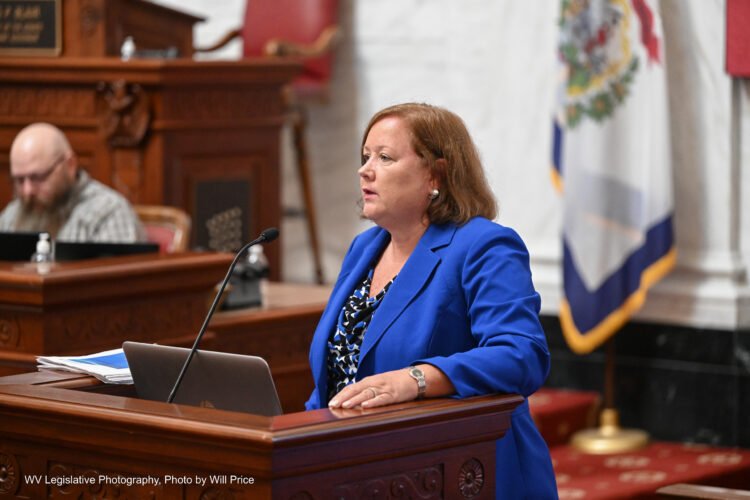
West Virginia Department of Human Services Cabinet Secretary Cynthia Persily said the state’s child care subsidy system is not in crisis during a legislative interim meeting Monday in Charleston.
CHARLESTON — Lawmakers had questions Monday for officials with the West Virginia Department of Human Services regarding recent announcements that provider reimbursement rates for Medicaid waiver programs would increase and the state child care subsidy is fully funded until the end of the year.
Members of the Joint Standing Committee on Finance heard Monday morning from DoHS Cabinet Secretary Cynthia Persily on the second day of August legislative interim meetings.
Gov. Jim Justice and DoHS announced last week that the state Child Care Assistance program now has enough money to continue at current funding levels through December.
DoHS told lawmakers during April interim meetings that the department would need $2.3 million per month, or about $23 million, to fund the Child Care Assistance program at the current rate beginning in September for the remaining 10 months of the current fiscal year.
The additional funds were needed to abide by new federal rules that take effect in September requiring states to fund child care providers based on enrollment at individual facilities instead of attendance.
Persily told committee members Monday that funding for the Child Care Assistance program was coming from surplus dollars in the Temporary Assistance for Needy Families (TANF) program. While the Child Care Assistance program is now projected to have the funds it needs through the end of the year, Persily said it is hard to predict when that funding will run out.
“I’m going to use a very official financial term of ‘squishy,’” Persily said. “We’re trying to model what that is going to look like in kind of a stable situation once our TANF funds are not used, and what we get from our child care block grant from the federal government, how much TANF funds we can count on using ongoing from our regular — not our surplus — TANF funds.”
The department said it will give providers a 60-day notice if the department makes any changes to funding. Based on the cost of $2.3 million per month, the program would need $13.8 million for the remainder of the fiscal year beginning in January 2025.
“There is not an immediate crisis, but we need to be planning, and we are,” Persily said.
Lawmakers wondered why DoHS was not using funds set aside for the department in the May special session. The Legislature passed Senate Bill 1001, a bill restoring more than $5 million to the Department of Health and more than $183 million to DoHS following a 10% cut to their budget for the current fiscal year prior to the state receiving word from the federal government that it would not need to spend more than $400 million on education.
Under questioning from Delegate Clay Riley, R-Harrison, Persily said they had no plans to touch that funding until the fourth quarter – April, May, and June – of the current fiscal year. The bill requires the funds to be spent by March 30, 2025, otherwise the funds return to the general revenue fund.
Justice had teased calling a special session to coincide with August legislative interim meetings for a 5% personal income tax cut and a child care tax rebate proposal. Lawmakers had also expected legislation to address the child care subsidy issue.
“You mentioned that the TANF surplus funds are unreliable,” said Delegate Amy Summers, R-Taylor, to Persily. “Do you think then since the governor didn’t ask for an additional appropriation in the regular session or the special session, that he will do that in our next special session to stabilize the ‘squishiness?’”
“I can’t speak for the governor, but I do know that the governor is dedicated to fixing and stabilizing the child care system,” Persily said. “That certainly could be an option.”
Also last week, Justice and DoHS announced that provider rates for Medicaid waiver services through the Bureau of Medicaid Services will increase by 15% beginning in October. The increase will also apply to family support and personal care rates.
The state manages four Medicaid waiver programs: the aged and disabled waiver, the children with serious emotional disorder waiver, the traumatic brain injury waiver and the intellectual and developmental disability waiver. The programs fund services for families in order to care for eligible family members at home instead of those family members being placed in nursing homes, hospitals and other care facilities, which can be more expensive for Medicaid to cover.
According to Persily, the 15% increase was a total between all four waiver programs, with some subsections seeing larger changes than others, such as a 30% increase in personal care services. The increases are based on recommendations from a December 2023 report commissioned by the Bureau for Medicaid Services by Myers and Stauffer LC.
Workers who provide services in state Medicaid waiver programs earn on average around $11 per hour, or just above $2 more than the state’s minimum wage of $8.75 per hour. The Myers and Stauffer report recommended raising provider reimbursements to allow for those workers to earn between $15.50 per hour and $18.60 per hour. The report recommended an overall increase of $170.6 million for the waiver programs between federal and state funding, with the state’s share of that being $45.1 million.
Funding for the provider rate increases is coming from $219 million in surplus unspent tax dollars from DoHS that rolled over once fiscal year 2024 ended on June 30. The carryover funds also allowed for an additional 50 people to be removed from the IDD waiver waitlist, with 99 people already removed as of July 1.