

Howard Marks put it nicely when he said that, rather than worrying about share price volatility, ‘The possibility of permanent loss is the risk I worry about… and every practical investor I know worries about.’ So it might be obvious that you need to consider debt, when you think about how risky any given stock is, because too much debt can sink a company. We note that Wing Lee Property Investments Limited (HKG:864) does have debt on its balance sheet. But is this debt a concern to shareholders?
What Risk Does Debt Bring?
Generally speaking, debt only becomes a real problem when a company can’t easily pay it off, either by raising capital or with its own cash flow. If things get really bad, the lenders can take control of the business. While that is not too common, we often do see indebted companies permanently diluting shareholders because lenders force them to raise capital at a distressed price. Of course, plenty of companies use debt to fund growth, without any negative consequences. When we examine debt levels, we first consider both cash and debt levels, together.
See our latest analysis for Wing Lee Property Investments
What Is Wing Lee Property Investments’s Net Debt?
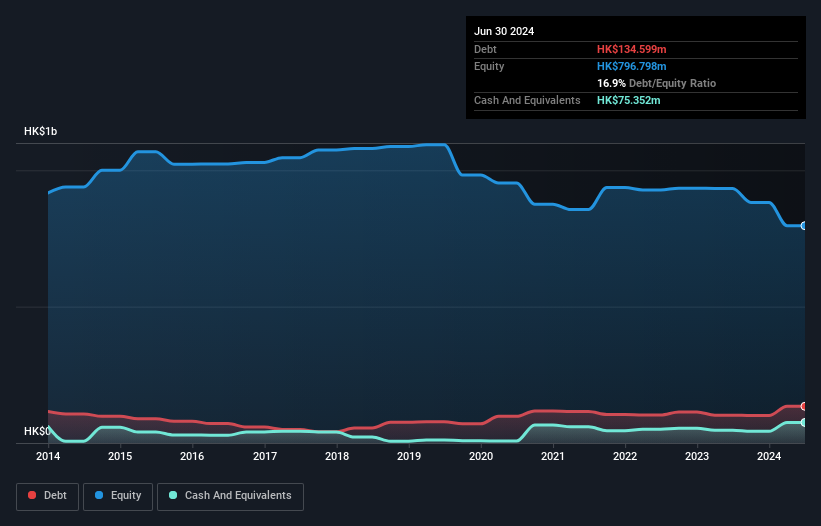
The image below, which you can click on for greater detail, shows that at June 2024 Wing Lee Property Investments had debt of HK$134.6m, up from HK$102.2m in one year. However, it also had HK$75.4m in cash, and so its net debt is HK$59.2m.
A Look At Wing Lee Property Investments’ Liabilities
Zooming in on the latest balance sheet data, we can see that Wing Lee Property Investments had liabilities of HK$50.3m due within 12 months and liabilities of HK$96.6m due beyond that. On the other hand, it had cash of HK$75.4m and HK$1.61m worth of receivables due within a year. So it has liabilities totalling HK$69.9m more than its cash and near-term receivables, combined.
This is a mountain of leverage relative to its market capitalization of HK$70.3m. Should its lenders demand that it shore up the balance sheet, shareholders would likely face severe dilution.
We use two main ratios to inform us about debt levels relative to earnings. The first is net debt divided by earnings before interest, tax, depreciation, and amortization (EBITDA), while the second is how many times its earnings before interest and tax (EBIT) covers its interest expense (or its interest cover, for short). This way, we consider both the absolute quantum of the debt, as well as the interest rates paid on it.
Wing Lee Property Investments has a debt to EBITDA ratio of 3.6 and its EBIT covered its interest expense 3.2 times. This suggests that while the debt levels are significant, we’d stop short of calling them problematic. Another concern for investors might be that Wing Lee Property Investments’s EBIT fell 14% in the last year. If that’s the way things keep going handling the debt load will be like delivering hot coffees on a pogo stick. The balance sheet is clearly the area to focus on when you are analysing debt. But it is Wing Lee Property Investments’s earnings that will influence how the balance sheet holds up in the future. So if you’re keen to discover more about its earnings, it might be worth checking out this graph of its long term earnings trend.
Finally, while the tax-man may adore accounting profits, lenders only accept cold hard cash. So we clearly need to look at whether that EBIT is leading to corresponding free cash flow. Over the last three years, Wing Lee Property Investments recorded free cash flow worth a fulsome 89% of its EBIT, which is stronger than we’d usually expect. That puts it in a very strong position to pay down debt.
Our View
To be frank both Wing Lee Property Investments’s level of total liabilities and its track record of (not) growing its EBIT make us rather uncomfortable with its debt levels. But on the bright side, its conversion of EBIT to free cash flow is a good sign, and makes us more optimistic. Looking at the balance sheet and taking into account all these factors, we do believe that debt is making Wing Lee Property Investments stock a bit risky. Some people like that sort of risk, but we’re mindful of the potential pitfalls, so we’d probably prefer it carry less debt. There’s no doubt that we learn most about debt from the balance sheet. However, not all investment risk resides within the balance sheet – far from it. For example Wing Lee Property Investments has 2 warning signs (and 1 which is a bit unpleasant) we think you should know about.
At the end of the day, it’s often better to focus on companies that are free from net debt. You can access our special list of such companies (all with a track record of profit growth). It’s free.
Valuation is complex, but we’re here to simplify it.
Discover if Wing Lee Property Investments might be undervalued or overvalued with our detailed analysis, featuring fair value estimates, potential risks, dividends, insider trades, and its financial condition.
Have feedback on this article? Concerned about the content? Get in touch with us directly. Alternatively, email editorial-team (at) simplywallst.com.
This article by Simply Wall St is general in nature. We provide commentary based on historical data and analyst forecasts only using an unbiased methodology and our articles are not intended to be financial advice. It does not constitute a recommendation to buy or sell any stock, and does not take account of your objectives, or your financial situation. We aim to bring you long-term focused analysis driven by fundamental data. Note that our analysis may not factor in the latest price-sensitive company announcements or qualitative material. Simply Wall St has no position in any stocks mentioned.