
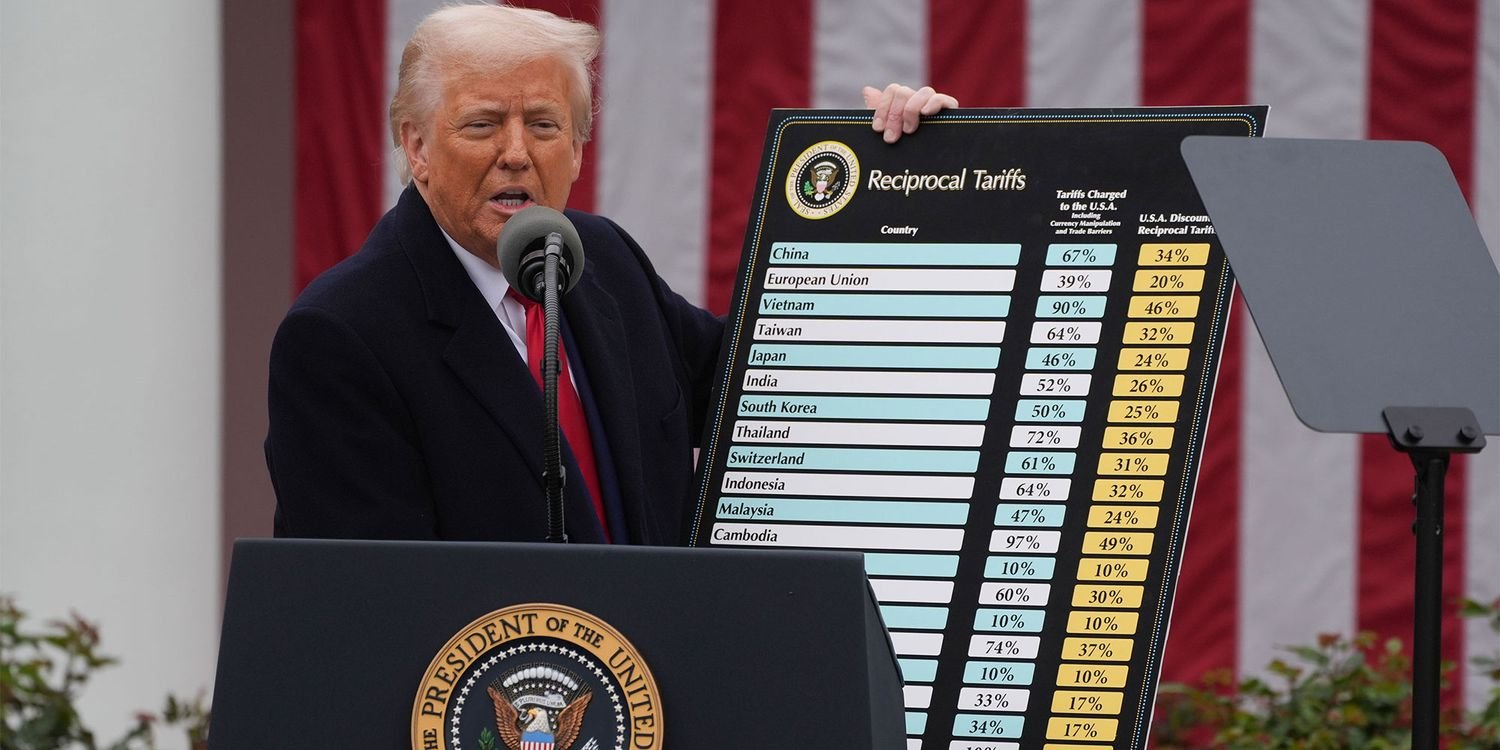
Global stock markets fell following the announcement of new US import tariffs, with UK pensions and investments affected.
The tariffs, most of which came into effect on 5 April, include new charges on a wide range of goods, including a 10% levy on exports from the UK on top of 25% duties on aluminum, steel, vehicles and car parts.
Here, we explain what’s happened so far and what to keep in mind if you’re saving or investing for the future.
What are Trump’s tariffs?
Tariffs are taxes placed on goods that are imported from other countries. The idea is to make foreign products more expensive and protect domestic industry.
Contrary to some beliefs, tariffs are not paid by the exporting country. The charges are paid by domestic companies whenever they import a tariffed good. Firms will often pass those charges on to their customers.
Tariffs can spark trade disputes, shaking investor confidence.
Two weeks ago, President Trump announced a minimum 10% tariff on nearly all goods imported into the US, including goods from the UK.
Trump has said that he wants the tariffs to encourage US consumers to buy more American-made goods. He has also pointed to trade imbalances with countries that export more to the US than they import.
This has led him to place much higher tariffs on certain countries. China was set to face a 34% tariff from 9 April, but Trump has now increased this to 145% after China introduced retaliatory tariffs on US goods.
The President surprised markets again last week when he announced a 90-day pause on certain tariffs from certain countries, although the flat 10% rate remains in effect.
What’s the impact on global markets?
The new tariff regime has rocked financial markets, with many leading stock market indices recording dramatic falls after the announcement.
European and Asian shares fell at last Monday’s open: Britain’s FTSE 100 dipped 2.5% after already dropping nearly 5% the previous Friday (as shown in the chart below), while Germany’s DAX plunged 10%.
Industries which export large volumes to the US are expected to suffer the most, particularly the automotive and defence sectors, but also pharmaceuticals and luxury goods.
US markets are also taking a hit, as many leading American companies rely heavily on global supply chains and cheap imported goods.
Markets have since rebounded somewhat following Trump’s proclamation that certain tariffs would be paused for 90 days, but most are still trading below where they were before the tariffs were initially announced.
- Find out more: how to buy shares.
What US tariffs mean for your investments
It’s natural to feel worried about this kind of announcement, but it’s important not to panic or make rash decisions – investing is best treated as a long-term strategy.
Diversifying your portfolio is key to weathering the ups and downs of the financial market. This includes spreading your assets between equities, commodities, bonds and cash, as appropriate.
Your first step should be to gauge your current exposure to the industries and markets most impacted by Trump’s tariffs. If you’re unhappy, you can dial down those investments.
Susannah Streeter, from the financial services company Hargreaves Lansdown, says: ‘Investors should ensure they are well diversified, without too much concentration on a particular market, and with money spread across different asset classes and geographies.
‘For investors owning quality companies over the long term, big bumps in the road are part of the journey.’
Investing smaller amounts over a longer time period, as opposed to big lump sums, can also help you smooth out brief periods of market instability.
- Find out more: best stocks and share Isas 2025.
What US tariffs mean for your pensions
If you have a pension, there’s a good chance part of it is invested in the stock market. When markets fall sharply, the value of your pension can drop, too, particularly if you’re in a fund with higher exposure to shares.
Here’s how your pension and retirement plans may be impacted:
Workplace pensions
Most people with a defined contribution pension are invested in a default fund, which spreads money across a mix of assets such as company shares, bonds and property.
These funds are built to handle ups and downs, and typically move into lower-risk investments as you get closer to retirement.
The market reaction to Trump’s tariffs may have unsettled some pension savers, but short-term ups and downs are a normal part of long-term investing.
Jason Hollands, managing director at wealth manager Evelyn Partners, says: ‘Amid uncertainty and periods of turbulence, sometimes the best course of action is to take a few deep breaths, sit tight and wait for the dust to settle.’
He says that while you might see the value of your pot take a dip in the coming days, there’s no need to panic or change things.
He adds: ‘In fact, your contributions could be picking up equities more cheaply, which is one of the benefits of regular investing – whether into a pension or an Isa.’
If you’re approaching retirement, you may be thinking about whether now is the right time to start drawing money from your pension. Some people might choose to wait until markets feel more stable, while others may prefer the certainty of a guaranteed income through an annuity.
- Find out more: do you know where your pension is invested?
Annuities
An annuity provides a set income for life or for a fixed number of years. You buy it with some or all of your pension pot and the amount you receive is fixed at the time you take it out.
With interest rate cuts expected later this year, some may choose to lock in while rates remain high.
According to Hargreaves Lansdown, a 65-year-old with a £100,000 pension can currently get up to £7,600 a year from a single life annuity with a five-year guarantee.
This is the highest rate since unisex annuity pricing was introduced in 2012.
- Find out more: best annuity rates 2025.
If you take out an annuity as a result of using the service from HUB Financial Solutions, Which? will earn a commission to help fund our not-for-profit mission.
Final salary pensions
Final salary, also known as defined benefit pensions, provide a guaranteed income for life, usually based on your salary and how long you’ve worked for your employer.
These pensions are not directly affected by short-term market movements, so most savers won’t see any change.
- Find out more: how much you need to retire
Income drawdown
Income drawdown lets you take some money from your pension while keeping the rest invested. If markets fall, the value of your investments can drop and withdrawing money during these periods can reduce your pot.
Helen Morrissey of Hargreaves Lansdown recommends using a ‘natural yield approach’. This means only taking the income your investments produce, rather than selling units to generate cash. This can help your pension last longer, but it also means your income may go up or down over time.
She says: ‘We recommend people keep one to three years of essential expenses in an easy-access account to supplement their income during these times and avoid them eating into their capital.’
- Find out more: what is pension drawdown?