
Close Menu
Fund Focus News
    Facebook X (Twitter) Instagram
    Trending
    • Median returns for equity funds with gold and silver – Business News
    • Lump sum vs SIP in volatile markets: Which strategy works better when markets swing sharply? – Money News
    • SEBI mutual fund reforms 2026: Equity funds can invest up to 35% of their non-core allocation in gold/silver, InvITs, debt instruments
    • Lebanon sinks deeper into conflict, but bonds hit six-year highs
    • SCHO’s Short-Term Treasuries vs. SMB’s Municipal Bonds: Which ETF Is a Better Fit for You?
    • Best SIP Portfolio Ideas to Consider for March 2026
    • Celebrity Investments in Energy 2026 Trends
    • 3 Total Stock Market ETFs to Buy With $500 and Hold Forever
    Facebook X (Twitter) Instagram
    Fund Focus News
    • Home
    • Bonds
    • ETFs
    • Funds
    • Investments
    • Mutual Funds
    • Property Investments
    • SIP
    Fund Focus News
    Home»Bonds»SCHO’s Short-Term Treasuries vs. SMB’s Municipal Bonds: Which ETF Is a Better Fit for You?
    Bonds

    SCHO’s Short-Term Treasuries vs. SMB’s Municipal Bonds: Which ETF Is a Better Fit for You?

    March 5, 2026


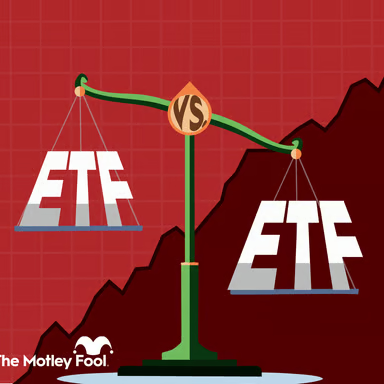
    Both the Schwab Short-Term U.S. Treasury ETF (SCHO 0.04%) and the VanEck Short Muni ETF (SMB +0.00%) are ultra-short bond funds targeting safety and liquidity, but with different approaches: SCHO tracks the short-term U.S. Treasury market, while SMB focuses on short-term, tax-exempt municipal bonds.

    SCHO features larger assets under management (AUM), higher yield, and lower fees compared to SMB, while SMB has slightly outperformed over the past year and five-year periods. This comparison unpacks their differences in cost, yield, risk, and holdings to help investors weigh which may fit their needs.

    Snapshot (cost & size)

    Metric SMB SCHO
    Issuer VanEck Schwab
    Expense ratio 0.07% 0.03%
    1-yr return (as of 2/27/2026) 4.28% 4.75%
    Dividend yield 2.6% 4%
    Beta 0.34 0.25
    AUM $303.7 million $12.3 billion

    Beta measures price volatility relative to the S&P 500; beta is calculated from five-year monthly returns. The 1-yr return represents total return over the trailing 12 months.

    While both funds are extremely affordable, SCHO edges out SMB with a lower annual expense ratio and a noticeably higher yield, which could appeal to investors seeking maximum income with minimal cost drag.

    Performance & risk comparison

    Metric SMB SCHO
    Max drawdown (5 y) (7.48%) (5.69%)
    Growth of $1,000 over 5 years $971.85 $951.12

    What’s inside

    SCHO tracks the performance of short-term U.S. Treasury bonds. It holds 98 securities and has been operating for over 15 years.

    Schwab Strategic Trust - Schwab Short-Term U.s. Treasury ETF Stock Quote

    Schwab Strategic Trust – Schwab Short-Term U.s. Treasury ETF

    Today’s Change

    (-0.04%) $-0.01

    Current Price

    $24.33

    Key Data Points

    Day’s Range

    $24.32 – $24.34

    52wk Range

    $24.19 – $24.47

    Volume

    13K

    SMB, by contrast, is entirely concentrated in tax-exempt municipal bonds, with over 330 holdings. This gives SMB a municipal credit profile that may offer tax advantages to some investors, but with a yield and risk profile distinct from Treasury-focused SCHO.

    VanEck ETF Trust - VanEck Short Muni ETF Stock Quote

    VanEck ETF Trust – VanEck Short Muni ETF

    Today’s Change

    (0.00%) $0.00

    Current Price

    $17.40

    Key Data Points

    Day’s Range

    $17.39 – $17.43

    52wk Range

    $16.70 – $17.53

    Volume

    55K

    For more guidance on ETF investing, check out the full guide at this link.

    What this means for investors

    Short-term Treasury bonds and municipal bonds both have some appealing characteristics for investors, including reliable income, liquidity, and low risk. In fact, Treasury bonds are considered virtually risk-free, as they’re backed by the “full faith and credit” of the U.S. government. Municipal bonds, issued by state and local governments, do carry some default risk, though defaults are relatively uncommon.

    One of the biggest differentiators between the two investment types is how they’re taxed. Municipal bonds, like those held in the SMB ETF, are generally exempt from federal taxes and the alternative minimum tax (AMT). Treasury bonds, on the other hand, are subject to federal income tax, but exempt from state and local taxes. For investors with a higher income tax rate, or who live in states with higher tax rates, these differences in tax treatment may be important.

    These tax differences are one reason the yield is lower for SCHO than for SMB, which could make the difference if income generation is your investing goal. But be sure to consider your after-tax gains before choosing between municipal bonds and Treasury bonds.


    Source link

    Share. Facebook Twitter Pinterest LinkedIn Tumblr Telegram Email

    Related Posts

    Lebanon sinks deeper into conflict, but bonds hit six-year highs

    March 5, 2026

    Premium Bonds prize myth debunked as this ‘doesn’t improve the odds’

    March 5, 2026

    Southampton Premium Bonds winners revealed for March 2026

    March 4, 2026
    Leave A Reply Cancel Reply

    Top Posts

    The Shifting Landscape of Art Investment and the Rise of Accessibility: The London Art Exchange

    September 11, 2023

    Charlie Cobham: The Art Broker Extraordinaire Maximizing Returns for High Net Worth Clients

    February 12, 2024

    The Unyielding Resilience of the Art Market: A Historical and Contemporary Perspective

    November 19, 2023

    Lebanon sinks deeper into conflict, but bonds hit six-year highs

    March 5, 2026
    Don't Miss
    Mutual Funds

    Median returns for equity funds with gold and silver – Business News

    March 5, 2026

    The recent decision by the Securities and Exchange Board of India (Sebi) to allow asset…

    Lump sum vs SIP in volatile markets: Which strategy works better when markets swing sharply? – Money News

    March 5, 2026

    SEBI mutual fund reforms 2026: Equity funds can invest up to 35% of their non-core allocation in gold/silver, InvITs, debt instruments

    March 5, 2026

    Lebanon sinks deeper into conflict, but bonds hit six-year highs

    March 5, 2026
    Stay In Touch
    • Facebook
    • Twitter
    • Pinterest
    • Instagram
    • YouTube
    • Vimeo
    EDITOR'S PICK

    Best Real Estate Crowdfunding Platforms for January 2025

    December 26, 2024

    More than 75% of Houston ISD residents support record $4.4 billion bond proposal

    August 22, 2024

    Active Vs Passive Mutual Funds: Which One To Choose? Know Key Differences

    February 19, 2025
    Our Picks

    Median returns for equity funds with gold and silver – Business News

    March 5, 2026

    Lump sum vs SIP in volatile markets: Which strategy works better when markets swing sharply? – Money News

    March 5, 2026

    SEBI mutual fund reforms 2026: Equity funds can invest up to 35% of their non-core allocation in gold/silver, InvITs, debt instruments

    March 5, 2026
    Most Popular

    🔥Juve target Chukwuemeka, Inter raise funds, Elmas bid in play 🤑

    August 20, 2025

    💵 Libra responds after Flamengo takes legal action and ‘freezes’ funds

    September 26, 2025

    ₹10,000 monthly SIP in this mutual fund has grown to ₹1.52 crore in 22 years

    September 17, 2025
    © 2026 Fund Focus News
    • Get In Touch
    • Privacy Policy
    • Terms and Conditions

    Type above and press Enter to search. Press Esc to cancel.