

Bonds are best viewed not as a short-term trading instrument but as an income-generating asset class. As such, there are many reasons why an investor may decide that buying an individual bond over a fund is right for them.
Not only does an individual bond in your portfolio offer a locked-in, contractual rate of return, but there are also tax advantages.
For gilts and qualifying corporate bonds, buying at a discount and redeeming at face value, or ‘par’, can deliver decent tax-free capital gains, although the interest will still be subject to income tax if held outside an Isa or Sipp.
And with yields now much higher than the Bank of England spot rate again, fixed income continues to look attractive.
“That is where this corporate bond market gets very exciting, because there are high-quality names with good yields on offer,” says Mike Coombes, chief operating officer of PrimaryBid.
Thanks to new rules that have made it easier for companies to issue in retail-friendly denominations, there is now more to consider than just the bond itself – the point in time at which you buy it is also worth some thought, too.
Read more from Investors’ Chronicle
Why buy primary?
Retail investors can now buy corporate bonds at launch, in what is known as the primary market, as well as trading them after the fact in the secondary market.
So what is the difference? The primary market is where new bonds become available to investors for the first time. The main advantage of buying here is that retail investors can ensure they pay the same price as institutional investors.
“Investors can be confident that the price is correct because the majority of the deal will be sold to sophisticated institutional investors which are in effect setting the price,” says Nick Smith, manager director of capital markets at RetailBook.
Unlike in the secondary market, where investors trade through intermediaries who may apply a margin or additional fee, buying in primary cuts out the middle man. This allows investors to buy at a fixed price.
“You could argue that you get the best price in primary,” Michael Smith, head of debt capital markets at Winterflood Securities, tells Investors’ Chronicle. “Prices go up and down, but you are generally going to be buying in a strong market.”
Even so, there are no guarantees. While a new issue will typically come at a slight discount, the concession can vary depending on market conditions, and in cases where there has been a drought of deals, it may not apply at all.
Meanwhile, the secondary market is where bonds are bought and sold between investors after they have been issued. As the price fluctuates based on demand and interest rates, bonds can be traded at a discount or a premium to par. This gives rise to the so-called secondary premium, which is common among highly prized bonds.
After price, the second disadvantage to buying this way is a potential lack of access. The demand for good-quality, investment-grade corporate bonds is usually high at the best of times, and particularly so in a volatile market. There may be fewer sellers of sought-after bonds in the secondary market, making them more expensive and harder to secure in the exact quantity you are after.
What to be aware of
Buying in the primary market can be advantageous for private investors in some respects, but it is not without obstacles. The more informed you are about these, the smoother the buying process will be.
The first is the speed of execution. Despite recent overhauls, this is one thing about the bond market that is unlikely to change. Large blue-chip issuers usually give a few days’ notice at the very most about an upcoming issuance, and want to enter and exit the market within hours. This preference for same-day execution means individuals must be willing to act fast to match the pace of professional investors.
This means that your assessment of the company, the bond and its quality must be completed in a very compressed timeframe. As I explained in ‘What you need to know about buying corporate bonds’, doing your homework is important if you plan to buy an individual security.
It also requires you to have the cash in your investment account available to deploy. The nature of buying at launch means waiting around for a bond to come along, and then pouncing at short notice.
For some private investors, this might not be a suitable model. Until there is a regular stream of retail-eligible deals coming to the market, some may prefer not to operate in a perpetual state of anticipation. For those who prefer to invest according to their own schedule, and conduct research in their own time, the secondary market may well be better.
“Corporate bonds trade in the secondary market on a daily basis, and that’s important to investors – having access to bonds there, to buy and sell whenever they want,” notes Mateusz Malek, head of bond research at Killik & Co.
How will it work?
Last month, Hargreaves Lansdown expanded its primary issuance service, in partnership with dealer Winterflood Securities, to successfully offer ‘green’ gilts to retail investors at launch for the first time.
And while the process for buying corporate bonds at launch is currently untested (one has yet to be issued under the new rules), many in the market feel that the process for directly purchasing gilts is a good indication of how it would work.
How bond deals flow through the primary market:
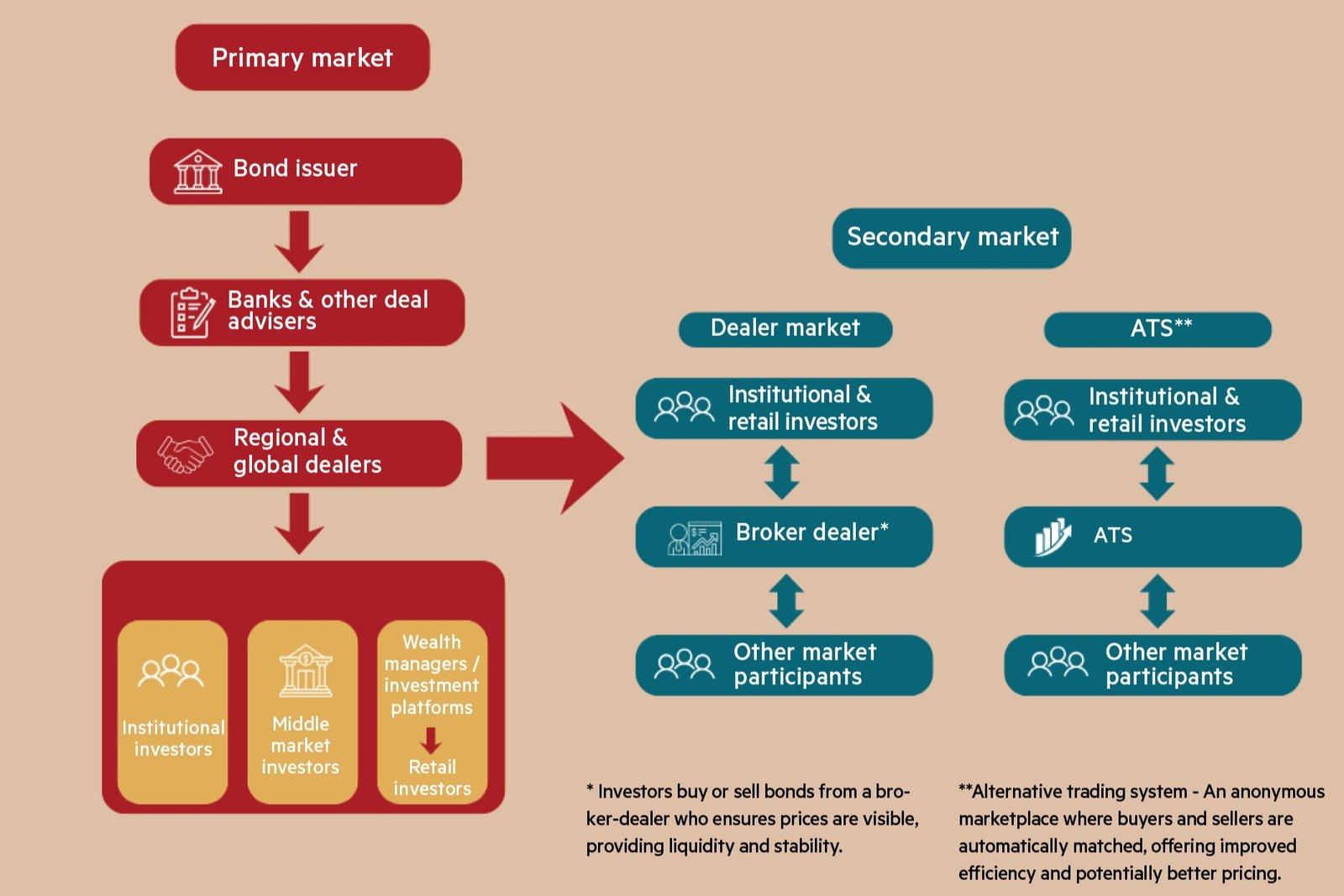
Dealers such as Winterflood will hear about a transaction first. It is their role to ‘build the book’, which means alerting the wealth managers and investment platforms such as Hargreaves Lansdown and AJ Bell about a deal, and telling them to notify retail investors to put their orders in.
The key difference to the gilts process will be a shorter notice period and execution window. This puts the burden of responsibility on the investment platforms to ensure retail investors know about it.
“It requires a bit of hustle on the part of whoever is coordinating the deal on the platforms to make sure the information gets out there, so I do think this comes back to that user journey,” says Coombes.
Wealth managers and the major investment platforms will offer participation to private investors in primary issuances through their ‘new issues’ process. The application process is done online, as it is with gilts, and orders can be made for Isa or Sipp accounts, but you need to know about it to find it.
For now, platform mailing lists and notification services from fintechs such as RetailBook offer the best chance for private investors to be made aware of any debut issuances in advance.
To ensure you don’t miss out, it is advisable to actively sign up to receive this information. Being proactive ensures you are informed and ready to act quickly.
“To be fair to the brokers, they have been great over the past couple of years at getting more familiar with rapid book-build processes,” says Smith. “They are to be commended on that.”
Once the orders are in, and the book ‘opens’, retail orders will be placed alongside those from institutional investors. The issuer and their banks then determine the allocations to each applicant, and the dealers co-ordinate the delivery of the bonds into investors’ accounts through their investment platforms.