
Vanguard ETFs have become synonymous with low-cost, diversified investing, making them a cornerstone of many portfolios. Their commitment to minimizing expenses and maximizing returns has attracted investors of all levels. Vanguard’s wide selection of ETFs provides exposure to various market segments, from broad market indexes to specific sectors and investment factors.
As we approach 2026, Vanguard ETFs continue to be relevant for their stability, transparency, and cost-effectiveness. In this article, we will explore some of the most compelling Vanguard ETFs to watch, focusing on growth-oriented strategies, sector-specific plays, and factor-based investing approaches, providing insights to help you optimize your investment strategy. We’ll highlight a selection of ETFs that are gaining attention for their consistent performance, strategic focus, and ongoing relevance in a changing market environment.
Below, we’ll examine a selection of popular and well-regarded Vanguard ETFs, highlighting their key characteristics to help you make informed investment decisions. We will consider factors such as expense ratios, top holdings, and reasons to consider each ETF.
| ETF Name | Symbol | Issuer | Inception Date | Expense Ratio |
| Vanguard S&P 500 Growth ETF | VOOG | Vanguard | Sep 09, 2010 | 0.10% |
| Vanguard Growth ETF | VUG | Vanguard | Jan 26, 2004 | 0.04% |
| Vanguard Mega Cap Growth ETF | MGK | Vanguard | Dec 17, 2007 | 0.07% |
| Vanguard Russell 1000 Growth Index ETF | VONG | Vanguard | Sep 20, 2010 | 0.08% |
| Vanguard Information Technology ETF | VGT | Vanguard | Jan 26, 2004 | 0.10% |
| Vanguard Communication Services ETF | VOX | Vanguard | Jan 26, 2004 | 0.10% |
| Vanguard U.S. Momentum Factor ETF | VFMO | Vanguard | Feb 06, 2018 | 0.13% |
| Vanguard Financials ETF | VFH | Vanguard | Jan 26, 2004 | 0.10% |
| Vanguard Consumer Discretionary ETF | VCR | Vanguard | Jan 26, 2004 | 0.10% |
| Vanguard Mega Cap 300 Index ETF | MGC | Vanguard | Dec 17, 2007 | 0.07% |
1. Vanguard S&P 500 Growth ETF (VOOG)
- Expense Ratio: 0.10%
- Top Holdings: Apple, Microsoft, Amazon, NVIDIA, Alphabet (Class A & C shares (these are typically the top holdings, but can fluctuate).
- Why Consider It? VOOG provides exposure to the growth stocks within the S&P 500, offering a concentrated bet on companies with higher growth characteristics. It’s suitable for investors seeking to overweight the growth component of the S&P 500.
2. Vanguard Growth ETF (VUG)
- Expense Ratio: 0.04%
- Top Holdings: Apple, Microsoft, Amazon, NVIDIA, Alphabet (Class A & C shares) (these are typically the top holdings, but can fluctuate).
- Why Consider It? VUG offers broader exposure to growth stocks across the US market, not limited to the S&P 500. It’s a low-cost option for diversified growth stock exposure.
3. Vanguard Mega Cap Growth ETF (MGK)
- Expense Ratio: 0.07%
- Top Holdings: Apple, Microsoft, Amazon, NVIDIA, Alphabet (Class A & C shares) (these are typically the top holdings, but can fluctuate).
- Why Consider It? MGK focuses on the largest growth companies in the US market, offering a concentrated bet on established growth giants. It appeals to investors seeking exposure to the most dominant growth names.
4. Vanguard Russell 1000 Growth Index ETF (VONG)
- Expense Ratio: 0.08%
- Top Holdings: Apple, Microsoft, Amazon, NVIDIA, Alphabet (Class A & C shares) (these are typically the top holdings, but can fluctuate).
- Why Consider It? VONG tracks the Russell 1000 Growth Index, providing exposure to growth stocks within the broader Russell 1000 (the 1000 largest US companies). This offers a wider selection of growth companies than S&P 500-based ETFs.
5. Vanguard Information Technology ETF (VGT)
- Expense Ratio: 0.10%
- Top Holdings: Apple, Microsoft, Amazon, NVIDIA, Alphabet (Class A & C shares) (these are typically the top holdings, but can fluctuate).
- Why Consider It? VGT provides targeted exposure to the information technology sector, offering investors a way to capitalize on the growth of technology companies. It’s suitable for those bullish on the tech sector’s long-term prospects.
6. Vanguard Communication Services ETF (VOX)
- Expense Ratio: 0.10%
- Top Holdings: Alphabet (Class A & C shares), Meta Platforms, Comcast, The Walt Disney Company, Netflix (these are typically the top holdings, but can fluctuate).
- Why Consider It? VOX offers targeted exposure to the communication services sector, encompassing media, telecommunications, and internet companies. It’s suitable for investors who believe in the continued growth of the communication and entertainment industries.
7. Vanguard U.S. Momentum Factor ETF (VFMO)
- Expense Ratio: 0.13%
- Top Holdings: UnitedHealth Group, Nvidia Corp., Microsoft Corp., Home Depot Inc., JPMorgan Chase & Co.
- Why Consider It? VFMO seeks to track the investment results of the MSCI USA Momentum Factor Weighted Index, an index that measures the performance of U.S. large- and mid-capitalization stocks exhibiting relatively higher momentum characteristics. Momentum is a factor that has shown to provide outperformance for many investors.
8. Vanguard Financials ETF (VFH)
- Expense Ratio: 0.10%
- Top Holdings: Berkshire Hathaway, JP Morgan, Visa, Mastercard, Bank of America (these are typically the top holdings, but can fluctuate).
- Why Consider It? VFH provides targeted exposure to the financials sector, encompassing banks, insurance companies, and investment firms. It’s suitable for investors who believe in the strength and growth potential of the financial industry.
9. Vanguard Consumer Discretionary ETF (VCR)
- Expense Ratio: 0.10%
- Top Holdings: Amazon, Tesla, Home Depot, McDonald’s, Nike.
- Why Consider It? VCR seeks to track the investment results of the MSCI US Investable Market Consumer Discretionary 25/50 Index, an index that measures the performance of the consumer discretionary sector. This provides a way for investors to track and invest in companies that provide goods and services that are considered non-essential.
10. Vanguard Mega Cap 300 Index ETF (MGC)
- Expense Ratio: 0.07%
- Top Holdings: Apple, Microsoft, Amazon, NVIDIA, Alphabet (Class A & C shares) (these are typically the top holdings, but can fluctuate).
- Why Consider It? MGC targets the largest 300 companies, thus diversifying across a variety of sectors.
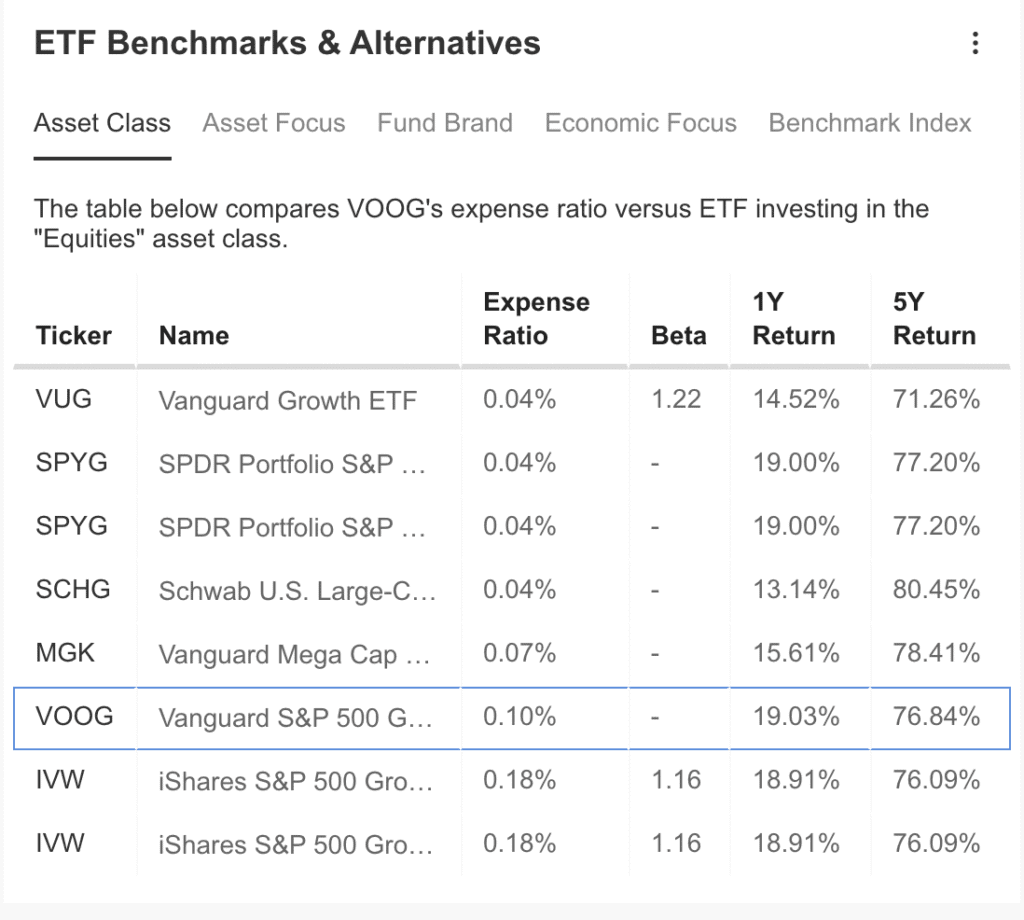
Discover the capabilities of InvestingPro for evaluating Vanguard ETFs. Access in-depth analysis of Vanguard ETFs, easily compare expense ratios, 1-year, and 5-year returns: InvestingPro provides real-time data, historical performance charts, and advanced analytical tools to help you make smarter investment choices. With InvestingPro, you can screen ETFs based on various factors, including expense ratios, trading volume, and holdings diversification, empowering you to identify the funds that best align with your investment goals.
Investing in Vanguard ETFs is generally considered a sound strategy for investors seeking broad market exposure, diversification, and relatively low risk. However, it’s crucial to assess your financial goals, risk tolerance, and time horizon before investing.
Potential Benefits
- Low Cost: Known for industry-leading low expense ratios, maximizing returns.
- Diversification: Offers a wide variety of ETFs providing diversified exposure to different market segments.
- Transparency: Highly transparent and well-managed, offering investors peace of mind.
- Long-Term Focus: Designed for long-term investors with a focus on consistent returns.
- Variety of Options: Provides ETFs for various investment strategies, from broad market indexes to sector-specific plays and factor-based investing.
Potential Risks
- Market Risk: All ETFs are subject to market risk, and you can lose money on your investment.
- Concentration Risk (Sector ETFs): Sector-specific ETFs are more concentrated and can be more volatile than broad market ETFs.
- Tracking Error: ETFs may not perfectly track the performance of their underlying index due to fees and other factors.
- Opportunity Cost: By investing in specific sectors or factors, you may miss out on gains in other areas of the market.
Choosing the right Vanguard ETF requires careful analysis and consideration of several factors. Here are some essential steps to help you find the top Vanguard ETFs for your investment needs:
1. Analyze Holdings
- Examine the top holdings to understand the ETF’s sector and company concentration. This helps you assess the ETF’s risk profile and potential for growth.
2. Check Expense Ratios
- Compare expense ratios across different Vanguard ETFs to ensure you’re getting the best value for your investment. Use InvestingPro to assess and compare expense ratios.
3. Review Performance and Liquidity
- Assess the historical performance of the ETF and its tracking error relative to its benchmark index. Ensure sufficient trading volume for easy buying and selling. Within InvestingPro you can find and compare the performance across ETF benchmarks.
4. Understand the Theme
- Determine whether you seek broad market exposure, sector-specific exposure, or exposure to specific investment factors (e.g., growth, value, momentum). Choose an ETF that aligns with your investment goals and risk tolerance. Carefully consider the risks associated with leveraged and inverse ETFs.
What makes Vanguard ETFs different from other ETFs?
Vanguard is known for its low expense ratios, investor-owned structure, and focus on long-term investing.
What is a factor-based ETF?
A factor-based ETF seeks to overweight certain investment factors (e.g., value, growth, momentum, quality) that have historically been associated with higher returns.
How do I choose the right Vanguard ETF for my portfolio?
Consider your investment goals, risk tolerance, time horizon, and desired level of diversification. Use tools like InvestingPro to compare ETFs and analyze their performance.
Are Vanguard ETFs tax-efficient?
Vanguard ETFs are generally tax-efficient due to their structure and low turnover. However, tax implications depend on your individual circumstances. Consult a tax professional.
If Vanguard is investor-owned, who manages the funds?
Vanguard’s funds are managed by experienced investment professionals at Vanguard who are fiduciaries to the fund shareholders.
How often does Vanguard rebalance its ETFs?
Rebalancing frequency varies by ETF. It’s typically done periodically to maintain alignment with the fund’s stated investment objective. Check the fund’s prospectus for details.