
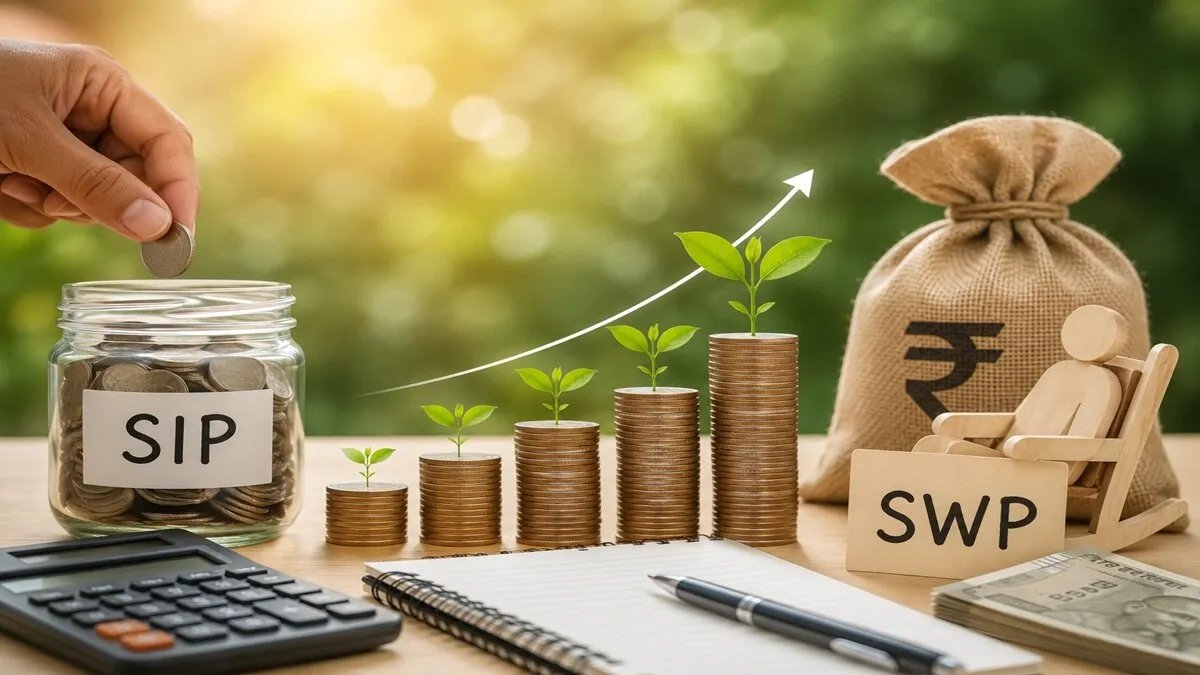
Many people believe they need a very high salary to enjoy a comfortable retirement. But in reality, retirement is often less about how much you earn and more about how consistently you invest. Even a modest SIP (systematic investment plan) can grow into a sizeable retirement corpus if you stay invested for decades and gradually increase your investments as your income rises. And once that corpus is built, a Systematic Withdrawal Plan (SWP) can help convert it into a regular monthly income without requiring you to withdraw the entire amount at once.
This is where the combination of SIP and SWP becomes a powerful retirement strategy. SIP helps you accumulate wealth during your working years, while SWP allows you to draw a steady income after retirement. When used together, they can create a disciplined path from wealth creation to wealth distribution.
How the SIP+SWP strategy works
Let’s understand this with an illustration.
Assume a person starts working at the age of 28 and begins investing just Rs 1,000 every month through an SIP. Instead of keeping the SIP amount fixed, the investor increases it by 10% every year as income grows. The investments continue till retirement at the age of 60.
For this illustration, the following assumptions have been made:
Starting age: 28 years
Monthly SIP: Rs 1,000
Annual SIP step-up: 10%
Expected annual return: 12%
Investment period: 32 years
Under these assumptions:
Total investment: Rs 24,13,653
Estimated wealth created: Rs 1,05,11,902
Estimated gains: Rs 80,98,249
In other words, an investor contributes a little over Rs 24 lakh over 32 years but ends up with a retirement corpus of more than Rs 1 crore, thanks to the power of compounding and regular step-ups in investments.
Why the annual step-up matters
The biggest takeaway from this illustration is not the starting SIP of Rs 1,000 but the discipline of increasing investments every year.
Most people receive salary hikes during their careers. Increasing SIPs alongside salary growth allows investors to save more without putting significant pressure on their monthly budget. Over long periods, these annual increases have a much bigger impact on the final corpus than keeping the SIP amount unchanged.
Without a step-up, building a Rs 1 crore corpus would require either a much higher starting SIP or a much longer investment period.
Is a 12% annual return assumption realistic?
The 12% annual return used in this illustration is an assumption and not a guaranteed return. However, history shows that diversified equity mutual funds have delivered similar or even higher long-term returns over extended periods.
Broad market-based equity categories such as flexi-cap, multi-cap, large & mid-cap and even large-cap funds have historically generated compounded annual returns exceeding 12% over investment horizons of 15, 20 and 25 years. Mid-cap funds have, in many cases, delivered even higher long-term returns, although they also come with greater volatility.
This is why equity mutual funds are generally considered more suitable for long-term goals like retirement, where investors have enough time to ride out market fluctuations.
From wealth creation to monthly income
Building a retirement corpus is only half the journey. The next challenge is generating a regular income after retirement.
This is where an SWP comes into play.
Under an SWP, investors withdraw a fixed amount from their mutual fund investment at regular intervals—usually every month—while the remaining money continues to stay invested and earn returns.
Unlike withdrawing the entire corpus at one go, an SWP allows retirees to create a pension-like cash flow while potentially extending the life of their investments.
How a Rs 1 lakh monthly income can be generated
Now assume the investor retires with a corpus and allocates Rs 1.5 crore to a medium-duration debt fund or a conservative hybrid fund.
For this illustration, the following assumptions have been used:
Investment amount: Rs 1.5 crore
Expected annual return: 6%
Monthly withdrawal: Rs 1 lakh
Withdrawal period: 12 years
Based on these assumptions:
Total withdrawals: Rs 1.44 crore
Total gains earned during the withdrawal phase: Rs 43.13 lakh
Balance remaining after 12 years: Around Rs 4.13 lakh
This means the investor is able to receive Rs 1 lakh every month for 12 years, while the invested corpus continues to generate returns during the withdrawal period.
Why a 6% return assumption is reasonable
The 6% return assumed during the SWP phase is intentionally conservative.
Many medium- and long-duration debt mutual funds have the potential to generate returns around this level over the medium term, although returns are market-linked and not guaranteed.
Investors willing to take slightly higher risk may also consider conservative hybrid funds or balanced hybrid funds, which have the potential to generate better long-term returns because of their equity exposure. However, these funds also experience greater fluctuations.
For this illustration, a 6% annual return has been assumed to keep the calculations conservative and realistic.
SIP and SWP complement each other
SIP and SWP are often discussed separately, but together they form a complete financial planning strategy. During the earning years, SIP helps investors accumulate wealth by investing regularly and benefiting from compounding. After retirement, SWP helps convert that accumulated wealth into a predictable monthly income while allowing the remaining corpus to stay invested. Together, the two strategies can help investors move smoothly from wealth creation to retirement income generation.
A few important points to remember
-While this illustration shows how the strategy can work, actual returns will vary depending on market performance.
-A 12% equity return and a 6% debt return are only assumptions and are not guaranteed.
-Equity mutual funds can witness sharp market corrections, especially over shorter periods.
-Investors should review their asset allocation as retirement approaches instead of staying fully invested in equities.
-The monthly SWP amount should be aligned with the size of the retirement corpus and expected expenses.
-Inflation should also be factored in while planning retirement income, as living costs are likely to rise over time.
A disciplined investment habit, regular SIP step-ups and a well-planned SWP can together create a retirement strategy that not only builds wealth over decades but also provides a steady stream of income when regular paycheques stop.
Disclaimer: The above content is for informational purposes only. Mutual Fund investments are subject to market risks. Please consult your financial advisor before investing.
Every financial journey has a turning point. What’s yours?
Financial Express is launching a new series highlighting real experiences with money, investments, and the taxman. Did a sudden tax rule catch you off guard? Did a piece of financial advice change your life? Your story could provide invaluable, practical lessons for thousands of fellow taxpayers. Share your experience with us. We respect your privacy: no stories will be featured without a direct conversation and your full consent. Thank you.