
Key Takeaways
- A master-feeder structure pools capital from domestic and international investors into a central master fund for investment activities.
- The structure allows hedge funds to benefit from economies of scale and favorable tax treatments.
- Feeder funds can vary in investor type, fee structures, and operational attributes, providing flexibility to cater to different markets.
- Offshore funds face a potential 30% withholding tax on U.S. dividends, posing a disadvantage for investors.
- Conflicts may arise due to differing investor priorities, complicating the establishment of a universal investment strategy.
What Is a Master-Feeder Structure?
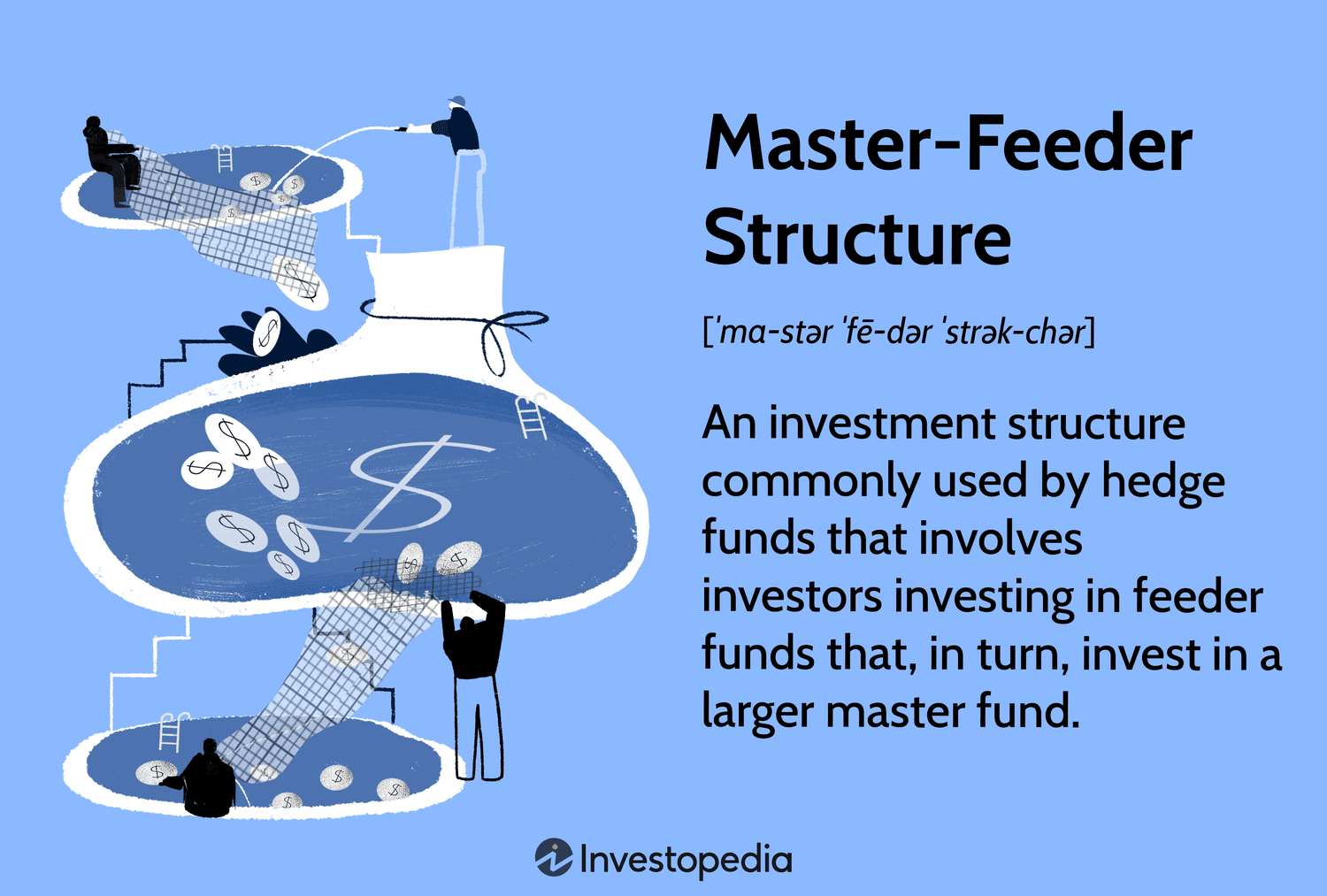
A master-feeder structure is a financial framework utilized by hedge funds to combine capital from U.S. and overseas investors into a single master fund. This setup involves separate feeder funds for different investor groups, which then channel the assets into a centralized master fund responsible for all portfolio investments and trading.
Known for its efficiency and tax benefits, this structure accommodates diverse investor needs while offering cost-effective management and potential challenges involving tax and investment strategies.
Understanding the Mechanics of the Master-Feeder Structure
The master-feeder structure begins with the investors, who deposit capital into the feeder fund. The feeder fund, containing all the limited partnership/shareholder capital, then purchases “shares” of the master fund, much like it would buy shares of any company’s stock. The primary difference, of course, is that a feeder fund—by buying into the master fund—receives all of the master fund’s income attributes, including interest, gains, tax adjustments, and dividends.
While this two-tiered structure can take forms like “funds of funds,” it is especially common in hedge funds serving U.S. and overseas investors. The use of the master-feeder fund structure allows asset managers to benefit from a large capital pool while also being able to fashion investment funds that cater to niche markets.
Breaking Down the Components of Master-Feeder Funds
The average master-feeder structure involves one offshore master fund with one onshore feeder and one offshore feeder. Feeder funds investing in the same master fund have the option of choice and variation. In other words, the feeders may differ in investor type, fee structures, investment minimums, net asset values, and various other operational attributes.
In this way, the feeder funds do not have to adhere to a specific master fund but can function legally as independent entities with the ability to invest in various master funds.
For example, if feeder fund A’s $100 contribution and feeder fund B’s $200 contribution provided the total investments to a master fund, then fund A would receive one-third of the master fund returns while fund B would receive two-thirds of the returns.
Key Benefits of Utilizing a Master-Feeder Structure
One significant advantage of the master-feeder structure is the consolidation of various portfolios into one entity. Consolidation reduces operations and trading costs. A larger portfolio benefits from economies of scale and offers better service options and favorable terms from brokers and institutions.
Potential Drawbacks of a Master-Feeder Structure
The primary drawback to the master-feeder structure is that funds held offshore are typically subjected to a 30% withholding tax on U.S. dividends. There is another disadvantage inherent in the structure, as it pools together a combination of investors that often have a wide spectrum of characteristics as well as investment priorities.
Finding a middle ground can be difficult because strategies that suit one investor type may not fit another.
Real-World Case Study: Master-Feeder Structure in Action
Relationships between a master fund and its feeder funds can be complex, as a 2018 court case showed. At issue was how redemptions by a feeder fund from a master fund are treated in a liquidation scenario.
The Ardon Maroon Asia Dragon Feeder Fund connected to the Ardon Maroon Asia Master Fund, sharing directors and appointing the same investment manager, administrator, and transfer agent for both.
In 2014, one of the feeder fund’s investors submitted a redemption notice. The feeder fund, which held no assets of its own, assumed the master fund would automatically satisfy the redemption request—something called a “back-to-back redemption.” However, both funds went into liquidation a few months later. When the original investor submitted a proof of debt, seeking to collect their money, it was rejected by the liquidators of the Ardon Maroon Asia master fund, on the basis that Asia Dragon had never officially submitted a separate redemption request notice to it.
A lawsuit ensued, filed in the Cayman Islands, where the funds were based. In mid-2018, the Grand Court of the Cayman Islands decided in favor of the master fund. Although back-to-back redemptions are common industry practices, the court noted that the constitutional documents of Ardon Maroon Asia did require a written notice of redemption from its feeder funds.
So Asia Dragon had been remiss in not separately notifying its master fund even though the same people served as directors of two funds, and both appointed the same investment manager, administrator, and transfer agent.
The Bottom Line
The master-feeder structure is a commonly used approach by hedge funds to streamline investments from both U.S. and non-U.S. investors into a centralized master fund. This structure presents the advantage of economies of scale and favorable tax treatment, as it reduces operational costs and aligns well with the diverse needs of its investor base.
However, it also carries notable challenges, such as withholding taxes on offshore dividends and the difficulty in harmonizing investment strategies across a varied set of investors. Understanding these dynamics is crucial for investors considering involvement in such arrangements, as illustrated by legal cases that underscore the importance of clear communication and compliance with fund protocols.