

Fact checked by Vikki Velasquez
Key Takeaways
-
Growth ETFs invest in companies that reinvest profits to expand faster, while dividend ETFs invest in mature companies that return capital to shareholders on a regular basis.
-
Growth funds have historically outperformed during economic expansions and periods of falling interest rates, when cash is readily available, and business prospects abound.
-
Dividends are coveted for their stability across environments and thus tend to hold up better in recessions and periods of rising rates.
-
Interest rates, inflation expectations, earnings growth, and shifts in investor sentiment can move which style is likely to outperform.
There’s an age-old debate in investing circles over whether it’s better to bet on companies with strong prospects to grow earnings or to own companies with steady income rates that make regular cash distributions. The former, a high-risk/high-reward strategy, is captured by growth ETFs, while the latter, a more conservative approach, is found in dividend ETFs.
The growth vs. dividend ETF divide essentially pits growth versus value investing, and both strategies require investors to make calculated judgments about valuation, earnings prospects, market sentiment, and the direction of the economy. ETFs allow investors to access diversified baskets of either category through a single, rules-based fund and to switch weightings toward both as market conditions or expectations change.
As investors weigh tactical moves into growth or dividend ETFs, it’s worth reviewing how the two styles compare, what environments favor each strategy, and how investors can put them to work within portfolios.
How Growth and Dividend ETFs Differ
Growth ETFs track indexes that screen for factors such as expanding earnings and revenues. As the name suggests, they invest in growth companies, typically clustered in communication services, biotech, and technology. These businesses use cash flow to reinvest in innovation and faster future growth. They may also borrow heavily to fund operations. As a result, they rarely pay dividends, and total return comes from price appreciation. Their valuations also tend to run well above the market average on a P/E basis, as investors pay up in anticipation of higher future profits.
Dividend ETFs flip these characteristics. Rather than picking growth leaders across every sector of the market, they target businesses that generate more cash than they can profitably reinvest. As a result, these funds target more staid sectors like consumer staples, healthcare, financials, energy, and utilities. They pay regular dividends, providing steady income. While their share prices tend to move slowly, the dividends provide yield that boosts total return.
Dividend ETFs are thus considered more defensive plays, since their yields tend to remain steady in economic downturns, while growth stocks suffer share-price volatility.
Warning
Dividend ETFs aren’t monolithic. Some invest in high-yield stocks, others focus on companies with long records of raising their dividends, and others look to income-generating assets like real estate investment trusts (REITS) or preferred stocks, which often pay above-average yields but carry different interest-rate and credit risks than common shares. Study the index methodology before assuming a fund will hold up defensively.
Market Environments for Each Strategy
This chart plots annual returns for the Vanguard Growth Index ETF (VUG) and the Vanguard Dividend Appreciation Index Fund ETF (VIG). Growth has been stronger than dividends over the past five years, four of which have been strong for equities. As expected, dividend stocks held up better in 2022-23, when the stock and bond markets swooned.
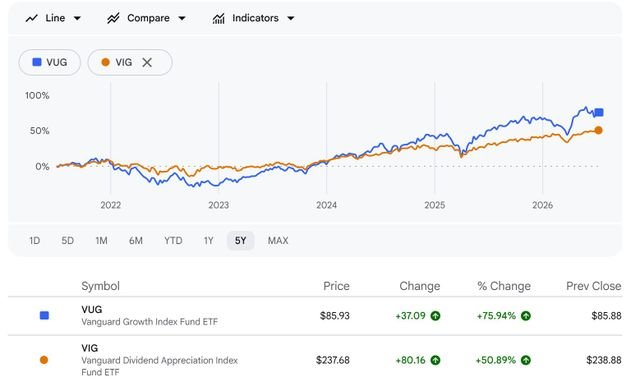
Economic expansions accompanied by strong earnings growth and stable or falling interest rates tend to favor growth ETFs. For example, faster-than-expected AI-inspired earnings growth powered rallies in growth stocks throughout 2024 and 2025. And when rates fall, the present value of those future earnings jumps, and growth stocks lead.
“Interest rates, inflation, earnings revisions, and investor sentiment all matter because they shift the relative appeal of future growth versus present cash flow,” David Dziekanski, CIO of Quantify Funds, said.
When interest rates rise, they threaten both growth stocks and dividend stocks. Fixed-income yields rise, making dividends less attractive relative to bonds. Growth stocks pay more to access capital; the value of future profits declines.
Because income-oriented stocks tend to be in sectors considered defensive—folks still need consumer staples, utilities, and healthcare even in a recession—they provide ballast when the overall stock market turns volatile.
Dziekanski adds, “When rates rise, or earnings growth expectations soften, higher-dividend and dividend-growth strategies can become relatively more attractive, though results still depend heavily on sector mix and fund construction.”
Important
Investors comparing dividend ETFs should look at whether the strategy targets current yield, dividend growth, dividend consistency, or financial-health screens. Investors comparing growth ETFs should look at sector concentration, valuation metrics, index methodology, and whether performance depends heavily on a few mega-cap stocks.
Factors That Can Shift Performance
Inflation tends to amplify the spread between growth and dividend ETFs as companies with pricing power can pass along rising costs to customers and protect their earnings and dividends. Growth stocks often lack that pricing power and see their valuations contract as interest rates rise.
Sector leadership can shift when earnings growth slows or accelerates. Tech mega caps fueled the Russell 1000 Growth Index’s outperformance in 2023 and 2024, and fears that AI would displace high-margin software services rotated money into defensive dividend payers at the start of 2026. It helps to consider earnings trends alongside valuation pressures from rates and inflation.
But beware. Investors who try to trade between growth and dividend cycles often miss the turn. Growth stocks sold off in early 2022 after two blockbuster years. The reverse happened in early 2023.
Tip
Industry research shows S&P 500 companies that grew or initiated dividends between 1973 and 2025 returned 10.22% annually with below-market volatility. Non-payers returned just 4.21% with substantially more volatility.
Using Growth and Dividend ETFs in a Tactical Portfolio
A tactical investor does not have to make an all-or-nothing call. A core equity allocation can be paired with smaller tilts toward growth or dividend ETFs as conditions evolve.
An investor who expects stronger earnings growth, improving risk appetite, and stable or falling rates may tilt modestly toward growth ETFs. An investor more focused on income, volatility management, or reducing dependence on a small group of mega-cap growth stocks may increase their exposure to dividend ETFs. The key is to size those tilts around personal goals, time horizon, tax situation, and risk tolerance rather than treating a market view as certainty.
Historical style data also argues against picking a permanent winner. FTSE Russell found that growth and value regimes have tended to persist for multiple years, but their timing and length have varied widely. That uncertainty is one reason many investors blend exposures rather than bet the whole portfolio on a single style.
The Bottom Line
Dividend and growth ETFs allow investors to choose the strategy they prefer and switch between them when sentiment turns.
But rather than trying to predict which style will work next, position your portfolio to benefit from both. Owning both styles eliminates the need to forecast and lets you decide which sleeve will lead based on signals such as interest rates, earnings growth, and valuation levels.
Read the original article on Investopedia