
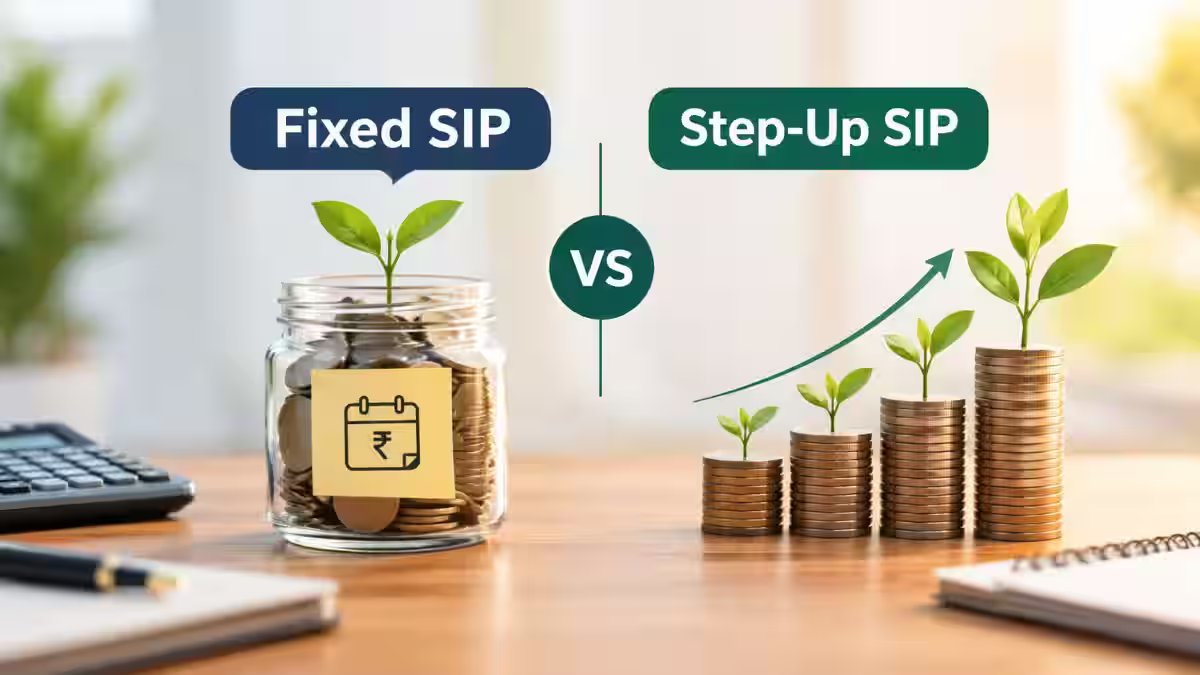
Fixed SIP vs Step-Up SIP: Starting a Systematic Investment Plan (SIP) is often the first step towards achieving long-term financial goals. However, starting an SIP and continuing with the same monthly investment amount for years may not always be sufficient, especially as inflation increases the amount required to achieve future goals.
In a conversation on Zee Business, Pankaj Mathpal, Managing Director of Optima Money, explained why investors should understand the role of an SIP and consider increasing their investments as their income and financial requirements change.
SIP is a mode of investment, not a product
Mathpal said that an SIP is not a product or a scheme in itself but a mode of investment.
“An SIP is not a product or a scheme in itself. It is a mode of investment. Instead of investing a lump sum, you invest in instalments,” he said.
He explained that SIPs can be used for different types of mutual funds, including equity, debt and hybrid funds, depending on an investor’s financial goals.
However, choosing the right investment according to the goal is important, as is reviewing whether the investment amount remains adequate over time.
Fixed SIP vs Step-Up SIP: What’s the difference?
In a fixed SIP, an investor continues to invest the same amount regularly.
For example, an investor starting with a monthly SIP of Rs 10,000 may continue investing the same amount every month unless the contribution is changed.
A Step-Up SIP, on the other hand, involves increasing the investment amount periodically.
In an example discussed by Mathpal, the SIP contribution was increased by 10 per cent every year.
Mathpal said investors often begin investing with a smaller amount when their income is limited but continue with the same contribution for years.
“You may start with a smaller amount because you have limited money initially and then continue with the same amount. But because of inflation, the financial goal you are working towards becomes much larger over time,” he said.
How inflation can increase the amount needed for a financial goal
Mathpal explained the impact of inflation on long-term financial planning with an example.
According to him, assuming an inflation rate of 6 per cent, a financial goal that requires Rs 1 crore today could require more than Rs 4 crore after 25 years.
“If we assume an inflation rate of 6 per cent, a financial goal that requires Rs 1 crore today could require more than Rs 4 crore after 25 years,” Mathpal said.
This means that investors need to consider not only their current financial target but also how inflation could increase the amount required in the future.
Rs 25,000 Fixed SIP vs Rs 11,000 Step-Up SIP: See examples
Mathpal shared an illustration based on a 25-year investment period and an assumed annual return of 12 per cent.
According to the example, an investor targeting a corpus of around Rs 4 crore over 25 years would need to invest approximately Rs 25,000 per month through a fixed SIP, based on the assumptions used.
However, Mathpal pointed out that starting with a Rs 25,000 monthly SIP may be difficult for many young investors.
“For many new investors, it may be difficult to start with a monthly SIP of Rs 25,000 at the age of 25,” he said.
He then shared an alternative illustration using a Step-Up SIP.
“If you increase your SIP by 10 per cent every year, you can start with Rs 11,000 per month. By increasing it by 10 per cent every year, you could build a corpus of around Rs 4 crore over 25 years,” Mathpal said.
Similarly, a fixed SIP of Rs 30,000 per month for 25 years, assuming a 12 per cent annual return, could potentially build a corpus of around Rs 5.64 crore. Instead, an investor could start with approximately Rs 13,300 per month and increase the SIP by 10 per cent every year to target a broadly similar corpus over the same investment period.
Note: The figures mentioned above are for illustrative purposes only. Actual returns from market-linked investments are not guaranteed and may vary.
How a 10% annual step-up can change the investment journey
The Step-Up SIP example shows how an investor may begin with a lower monthly contribution and increase the amount every year.
In the illustration shared by Mathpal, the investor starts with a monthly SIP of Rs 11,000 and increases the contribution by 10 per cent annually.
Mathpal said this approach can be considered in line with an investor’s rising income.
“Your income is likely to be several times higher after 25 years. Your income can increase through promotions or business growth. If your income rises, you can continue increasing your investments accordingly,” he said.
He said investors should increase their SIP contributions as their income rises so that they can work towards building an inflation-adjusted corpus for their financial goals.
Why inflation is not the only factor
While Mathpal explained how increasing SIP contributions can help investors work towards a larger long-term corpus, Harshvardhan Roongta, CEO of Roongta Securities, highlighted another factor investors should consider while planning for the future: rising lifestyle costs.
Roongta said investors should not consider inflation alone while estimating their future financial requirements.
He explained that inflation increases the cost of maintaining the same lifestyle, but an individual’s own standard of living can also change over time as income rises.
According to Roongta, people often upgrade their lifestyle over the years. Their spending patterns, housing choices and consumption habits may change as their income increases.
“Inflation is one factor that increases future costs, but you should also include the increase in your standard of living in your calculations,” Roongta said.
He explained that when planning for long-term goals such as retirement, investors may want to continue with the lifestyle they have built by the time they retire rather than the lifestyle they had many years earlier.
Roongta said financial calculations should therefore be reviewed periodically.
“If your lifestyle and expenses have changed, you need to increase your investments accordingly and revise your corpus target,” he said.
Why does reviewing your SIP amount matter?
Mathpal said that investors should not only focus on starting an SIP but also on selecting investments according to their financial goals.
The investment horizon can also play an important role in determining the type of investment selected.
He further emphasised that investors should increase their investments as their income grows.
“Investors should increase their investments in line with the growth in their income so that they can build an inflation-adjusted corpus for their financial goals,” Mathpal said.
Fixed SIP vs Step-Up SIP: Key takeaway for investors
A fixed SIP allows an investor to continue investing the same amount regularly. A Step-Up SIP involves increasing the contribution periodically.
Mathpal’s illustration showed that, based on an assumed 12 per cent annual return and a 25-year investment period, an investor could either invest approximately Rs 25,000 every month through a fixed SIP or start with around Rs 11,000 per month and increase the SIP contribution by 10 per cent annually to target a corpus of around Rs 4 crore.
For investors, the key lesson is that an SIP amount should not necessarily remain unchanged throughout the investment journey. As inflation, income and lifestyle change over time, investors may need to review not only their financial goals but also the amount they invest regularly.