
SEBI has approved the proposal to introduce the Securities and Exchange Board of India (Portfolio Managers) Regulations, 2026, replacing the existing PMS Regulations, 2020.
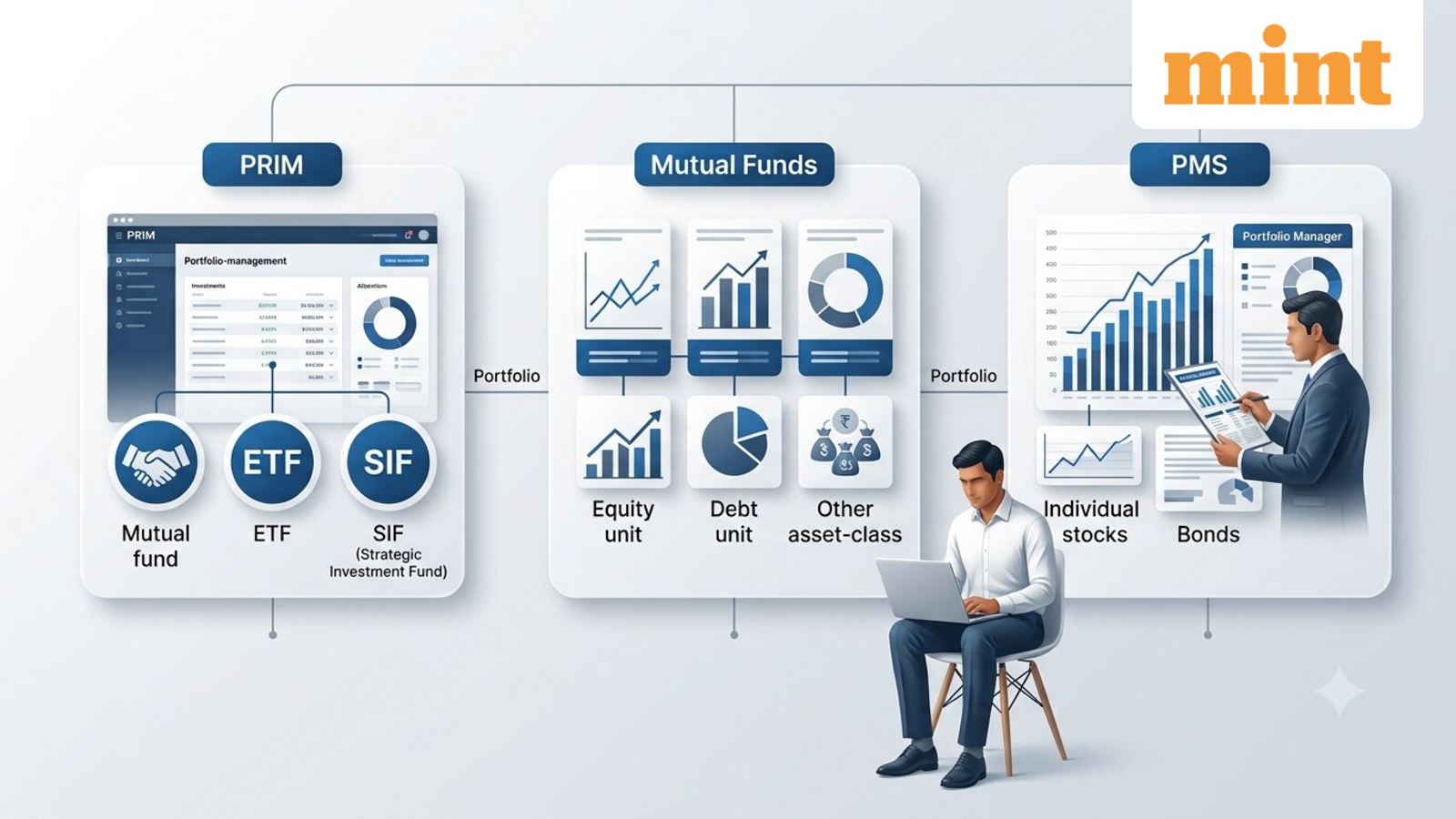
The new framework also introduces the Portfolio Managers Route for Investing in Mutual Fund units (PRIM), a route through which investors can get a professionally managed portfolio of mutual funds, SIFs and ETFs.
But how do PMS, PRIM and mutual funds differ for investors? Here is what experts say.
What are PMS, PRIM and mutual funds?
Sandeep Jethwani, Co-founder of Dezerv, said a PMS creates a customised portfolio of stocks, bonds and other permitted securities in the investor’s name. The minimum investment is ₹50 lakh.
Under the new regulations, the permissible universe also expands to include listed equities and debt, IPOs, exchange-traded derivatives, foreign securities and up to 10% in investment-grade unlisted debt with client consent.
On the other hand, PRIM allows a portfolio manager to build a customised portfolio using direct plans of mutual funds, SIFs and ETFs. The minimum investment is ₹25 lakh, he added.
Jethwani said a mutual fund is a pooled investment vehicle where investors own units of the same portfolio. The fund invests according to its SEBI-defined category, and the minimum investment is generally low at ₹100.
How do they work differently?
In mutual funds, the investor chooses the schemes and decides how much to allocate to each. The fund manager manages the securities within each scheme. Costs are primarily the scheme’s expense ratio or any platform fee incurred, Aditya Agarwal, Co-founder of Wealthy.in, said.
Under PRIM. the portfolio manager builds and manages the investor’s portfolio using direct plans of mutual funds, including ETFs, index funds and SIFs offered by Indian AMCs. The manager decides fund selection, allocation and rebalancing, while the underlying securities continue to be managed by the respective fund managers, he said.
Fixed management fees under PRIM are capped at 1% of client AUM. Unlike PRIM, conventional PMS allows the portfolio manager to directly manage a broader portfolio of permitted securities, such as equities, bonds and other eligible investments, Agarwal added.
How does taxation differ?
In both PRIM and conventional PMS, every time the manager sells an investment, it creates a short-term or long-term capital gains event, depending on the type of asset, Vikas Gupta, CEO & Strategist at Omniscience Capital, noted.
In a mutual fund, redeeming units also creates a short-term or long-term capital gains event. The timing of the redemption is completely under the investor’s control, he added.
What are the key differences between the three?
Shobhit Mathur, Co-founder at Ionic Wealth, outlined the key differences between conventional PMS, mutual funds and the new PRIM route.
| Feature | PMS | Mutual fund | PRIM |
| Minimum | ₹50 lakh | Low; varies by scheme | ₹25 lakh |
| What you own | Securities in your demat account or folio-level holding | Units of a pooled scheme | Direct-plan units in your account |
| Manager fee | Fixed, performance or both; no cap | Inside the expense ratio | Fixed up to 1%; performance fee allowed |
| Other costs | Up to 0.5% operating expenses, plus brokerage and levies, but statutory levies sit outside the 0.5% cap | Expense ratio within SEBI caps | Underlying funds’ expense ratios on top |
| Exit load | Up to 3%, 2%, 1% in years 1 to 3 | As per scheme | No PMS-level load; fund loads may apply |
| Overseas | Direct, within LRS | Via international funds, within industry limit | Only via Indian international funds and ETFs |
| Tax | Each trade taxed in your hands | On redemption or switch | Each fund switch taxed in your hands |
Does PRIM mean two layers of professional management?
Yes. The mutual fund manager decides which securities to hold within a scheme, while the PRIM manager decides which schemes the investor should own, how much to allocate to each and when to rebalance or replace them, Agarwal said.
For example, a PRIM portfolio manager could allocate money across multiple debt funds, a flexi-cap fund, mid-cap and small-cap funds, along with other strategies, depending on the investor’s mandate, Gupta said.
How much control does an investor have under PRIM?
The mutual fund units are held in the investor’s own name, so ownership and visibility remain with the investor. The level of control depends on the arrangement, Jethwani said.
In a discretionary PMS, the manager takes investment decisions within the agreed mandate, including the investment objective, risk profile, and allocation limits. In a non-discretionary arrangement, the manager recommends investments but requires the investor’s approval for each transaction, he explained.
Does the ₹25 lakh PRIM minimum limit asset allocation?
Yes. PRIM does not allow direct investment in equities or bonds. An investor with ₹50 lakh who wants direct exposure to selected equities, debt or other eligible securities may instead consider a conventional PMS. It also involves a single fee layer, Gupta mentioned.
PRIM is designed to provide diversification only through mutual funds, ETFs and SIFs. A ₹25 lakh portfolio could be spread across equity, debt, gold, silver, hybrid and long-short strategies, Jethwani said.
If the investor instead wants the portfolio manager to directly manage a broader range of securities within the same mandate, conventional PMS provides greater flexibility, Agarwal added.
What has changed under the 2026 PMS regulations?
Mathur explained how the 2026 PMS regulations differ from the 2020 rules.
| Area | 2020 PMS Regulations | 2026 PMS Regulations |
| Minimum investment amount | ₹50 lakh | ₹50 lakh for PMS; ₹25 lakh for PRIM |
| Discretionary universe | Listed securities, money market instruments, direct MF units | Adds IPOs, primary debt, up to 10% unlisted investment-grade NCDs, foreign securities |
| Non-discretionary universe | Up to 25% unlisted; Indian securities only | Adds listed foreign securities/MF under FEMA and LRS |
| Derivatives | Hedging and rebalancing only | Up to 1.25x client AUM |
| Fees and costs | Fixed, performance or hybrid; no upfront fee; operating expenses up to 0.5% a year | Same for PMS, but statutory levies sit outside the 0.5% cap; PRIM fixed fee capped at 1% |
The 2026 regulations have been approved by the board but are yet to be notified, so the final text and subsequent circulars could differ, Mathur added.
Disclaimer: This story is for educational purposes only. The views and recommendations made above are those of individual analysts or broking companies, and not of Mint. We advise investors to check with certified experts before making any investment decisions.
About the Author
Sheetal Goel is a Content Producer at Livemint, where she covers corporate developments, personal finance, business trends, markets, and SEBI-related updates. She focuses on simplifying complex financial concepts and presenting them in a clear, reader-friendly manner, thereby helping audiences better understand investment trends, personal finance, and market developments. Her writing focuses on making finance more accessible to everyday readers while maintaining clarity, accuracy, and relevance.
She holds a degree in Economics (Hons.) along with an MBA in Finance, which has helped her develop a strong foundation in financial analysis, market understanding, and business reporting. Before joining journalism, she worked with finance and broking firms, where she closely followed market developments, investment strategies, and evolving industry trends. This practical exposure strengthened her understanding of financial markets. She has also written content across multiple formats and platforms, including YouTube, LinkedIn, and Instagram.
Over time, she has developed expertise in covering market-linked stories, investor-focused topics, and regulatory updates in a simplified yet informative style. She also enjoys reading and listening to Hindi poetry, reflecting her appreciation for literature and creative expression beyond the world of markets and numbers.