

Recently, I often see news about rising government bond prices. The US 10-year Treasury yield has also exceeded 5%, which is being widely covered in the news.
“When interest rates rise, government bond prices fall.” This is an explanation often heard in the news. Even though rising interest rates sound like a good thing, why do prices fall?
The answer is that government bonds are “products where the amount received in the future is fixed from the start.” Once you grasp this, bond news becomes much easier to read.
A government bond is a country’s IOU.
Government bonds are bonds issued by a country to borrow money. People who buy them are lending money to the country.
For typical fixed-rate government bonds, the following two things are guaranteed:
・Interest is paid in a fixed amount twice a year. ・The face value is returned at maturity.
Maturities include 2, 5, 10, 20, 30, and 40 years. When the news mentions “long-term interest rates,” it usually refers to the yield of newly issued 10-year government bonds.
What is important here is that once issued, government bonds are traded in the market, and their prices fluctuate every day.
The amount received does not change. Only the price changes.
Let’s consider an example. To simplify the calculation, assume interest is paid once a year.
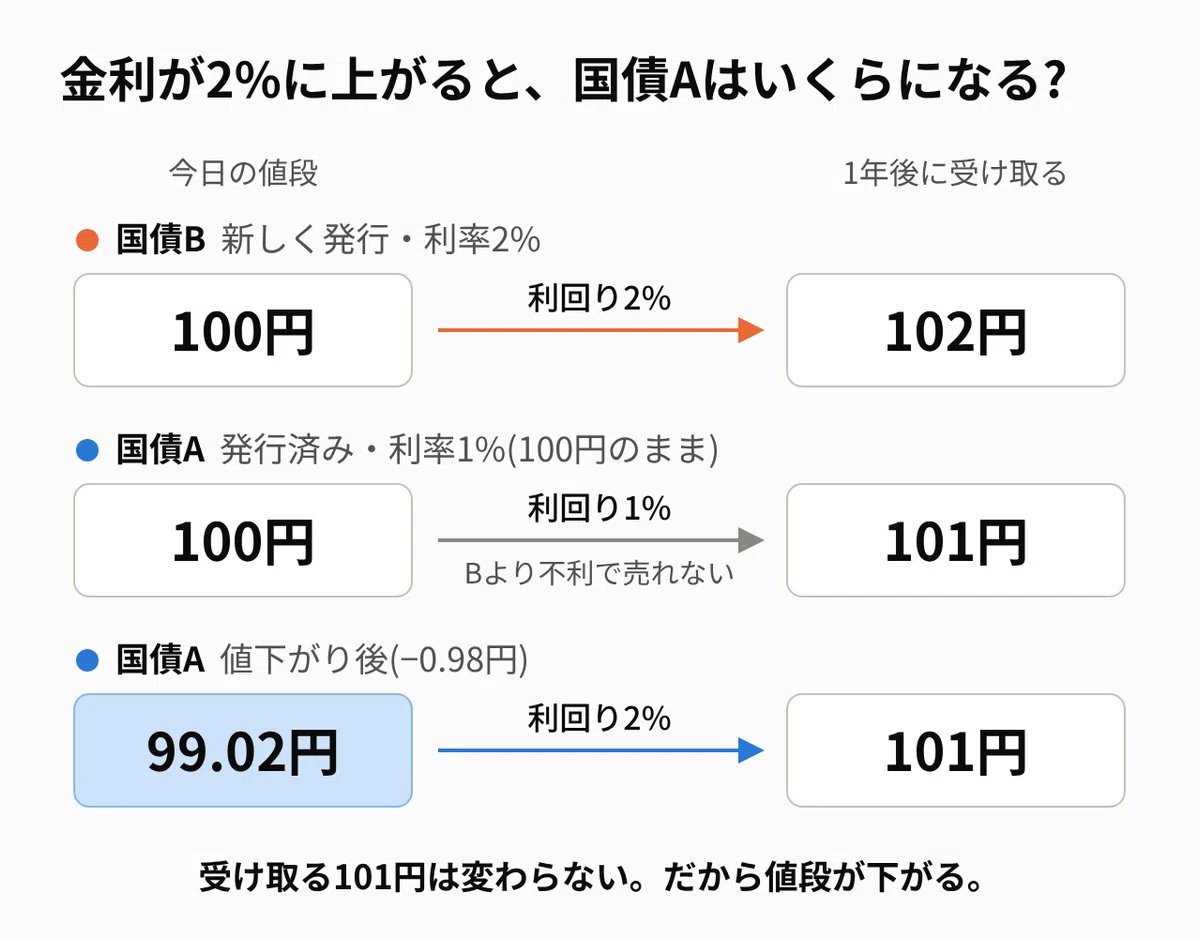
There is a government bond A with a face value of 100 yen, a 1% coupon rate, and 1 year remaining until maturity. One year later, you will receive a total of 101 yen, consisting of 1 yen in interest and 100 yen in face value. This 101 yen does not change regardless of how interest rates move.
Now, suppose market interest rates rise to 2%. A newly issued government bond B will become 102 yen in one year if bought for 100 yen.
Consequently, no one will buy government bond A for 100 yen if it only becomes 101 yen in a year. People who want to sell government bond A have no choice but to lower the price.
How low should they lower it? To a price that results in the same 2% yield as government bond B.
101 yen ÷ 1.02 = 99.02 yen
If you buy it for 99.02 yen and receive 101 yen one year later, the yield will be exactly 2%. This is the essence of “when interest rates rise, prices fall.”
Conversely, if interest rates fall to 0.5%, government bond A will rise in price to 101 yen ÷ 1.005 = 100.50 yen. This is because a bond with a 1% coupon becomes more advantageous.
Because the amount received is fixed, changes in interest rates are all adjusted through price. Price and yield have a seesaw relationship.
This is the very calculation of “present value.”
The calculation of 101 yen ÷ 1.02 is the same as “discounting,” which converts future money into its present value.
The price of a bond is the sum of the present value of future interest payments and the face value, discounted by the current interest rate. If the discount rate rises, the present value decreases.
The concept of present value is covered in this article.
The longer the time to maturity, the greater the price fluctuation
Let’s calculate the price of a government bond with a 1% coupon rate for different remaining terms to maturity when interest rates rise from 1% to 2%.
・1 year remaining: 100 yen → 99.02 yen
・5 years remaining: 100 yen → 95.29 yen
・10 years remaining: 100 yen → 91.02 yen
・20 years remaining: 100 yen → 83.65 yen
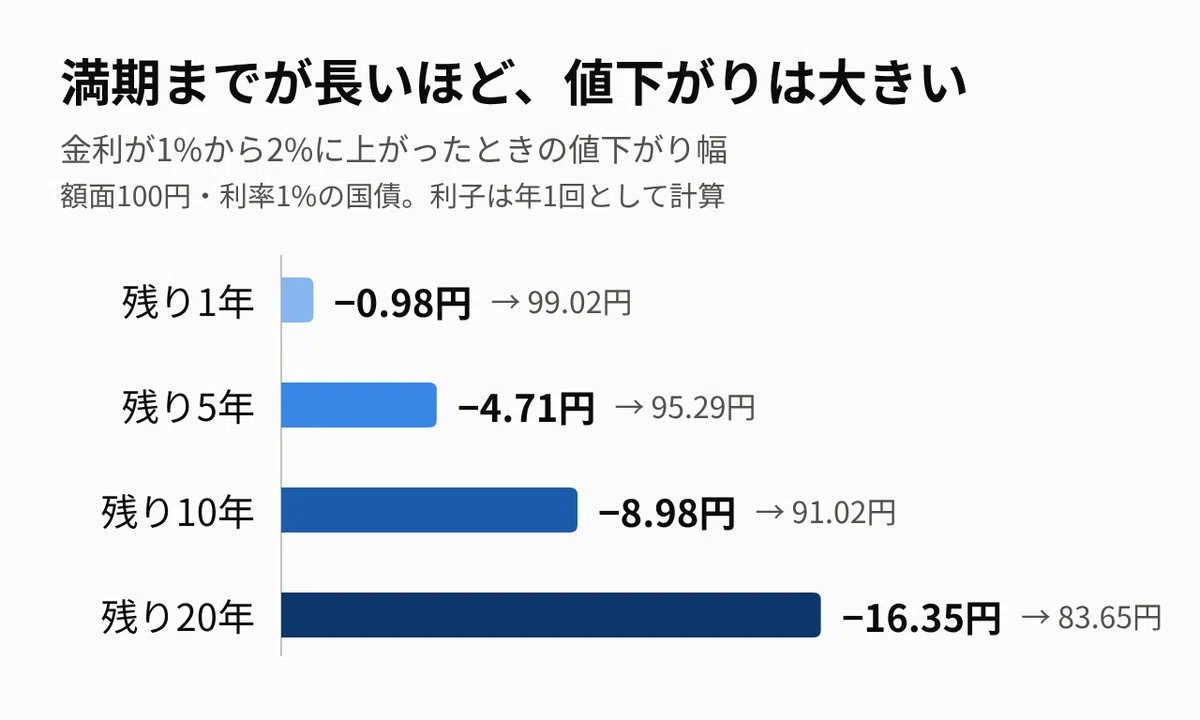
Even with the same 1% interest rate hike, the price drops by about 1 yen if there is 1 year remaining, and by about 16 yen if there are 20 years remaining.
The reason is that the longer the period you are stuck with an unfavorable interest rate, the greater the impact. The magnitude of the difference changes depending on whether the state of only receiving 1% ends in one year or continues for 20 years.
The longer the bond, the more sensitive it is to changes in interest rates.This is a fundamental principle when looking at bond risk.
If you hold until maturity, you get the face value back
Even if the price falls, if you hold the bond until maturity, you will get back the face value of 100 yen. The loss from the price drop is only realized if you sell it before maturity.
However, even if you hold until maturity, your funds remain locked at a low interest rate during that time. This means you have missed the opportunity to switch to government bonds after interest rates have risen.
Government bonds for individuals are designed not to fall in price
As government bonds that are easy for individuals to purchase, there are “Government Bonds for Individuals.” There are three types: 10-year floating rate, 5-year fixed rate, and 3-year fixed rate, and they can be purchased from 10,000 yen.
What makes them different from regular government bonds is that they are not sold at market prices, but are bought back by the government at face value. They can be redeemed early after one year from issuance, and the only amount deducted at that time is equivalent to the interest for the two most recent periods (pre-tax interest × 0.79685). Even if interest rates rise, the principal will not be lost.
The 10-year floating rate bond has its interest rate reviewed every six months, so if interest rates rise, the interest received also increases. For all types, there is a minimum interest rate floor of 0.05% per annum.
In terms of what we have discussed so far, government bonds for individuals are products where the government takes on the part that is “adjusted by price.” In exchange, the interest rate is set slightly lower based on market interest rates. The 5-year fixed rate is the base rate minus 0.05%, and the 10-year floating rate is the base rate multiplied by 0.66.
Government bond yields form the foundation for other interest rates
Government bonds are bonds for which the government promises to pay interest and principal. Because they are considered the safest assets in the country, their yields are called the “risk-free rate” and serve as the starting point for determining other interest rates.
・Corporate bond yield = Government bond yield + spread based on creditworthiness
・Cost of equity = Risk-free rate + β × (Market expected return – Risk-free rate)
When government bond yields rise, the cost for companies to raise funds also increases. The cost of capital that appears in corporate finance for the Securities Analyst examination is linked to this.
Practice Problems
(a) When interest rates fall, what happens to the price of already issued government bonds?
(b) There is a government bond with a face value of 100 yen, a coupon rate of 2%, and 1 year until maturity. When the market interest rate is 1%, what will the price be? (Assume interest is paid once a year).
(c) When interest rates rise, which bond experiences a larger price drop: one with 2 years remaining or one with 20 years remaining?
Think about it, then scroll down.
↓
↓
↓
(a) It rises. This is because the already determined interest becomes more favorable than that of newly issued government bonds.
(b) 102 yen ÷ 1.01 = 100.99 yen.
(c) The bond with 20 years remaining. This is because the period during which the unfavorable interest rate continues is longer.
Summary
・The amount received from government bonds is fixed. Therefore, when interest rates change, the price moves.
・The price of a bond is the present value of future receipts discounted by the current interest rate.
・The longer the time to maturity, the greater the price movement due to changes in interest rates.
#MoneyStudy #GovernmentBonds #Bonds #InterestRates #AssetManagement #StudyRecord
This article is intended to provide general knowledge and information and is not intended to solicit the purchase of specific financial products or investment. While we strive to ensure the accuracy of the information in this article, we do not guarantee its completeness or timeliness. Please make actual investment and business decisions based on your own judgment and responsibility.