

While equity mutual funds are expected to beat inflation over the long term, low-risk investment avenues are seldom assessed on this parameter. Our analysis of debt mutual funds, ‘How debt mutual funds protected purchasing power’ (bl.portfolio edition dated September 27), found that several debt fund categories outperformed inflation more often than commonly believed.
We now extend the analysis to arbitrage funds, which have also demonstrated a notable ability to beat inflation despite being viewed primarily as short-term parking avenues.
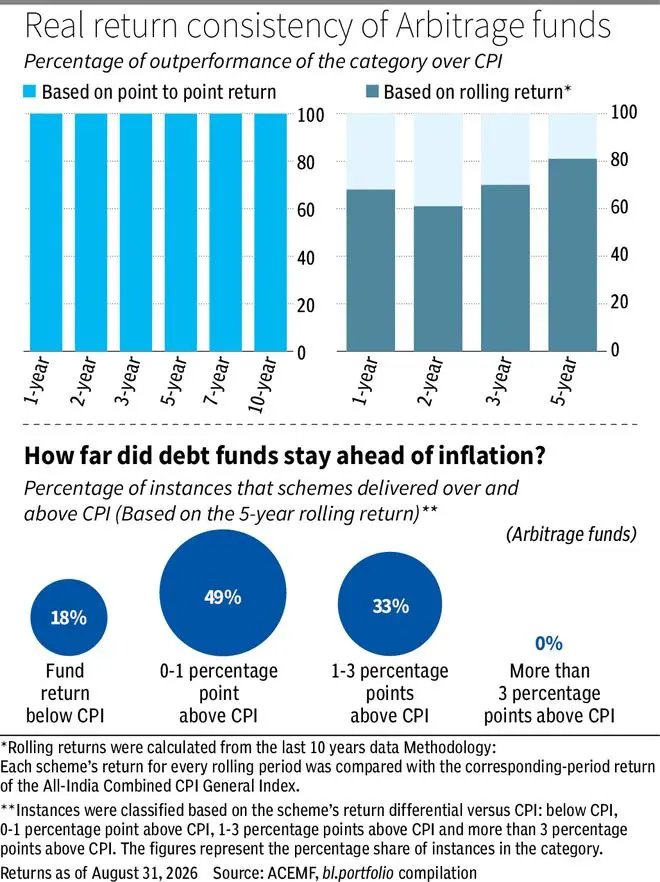
A bl.portfolio analysis of rolling returns shows that arbitrage funds beat CPI inflation in 68 per cent of one-year periods. The success rate was 61 per cent over two years, rising to 70 per cent over three years and 81 per cent over five years.
Although arbitrage funds must invest at least 65 per cent in equities and equity-related instruments, their returns resemble those of debt products. Fund managers exploit price differences between the cash and futures markets by buying stocks in the spot market and simultaneously selling futures.
As the futures contract approaches expiry, the price gap narrows, allowing the fund to lock in the spread as income.
Since the equity position is hedged with futures, the fund has limited exposure to market direction. However, returns are not assured and depend on the availability of arbitrage opportunities, market liquidity, transaction costs and the cost of carrying positions.
What we analysed
We analysed both point-to-point and rolling returns over the past 10 years, based on the availability of schemes with sufficiently long track records. The point-to-point analysis covered all available arbitrage funds for each holding period, using their direct plans, while the rolling return analysis was restricted to 15 schemes with at least a 10-year track record. To assess performance across different entry points, we calculated one-, two-, three- and five-year rolling returns at monthly intervals. Scheme returns were compared with the All-India Combined Consumer Price Index (CPI), adjusted using the Ministry of Statistics and Programme Implementation’s linking factors to ensure consistency across its three base-year revisions.
Findings
Odds improve over longer horizons
The point-to-point analysis produced striking results. Every eligible arbitrage fund beat CPI inflation across the investment horizons for which it had sufficient history: one, two, three, five, seven and 10 years.
However, rolling returns offer a more realistic picture. Arbitrage funds beat inflation in 68 per cent of one-year periods and 61 per cent of two-year periods. The proportion then rose to 70 per cent over three years and 81 per cent over five years. The success rate did not rise at every step, but the longer holding periods showed better consistency in beating inflation.
High consistency, modest real returns
At the scheme level, Invesco India Arbitrage and Edelweiss Arbitrage Fund outperformed inflation in about 98 per cent of five-year rolling observations. Kotak Arbitrage Fund and Nippon India Arbitrage Fund followed closely, with a success rate of 97 per cent.
However, the magnitude of outperformance remained limited. About 49 per cent of five-year rolling observations delivered returns just 0-1 percentage point above inflation, while 33 per cent were 1-3 percentage points above it. The remaining observations failed to beat inflation. Notably, no five-year rolling observation generated real returns exceeding three percentage points over CPI. This suggests that while arbitrage funds have generally been effective at preserving purchasing power, their ability to generate substantial inflation-adjusted gains remains constrained.
What it means for investors
Arbitrage funds occupy a distinct position in the investment landscape, combining relatively-low market risk with equity-oriented taxation. For investors in higher tax brackets, this tax treatment can make a meaningful difference to post-tax returns.
While most debt mutual funds purchased on or after April 1, 2023, are taxed at the investor’s applicable income-tax slab rate, irrespective of the holding period, arbitrage funds qualify for equity taxation, provided they maintain the prescribed equity exposure. Gains on units held for more than a year are taxed at 12.5 per cent, subject to the applicable exemption for long-term capital gains. This can make them more tax-efficient than debt funds for investors with a longer holding period.
The difference can be meaningful. Assuming both an arbitrage fund and a liquid fund generate an annual pre-tax return of 6 per cent, an investor in the 20 per cent and 30 per cent tax bracket would retain about 4.8 per cent and 4.2 per cent respectively from the liquid fund after tax, compared with approximately 5.25 per cent from the arbitrage fund if held for more than a year, ignoring the applicable long-term capital gains exemption, surcharge and cess. Over time, this tax advantage can materially improve realised returns.
Over the past decade, the one-year rolling returns of arbitrage funds’ direct plans averaged 6.3 per cent, marginally higher than the 6.1 per cent delivered by liquid funds’ direct plans. The advantage persisted over longer periods, with five-year rolling returns averaging 5.8 per cent CAGR for arbitrage funds, compared with 5.5 per cent for liquid funds.
The combination of comparable historical returns and favourable tax treatment makes arbitrage funds an alternative for parking surplus money, particularly when the investment horizon exceeds one year. However, investors should also account for expenses, exit loads and the possibility of short-term fluctuations.
Arbitrage funds are better suited to investors seeking relatively-stable returns and tax efficiency than those pursuing substantial long-term wealth creation. Their historical record of beating inflation is encouraging. However, the modest margin of outperformance also highlights their limitations.
While they can help preserve purchasing power and enhance post-tax returns, their primary role remains managing surplus money rather than building long-term wealth.
Published on October 3, 2026