


By Archit GuptaMost investors spend weeks deciding what to buy. Very few spend even an hour planning how they will sell. Yet the tax on an investment is charged when you realize your gains, not when you deploy your capital.This gap matters today more than ever. India now accounts for over 23 crore demat accounts, and millions of middle-class families hold gold or property that they will eventually monetize. Capital gains tax is no longer an exclusive concern for high-net-worth individuals.A few years ago, capital gains appeared mostly in the tax returns of seasoned traders and business owners. Today, salaried professionals with a basic SIP, a small equity portfolio, or an inherited apartment routinely encounter these provisions. Unfortunately, many learn the operational rules only after executing a sale.My view on this is simple. The best time to plan for capital gains tax is before you place a sell order, and ideally when you make the initial investment. The foundational rules are clear, and a small amount of advance planning can reduce your tax outflow significantly.This year is a good time to revisit the rules. From April 1, 2026, the Income-tax Act, 2025 has replaced the 1961 law. Section numbers have changed and the law now uses the term tax year, but capital gains are taxed largely as before.
Short-Term versus Long-Term Classification
Every capital gains calculation begins with a single variable: holding duration.Listed shares, equity mutual funds, and listed securities such as gold ETFs transition into long-term assets after 12 months. Immovable property, physical gold, unlisted shares, and non-equity mutual funds require a holding duration of 24 months to qualify as long-term assets.Two critical nuances are often overlooked during portfolio reviews:Systematic Investment Plans (SIPs): Each monthly instalment carries its own distinct acquisition date. The law applies First-In, First-Out (FIFO) accounting, treating the earliest acquired units as the first sold.Inherited or Gifted Assets: When you inherit property or receive an asset from a relative, both the holding period and the original cost of acquisition transfer to you from the previous owner.
Equities and Mutual Funds: Timing Your Exits
In equity markets, holding duration dictates net returns. Selling a profitable equity mutual fund one week before it completes 12 months triggers a Short-Term Capital Gains (STCG) tax rate of 20%. Holding that same fund for one additional week subjects the gain to the Long-Term Capital Gains (LTCG) rate of 12.5%, while unlocking an annual tax-free threshold.The Rs 1.25 lakh annual LTCG exemption under Section 112A remains one of the most effective tax-planning tools available to retail investors. It applies cumulatively across listed shares and equity mutual funds. Unused portions of this limit lapse at the end of each financial year.Harvesting gains systematically by selling sufficient units each year to utilize the Rs 1.25 lakh threshold, then reinvesting the proceeds, resets your cost basis higher and lowers future taxable gains. Investors should account for exit loads and transaction charges before executing this maneuver.
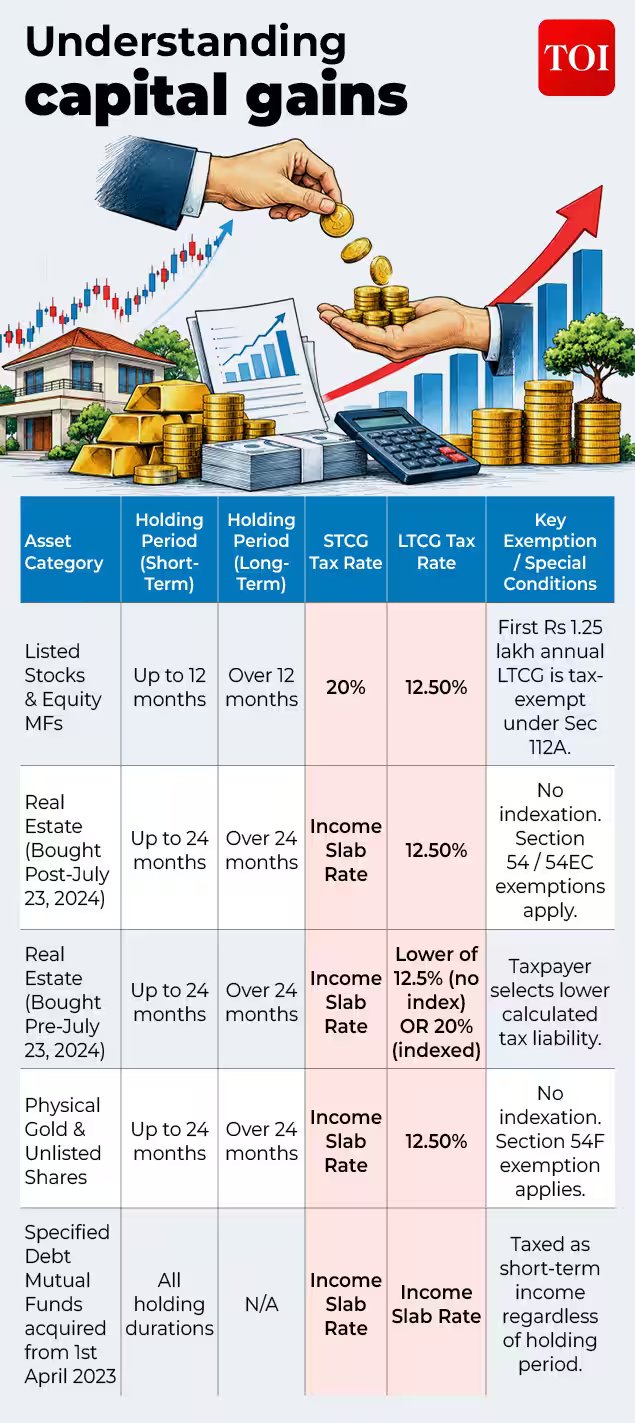
Understanding capital gains across various asset classes
Gold, Real Estate, and Fixed Income Assets
Holding period classifications govern taxation across non-equity assets:General Rule: Long-term gains on real estate, physical gold, and unlisted securities incur a flat tax rate of 12.5%. Short-term gains are added directly to your taxable income and taxed at your applicable personal slab rate.Debt Mutual Funds: Units in debt schemes investing over 65% in debt instruments acquired on or after April 1, 2023, do not qualify for long-term tax rates. All realized gains are treated as short-term income and taxed at your income tax slab rate, regardless of holding duration.Sovereign Gold Bonds (SGBs): While fresh tranches ceased issuing in early 2024, secondary market and historical holdings remain active. Gains realized upon maturity are tax-exempt solely for original subscribers who hold the bonds through redemptions with the Reserve Bank of India. Bonds purchased on stock exchanges or transferred prior to maturity remain taxable.
The Rs 12 Lakh Tax Rebate Misconception
A widespread belief among salaried taxpayers is that total income up to Rs 12 lakh is completely tax-free under the current tax regime. This assumption breaks down when capital gains are subject to special tax rates.Consider a professional earning a taxable salary of Rs 12 lakh who realizes a Rs 1 lakh short-term gain on equity shares. While the salary component receives rebate benefits, the Rs 1 lakh short-term gain is taxed independently at 20% plus applicable cess. Special capital gains tax rates operate uniformly across both old and new tax regimes.Conversely, resident individuals with limited primary income can offset unutilized portions of their basic exemption limit against capital gains. A retired parent with zero taxable income can realize up to Rs 4 lakh in long-term equity gains under the new regime without triggering net tax liability.
Property Transactions and Indexation Options
Real estate transactions require careful planning due to the scale of capital involved. Under current regulations, resident individuals and Hindu Undivided Families (HUFs) selling residential properties acquired before July 23, 2024, can choose between two tax computation methods. They are permitted to pay the lower of 12.5% without indexation or 20% with indexation.Indexation does not automatically guarantee a lower tax burden. Selecting the optimal method depends on how your property’s appreciation compares to official inflation metrics:When Indexation Helps (20% Rate): When the holding period is very long, since the property acquisition date is early. In these cases, the benefit of indexation beats the benefit of the reduced tax rate at 12.5%When Unindexed Flat Rate Helps (12.5% Rate): When the holding period is relatively shorter, where the reduced tax rate is more beneficial, as compared to applying indexation with 20% tax rate
Reinvesting to save tax
Taxpayers can neutralize long-term capital gains tax by reinvesting their gains:Section 54 (Residential Real Estate): Capital gains from selling a residential property are exempt if reinvested into another residential house in India. The replacement property must be acquired within 1 year before or 2 years after the sale, or constructed within 3 years. The exemption is capped at Rs 10 crore. Taxpayers realizing gains up to Rs 2 crore can exercise a one-time lifetime option to invest in two residential properties.
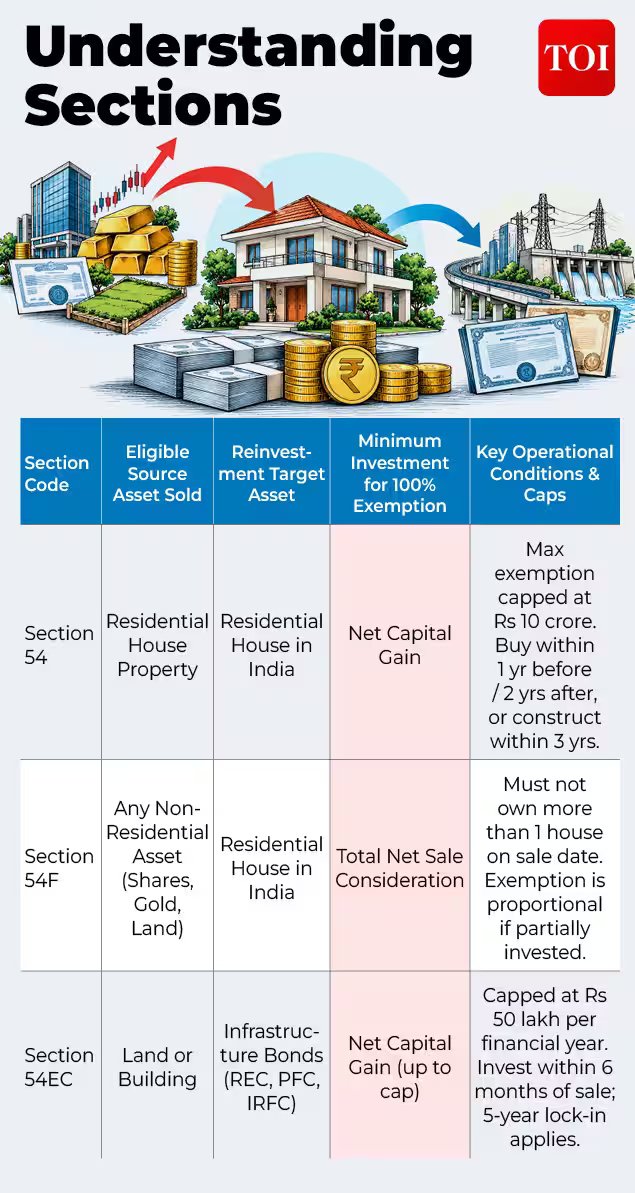
Understanding Section codes and tax exemptions
Section 54F (Non-Residential Assets): Selling non-residential assets (such as equity shares, gold, or commercial plots) and reinvesting into a residential house qualifies for tax relief. To secure a 100% exemption, the entire net sale consideration must be reinvested. Investing a portion yields a proportional exemption. Claimants must not own more than one residential house on the transaction date.Section 54EC (Capital Gains Bonds): Real estate investors can deploy up to Rs 50 lakh of long-term gains into designated infrastructure bonds (issued by REC, PFC, or IRFC) within 6 months of sale. These bonds offer a 5.25% annual return, carry a 5-year lock-in period, and generate taxable interest income.For Sections 54 and 54F, disposing of the new residential property within 3 years revokes the exemption. If suitable property acquisitions cannot be finalized before the tax return filing deadline, funds must be deposited into the Capital Gains Account Scheme (CGAS) with a scheduled bank to retain tax relief.Real estate involves long-term operational commitments. Acquiring real estate solely to save tax is rarely optimal. If homeownership does not fit your operational goals, infrastructure bonds provide a cleaner capital preservation vehicle despite the Rs 50 lakh limit.
Loss Set-Off and Carry-Forward Execution
Managing capital losses effectively preserves portfolio yield. A Short-Term Capital Loss (STCL) can offset both short-term and long-term capital gains across any asset class. A Long-Term Capital Loss (LTCL) can only offset long-term capital gains.Capital losses cannot reduce salary or business income. Unabsorbed losses can be carried forward for up to 8 consecutive tax years, provided the original income tax return is filed on or before the statutory due date. Missing the filing deadline forfeits loss carry-forward privileges permanently.
Pre-Exit Planning Checklist
Net returns are governed by post-tax capital retention. Two investors can acquire the same asset on the same date and realize identical gross profits, yet experience significantly different net outcomes based on exit execution.Before executing a sale across any asset class, evaluate purchase timestamps, compute alternative tax scenarios, and establish target reinvestment channels. Strategic exit planning remains a high-return exercise in personal finance.
Making Exit Planning Your Advantage
For too long, investors have treated capital gains tax as an unexpected bill after selling. In reality, what you keep after tax is the true measure of your investment success.As Indian families build wealth across shares, property, and gold under the Income-tax Act, 2025, exit planning is no longer optional. It is a necessary financial habit.By tracking your purchase dates, using annual tax-free limits, and checking reinvestment options before you sell, you can save a significant amount of tax. Before you place your next sell order, take a few minutes to calculate your post-tax return. Those few minutes will pay off better than almost any other financial decision you make.The author is Founder and CEO, ClearTax