

- A SIP invests a fixed sum every month.
- Time and compounding do most of the work.
- Track real returns with XIRR, not guesses.
Start Small, Stay Steady
Many people believe that they need a large amount of money to begin investing. However, this is not true. SIP (systematic investment planning) investing allows individuals to make monthly investments using smaller amounts of capital. SIP investing involves transferring a set amount of funds from an individual’s bank account to a mutual fund at a specific time every month. For example, during October, Indian investors contributed approximately ₹32,160 crore to SIPs as per AMFI. Let us see the numbers.
What the Chart Shows
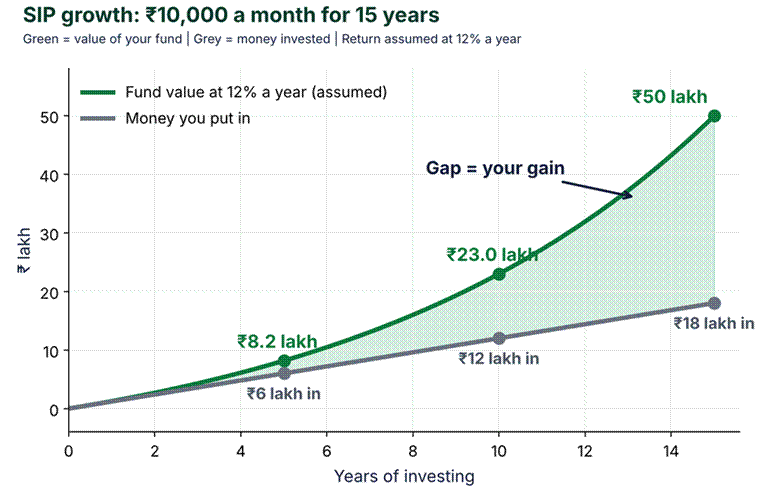
SIP growth chart: ₹10,000 a month for 15 years, assuming 12% a year.
Look at the graph carefully. This represents a systematic investment plan (SIP) with an amount of ₹10,000 every month for a total period of 15 years. The Gray line represents the total amount of money that was invested. This line is linear and will continue upward until the total amount of money that was invested reaches ₹18 lakhs. The green line represents the projected value of your investment based upon an annual return rate of 12%. At first, this curve will rise slowly; however, it will begin to rise at a faster pace as time goes on. After five years, the value of your investment would be approximately ₹8.2 lakhs.
Then, After ten years, the value of your investment would be approximately ₹23 lakhs. After fifteen years, the value of your investment would be approximately ₹50 lakhs. The green shaded area is the difference between the amount of money you have invested and the amount of money your investment has earned. Note how large the green shaded area becomes during the final years. That is compounding at work. The 12% is only an assumption. Real returns will differ.
Why Monthly Investing Works
SIP buying purchases more units during price drops and less during price increases. This process is referred to as “rupee cost averaging.” There is no need to make a guess about the most advantageous day. The Nifty 50 was close to 25,291 at the end of business on Monday; however, small-cap stock prices declined by approximately 4 percent throughout October. A SIP will help you maintain your composure during both of these situations. SIPs from retail investors have also assisted in stabilizing Indian stock prices when foreign investors were selling off, as we reported in GIFT Nifty is rebounding. Mutual funds in India are overseen by SEBI, the market regulator.
Check Your Real Returns
Many people judge a SIP by one simple number. That can mislead you. Each instalment goes in on a different date. Use XIRR instead. It counts every payment and its date. Our guide to mutual fund returns and XIRR shows how to read your statement.
Choosing Your Fund
Start with your goal and your time frame. For goals beyond seven years, many investors use equity funds. For shorter goals, debt funds are calmer. Compare costs, and compare each fund with its benchmark. Our guide to the best mutual funds to invest in lists the checks. For a plain explainer, see Investopedia.
Price matters too. When shares are expensive, future returns can be lower. Our P/E ratio guide shows how to judge that.
Three Ways the Market Can Go
In a bull market, your investments increase in value. In a bear market, you can use your SIP to buy more of your investment vehicle for less money. When the market moves sideways, you continue to make regular contributions to your investment portfolio. You will see some volatility in the short-term, however, over the long-term, consistency in making regular contributions to your investment portfolio is what counts the most.

Your Turn
Could you please provide ₹5,000 per month for me? What goal should I begin working on first? Choose one of your goals, establish a timeline for completing it, and get started. Today’s small steps will lead to a larger sum in the future. I am providing general information about investing, not advice.
FAQs
What is SIP investing?
SIP (systematic investment plan) is an investment strategy where you invest a set sum of cash in a mutual fund on a recurring schedule, most often once per month. Your investment will be automatically transferred from your bank account.
How much money do I need to start a SIP?
A large number of mutual funds allow you to begin investing at either ₹500 or ₹1,000 per month. Please check the requirements for each mutual fund that you are considering.
Is a SIP better than a lump sum?
The first method doesn’t always win. The SIP approach allows for you to spread out your purchases, so that you don’t have to worry about timing. On the other hand, the Lump Sum method is often more beneficial when there is a rapid rise in market value.
Can I stop a SIP at any time?
Yes, most SIPs may be paused or stopped. You should check for an exit load if you intend to sell your units shortly after purchasing them.