
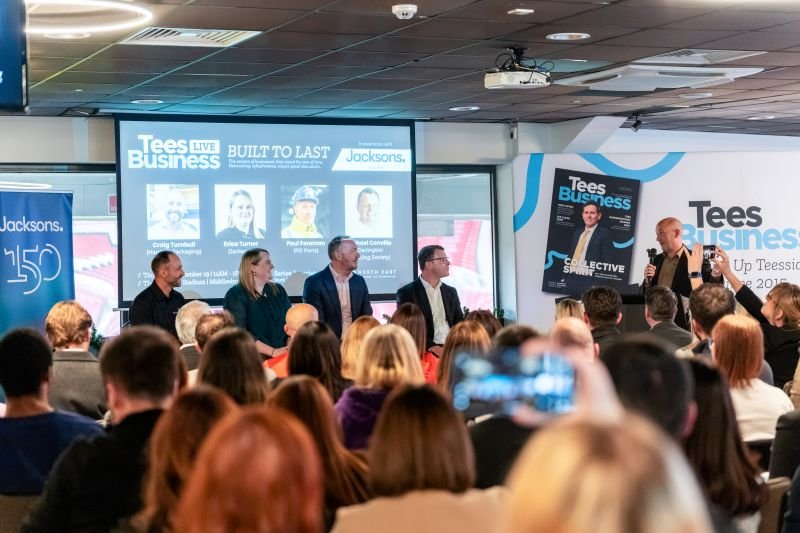
Artificial intelligence, digital transformation and multimillion-pound investment are helping some of Teesside’s oldest businesses prepare for the future, delegates heard at the latest Tees Business Live.
A 150-year-old Teesside law firm has launched an innovative artificial intelligence initiative designed to give every employee 18 minutes of their working day back.
Jacksons partner Erica Turner revealed details of the project during the event, which explored how established organisations are adapting to the demands of the modern business world.
More than 90 delegates attended the event – featuring a panel discussion entitled “Built to Last – The Secrets of Business Longevity” – in the Legends Lounge at Middlesbrough FC’s Riverside Stadium.
Erica was joined by PD Ports chief executive Paul Foreman, Harrison Packaging managing director Craig Turnbull and Darlington Building Society chief customer officer Michael Conville.
Together, the four organisations represent more than 600 years of business history.
But despite their heritage, all four are investing in new technology, infrastructure and ways of working to remain competitive.
Erica explained that Jacksons had taken a measured approach to adopting artificial intelligence, recognising both its potential and the concerns it could create among employees.
“We were probably early adopters from a legal perspective in relation to artificial intelligence, but we recognise that AI is moving at an incredibly fast pace,” she said.
“What we are not seeking to do is run with that same pace.”
Instead, the firm established an internal technology and AI committee, known as Project 18.
The initiative aims to use technology to reduce repetitive tasks and improve employees’ working experiences.
“Project 18 was essentially the concept that we wanted to effectively give all of our people 18 minutes of their working day back through clever, strategic use of AI,” Erica explained.
“We can make your day less stressful. You are not going to be replaced. You can see that AI can bring benefits in terms of what you do.”
Erica said the firm had made it clear from the outset that artificial intelligence would not be used to replace its workforce.
And she revealed an amusing consequence of the technology’s growing popularity – clients increasingly sending AI-generated correspondence to their solicitors.
“We know straight off when we’ve had correspondence from a client that has been generated by ChatGPT or some form of AI,” she said.
“It usually tends to be the language, because we get to know how our clients speak, and all of a sudden we’re getting an email that is three pages long, full of redundant information.”
For Harrison Packaging, technological change has been equally dramatic.
Founded in 1882, the Thornaby-based business has evolved from traditional printing presses to highly sophisticated manufacturing equipment.
Managing director Craig Turnbull illustrated the transformation by showing delegates images of the machinery used by the company’s founder, John Harrison, alongside modern equipment.
One of the company’s printing machines now measures 30 metres long, operates at 20,000 sheets per hour and cost approximately £4m.
Craig said businesses needed to embrace investment as an ongoing process rather than waiting until change became unavoidable.
“If you’re a business that’s had a plan, an investment strategy, and you’ve continued that, and you’ve continued to invest in your people and your kit and equipment, then change is normalised,” he explained.
“It’s not such a big issue for people.”
Darlington Building Society is also preparing for significant technological change.
Chief customer officer Michael Conville revealed plans to invest heavily in digital services over the next few years.
However, he stressed that the society would retain the personal service that has helped sustain it since 1856.
“What I wouldn’t want to do is force customers down a particular channel,” said Michael.
“I still think there’s a real place for that personal face-to-face service that Darlington has had for the last 170 years.”
Michael said digital technology should simplify everyday banking while allowing customers to access personal support when making major financial decisions.
He also highlighted the importance of helping vulnerable customers who may struggle with online services.
Meanwhile, PD Ports chief executive Paul Foreman discussed the enormous investment decisions facing the port operator.
Paul revealed that the business typically spends between £15m and £80m annually on capital projects, with individual cranes costing up to £8m.
He also outlined plans for the Tees Offshore Gateway, a potentially transformative infrastructure development along the River Tees.
“We’ve got a big scheme to build out a large piece of infrastructure along the riverfront, what we call Tees Offshore Gateway,” said Paul.
“That could be £100m, £200m, £300m or £400m, depending on the scale and size of it.
“Getting that one right is critical for us going forward to make sure we can cater for the activities that are coming next.”
Paul said the challenge was predicting what industries would need from the port in 20 or 30 years, while making investment decisions based on the information available today.
For all four businesses, the message was clear.
Their history provides a strong foundation, but it is their willingness to embrace change that will determine whether they remain successful for another century.
🎧 Listen to the full Tees Business LIVE discussion on Apple, Amazon and Spotify – search for ‘Talking Tees Business’.