

The term “government bond” is something we often hear in the news, but it is surprisingly difficult to understand how it relates to our daily lives.
In previous articles, we have thought about prices and interest rates.
This time, I would like to think about “government bonds,” which are deeply related to those interest rates, from the perspective of our daily lives.
Government bonds mean lending money to the government
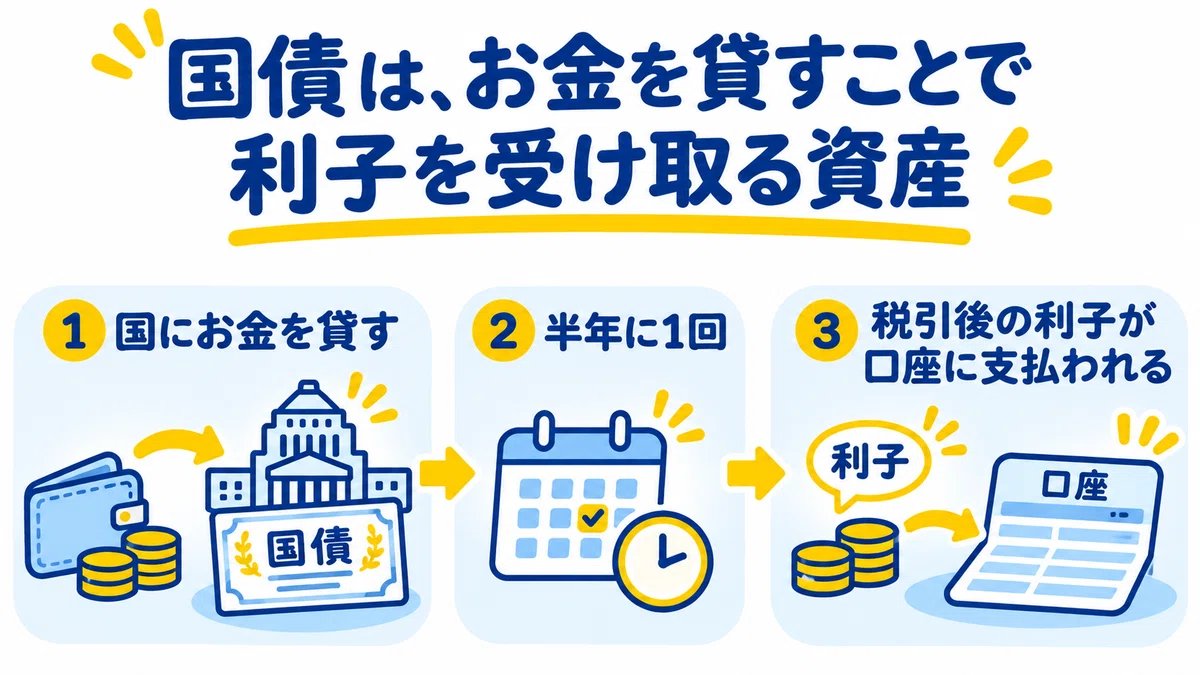
Simply put, a government bond is a “mechanism for lending money to the government.”
The government issues government bonds to raise the money necessary for things like road maintenance and social security.
When we buy government bonds, it means lending money to the government.
It is a system where you receive interest from the government every six months, and when a set period (maturity) arrives, the money you lent is returned.
In other words, government bonds are assets that earn interest by lending money.
How are they different from bank deposits?
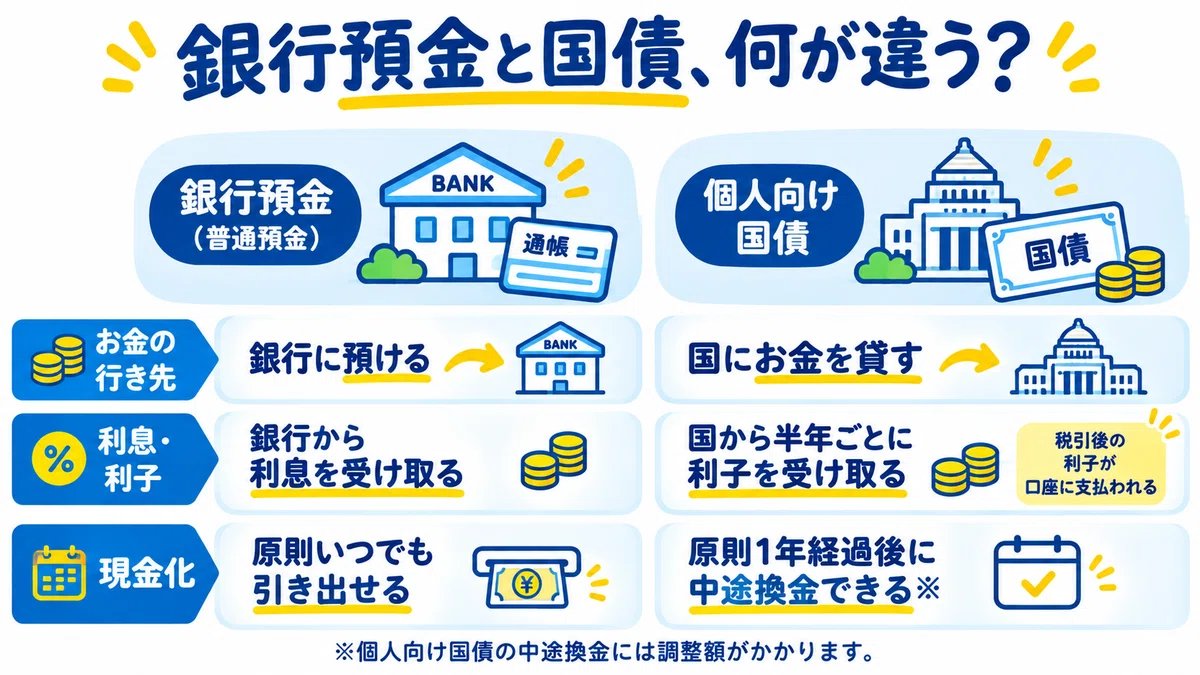
Bank deposits and government bonds are similar in that you can receive interest by depositing or lending money.
The big difference is who you are lending the money to.
For bank deposits, there is a “deposit insurance system” where the principal and interest are protected up to a certain amount.
On the other hand, government bonds are a system where the government promises to pay the principal and interest.
Both are relatively safe assets, but the mechanisms that protect them are different.
There are three types of government bonds for individuals
A representative type of government bond that we can purchase is the “government bond for individuals.”
They are offered every month at banks and securities companies, and the interest rate is determined based on the market interest rates at that time.
Even for the same type of government bond, the interest rate may differ depending on the month of purchase.
There are the following three types.
・Floating 10-Year The interest rate is reviewed every six months in line with changes in interest rates.
・Fixed 5-Year The interest rate at the time of purchase remains unchanged for five years
・Fixed 3-Year The interest rate at the time of purchase remains unchanged for three years
For example, if you think interest rates will rise in the future, the “Floating 10-Year” bond, which has the potential for increased interest payments, becomes an option.
On the other hand, if you want to invest at current interest rates, there is also the option of fixed-rate bonds where the interest rate does not change.
The important thing is to choose based on interest rate trends and your plans for using the money.
Note that for individual government bonds, if you hold them until maturity, the principal will be returned at face value.
Also, once one year has passed since issuance, you can redeem them early. However, in principle, an amount equivalent to the most recent two interest payments after tax will be deducted.
Government bonds also have risks
Government bonds are considered relatively safe assets.
In particular, individual government bonds are structured so that the price of the principal does not change even if interest rates fluctuate.
However, having your principal protected and having the value of your money protected are two different things .
For example, what if you earn 1% interest per year, but prices rise by 2% per year?
Even if the amount of money increases, the goods and services you can buy with that money will be less than before.
This is the “decline in the value of money due to inflation” that I mentioned in a previous article.
Also, since the government promises to pay the principal and interest on government bonds, there is a risk that depends on the government’s creditworthiness.
Government bonds are relatively stable assets, but that does not mean all risks are eliminated.
This session’s workshop: “Let’s think about when to use your money”
We have been thinking about deposits and government bonds.
Let’s take a moment here to think about when you plan to use your money.
-
Money you plan to use in the near future
-
Money you will need in a few years
-
Money you have no plans to use for a while
Even with the same 1 million yen, the suitable place to keep it changes depending on whether it is money you plan to use next year or money you will not use until 10 years from now.
What is important is not just increasing your money, but thinking about where to keep your money based on when you plan to use it and for what purpose.
There are options for where to keep your money
In this article, we introduced the option of not only depositing money in a bank but also lending it to the government to receive interest.
Furthermore, when you look at the growth of the economy and companies, you can see different ways to hold assets.
Next time, we would like to think about “investment trusts,” which allow you to manage your money by combining stocks, bonds, and other assets.
Having assets that grow is not necessarily something you must do.
Understanding how things work and becoming able to choose the method that suits your lifestyle.
That is what I most want to convey in this series.