
CoinDesk reports:
Key points
- CoreWeave co-founders purchased $30 million in face value of the company’s unsecured bonds.
- The CoreWeave notes maturing in 2031 are trading at approximately a 19% discount to par value.
- Despite a surge in revenue backlog, Wall Street’s concerns about AI infrastructure debt persist.
As Wall Street’s concerns over AI infrastructure debt intensify, Brian Venturo, Co-Founder and Chief Strategy Officer of CoreWeave, purchased $30 million in face value of the company’s unsecured bonds—a rare personal investment.
At the time of this purchase, CoreWeave’s senior unsecured notes maturing in October 2031 with a coupon rate of 9.75% were trading at approximately 81 cents per dollar of face value, representing a discount of about 19% from par. This discount reflects investors demanding a higher yield to compensate for the company’s financing risk.
CoreWeave executives bet $30 million on company bonds
According to MarketWatch, these notes recently traded at approximately 81 cents per dollar of face value, while other market data shows that these securities were priced near 80 cents in early November.
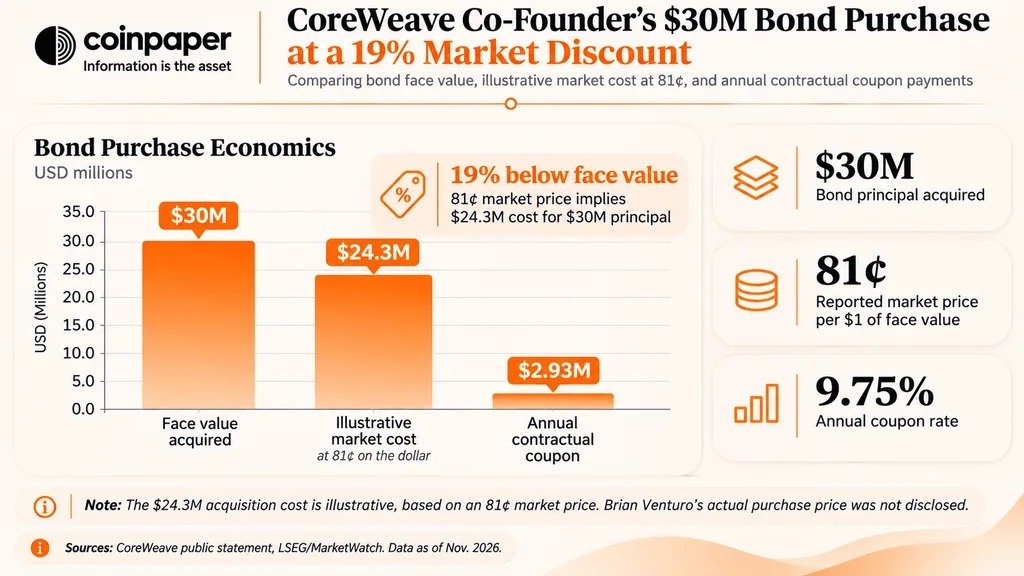
At the illustrative bid price of $0.81, purchasing $30 million in face value bonds would result in a principal cost of approximately $24.3 million. However, Venturo has not disclosed its actual purchase price, so the exact amount of cash invested remains unclear.
If the company continues to make timely interest payments, the annual contractual interest income would be approximately $2.93 million, based on a principal amount of $30 million and a coupon rate of 9.75%.
CoreWeave’s $132.5 billion backlog faces higher interest costs
This point also highlights the tension between CoreWeave’s accelerating business growth and its borrowing needs.
This cloud service provider backed by NVIDIA reported third-quarter revenue of approximately $3.66 billion, a 168% year-over-year increase; meanwhile, its signed backlog reached $132.5 billion.
Management expects interest expenses in the fourth quarter to range between $1.05 billion and $1.15 billion, highlighting rising financing costs for its expanding computational infrastructure.
According to filings submitted to the U.S. Securities and Exchange Commission (SEC) as of September 30, CoreWeave has $2.8 billion in outstanding senior notes maturing in 2031 with a 9.75% coupon, along with several other unsecured notes, convertible securities, and secured borrowing arrangements.
The company’s ambitious capital expenditure plan requires ongoing investment in GPUs, networking equipment, and data centers before customer contracts generate their full expected revenue.
The risks faced by AI debt investors differ from those of shareholders.
Venturo’s choice to purchase debt rather than equity highlights a fundamental difference in how investors are participating in CoreWeave’s future growth.
However, if CoreWeave fails to meet its debt obligations, unsecured bondholders may still face losses, and their claims on pledged assets are typically subordinate to those of secured creditors.
This investment comes amid broader concerns about the $466 billion expansion of AI-related debt, as an increasing number of companies are financing infrastructure spending through capital markets.
Author Adrian Cole states in the article that he has long followed financial markets, with a focus on crypto assets, equities, and macroeconomic trends.