

Do you know about bonds?
With the spread of the new NISA, more people are starting asset management through index investments like All Country (Orkan) or the S&P 500. Some may also be expanding their interests to individual stocks, high-dividend stocks, or gold.
On the other hand, what about bonds? Even if you know the name, many people likely do not fully understand their mechanisms or their role in asset management.
Deposits, stocks, gold, and bonds. Let’s consider the meaning of holding bonds while comparing the characteristics of each.
⸻
What exactly is a bond?
A bond is a financial product issued by governments, corporations, and others to borrow money. By purchasing bonds, investors become the lenders.
With a standard interest-bearing bond, you receive interest periodically during the holding period, and the face value is returned upon maturity.
For example, for a bond with a face value of 1 million yen, a 2% annual interest rate, and a 5-year maturity, you would receive 20,000 yen in interest each year, and 1 million yen would be redeemed after 5 years. The total interest over 5 years is 100,000 yen (this is a simple example that does not account for taxes or purchase price).
While stocks represent an investment in a company, bonds represent lending money. This difference is fundamental.
⸻
How are they different from deposits, stocks, and gold? The role of bonds
When considering asset management, it is important to organize what the purpose of each financial product is.
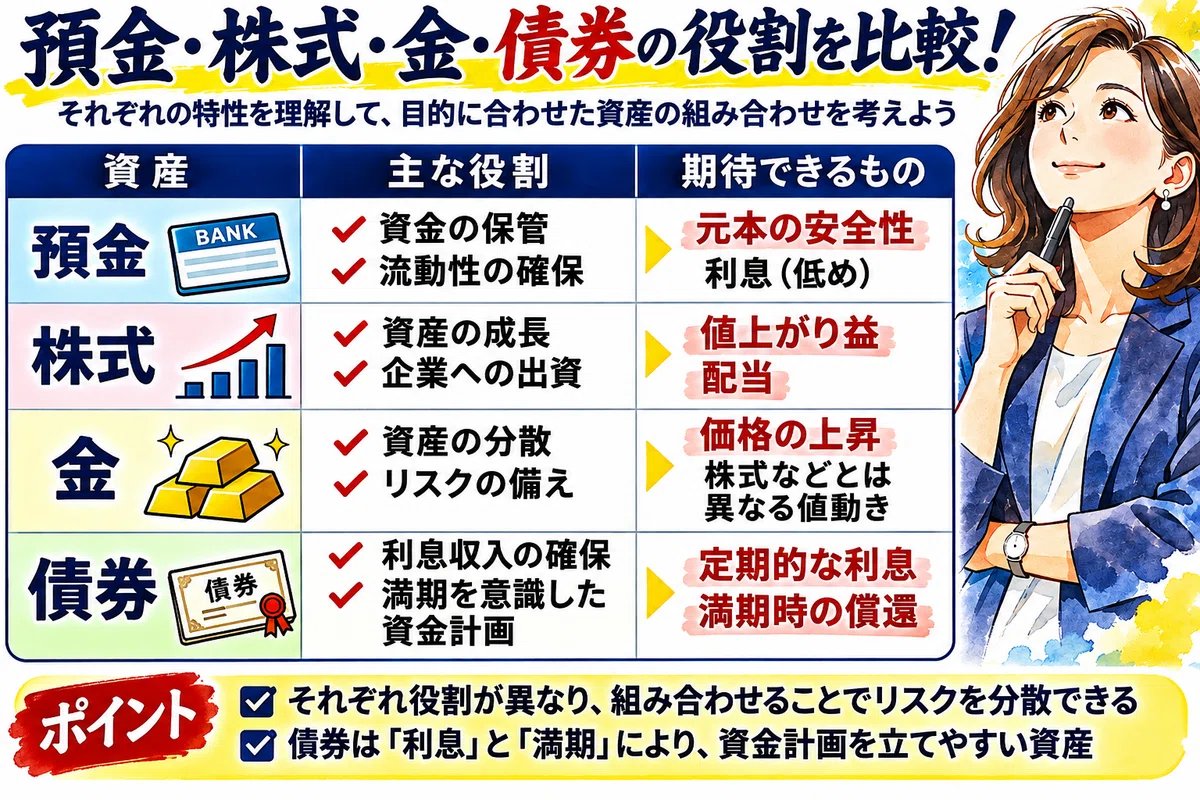
Deposits are for securing funds that can be used when needed. Stocks are for expecting price appreciation and dividends from corporate growth. Gold does not generate interest, but it is used for diversification as an asset that moves differently.
So, what about bonds?
The characteristic of bonds is that conditions such as the interest rate and maturity are determined in advance. If held until maturity, as long as the issuer fulfills its obligations, you will receive interest and the redemption of the face value.
In other words, bonds are financial products that allow you to earn interest income while making it easier to foresee the timing of future fund recovery. They may also move differently from stocks, which can be useful when considering the balance of your overall assets.
However, bonds do not necessarily compensate for declines in stocks.
⸻
What types of bonds are there?
Bonds are broadly categorized by their issuer.
* Government bonds: Bonds issued by the government
* Corporate bonds: Bonds issued by companies to raise funds
* Foreign bonds: Bonds issued by foreign governments, companies, etc.
There are also “government bonds for individuals” designed to be easy for individuals to purchase. In Japan, three types are sold: 10-year floating rate, 5-year fixed rate, and 3-year fixed rate.
There are newly issued bonds (primary market bonds) and bonds that have already been issued and are circulating in the market (secondary market bonds). A feature of secondary market bonds is that the yield changes depending on the purchase price.
⸻
Where and how do you buy bonds?
Government bonds for individuals can be purchased at banks, securities companies, post offices, etc. They are also handled by online securities companies like Rakuten Securities and can be purchased from 10,000 yen. Interest is paid twice a year to your securities account, etc.
Corporate bonds and foreign bonds are also mainly handled by securities companies. There are ways to purchase new bonds during the offering period or to purchase existing bonds. While bond trading is primarily over-the-counter, there are products that can also be purchased through online securities companies.
Also, in addition to purchasing individual bonds directly, there are ways to invest through bond ETFs or bond investment trusts. You can invest in multiple bonds at once and purchase them from your securities account.
However, bond ETFs and investment trusts do not have face value redemption at maturity like individual bonds.
⸻
Advantages and risks of bond investment
The advantages of bonds are that you can expect interest income and, if held until maturity, it is easier to foresee the timing of fund recovery.
On the other hand, bonds also have risks.
Particularly important is the relationship between interest rates and bond prices. Generally, when market interest rates rise, the prices of already issued bonds tend to fall. Conversely, when interest rates fall, the prices of existing bonds tend to rise.
For example, what happens if you hold a bond with a 1% annual interest rate and a new bond with a 3% annual interest rate is issued? Since the new bond becomes more attractive, it becomes difficult to find buyers for the 1% existing bond unless its price is lowered.
In addition, you need to be aware of credit risk where the issuer cannot repay, foreign exchange risk for foreign bonds, and price fluctuation and liquidity risk when selling mid-term.
Just because it is a bond does not mean it is safe, or that you will definitely not lose money if you hold it until maturity.
⸻
Bonds are one of the options for asset management
Deposits are for storing funds, stocks are for aiming for asset growth, and gold is used for asset diversification. And bonds have the role of allowing you to earn interest income while making it easier to plan your finances with maturity in mind.
Of course, bonds also have price fluctuations and credit risks. They do not necessarily compensate for declines in stocks.
You do not need to force yourself to buy bonds when you have just started investing. However, when your assets grow and you start thinking about investment periods and future uses, knowing the mechanisms and roles of bonds will lead to expanding your asset management options.