
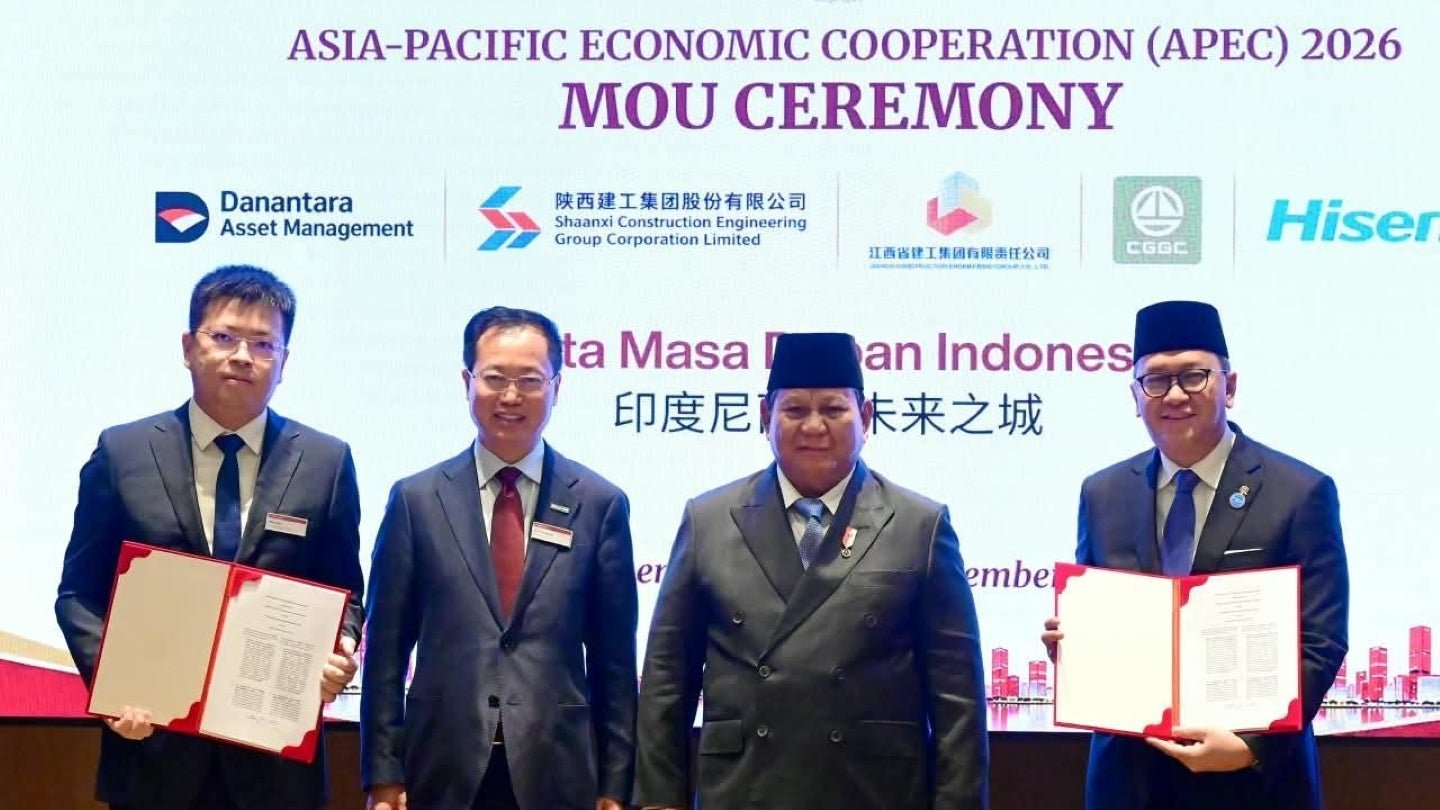
Indonesia and China have signed four investment partnerships and memorandums of understanding (MoUs) with an estimated combined value of $71.8bn.
The agreements, signed during the Asia-Pacific Economic Cooperation (APEC) summit in Shenzhen, China on yesterday (18 November), cover smart city development, manufacturing and research, infrastructure financing, and coal-to-ethanol technology.

Discover B2B Marketing That Performs
Combine business intelligence and editorial excellence to reach engaged professionals across 36 leading media platforms.
The first agreement, valued at $50bn, is between PT Kota Masa Depan Indonesia, which operates under Indonesian sovereign wealth fund Danantara, and a consortium led by China’s Shaanxi Construction Engineering Group.
It covers the development of ten initial “future smart city” sites.
The second, worth $10bn, is a commitment by Hisense, a Chinese appliance manufacturer.
It was made in collaboration with Indonesia’s Ministry of Higher Education, Science, and Technology and Danantara.
The commitment covers the establishment of a joint research and development laboratory, talent development initiatives and home appliance manufacturing.
A further $10bn has been allocated to an infrastructure financing partnership between Danantara and a consortium led by the State Development and Investment Corporation (SDIC).
The fourth agreement is a $1.8bn MoU on coal-to-ethanol technology, involving the Ministry of Higher Education, Science, and Technology, state-owned oil and gas company Pertamina and Beijing Petrochemical Engineering.
The project aims to advance domestic fuel technology and facilitate technology transfer.
Speaking about the smart city initiative, Indonesia Minister of Investment and Downstreaming and Danantara CEO Rosan Roeslani said: “That will become a historical project to be implemented next year.”
On the broader economic impact of the agreements, Roeslani added: “This will indeed have a positive impact on job creation and will also facilitate technology transfer.”
According to Roeslani, the agreements reflect investor confidence in Indonesia’s economic prospects.
He said bilateral efforts are concentrated on productive, value-added industrial projects across technology, infrastructure and resource processing.
Implementation of the initial smart city developments is scheduled to begin next year.
