

When researching mutual funds,
you have probably come across terms like
“index funds”
and “active funds.”
While both are types of mutual funds,
they actually differ in how they are managed.
Not only do their fees vary, but their investment performance differs as well.
Each has its own advantages and disadvantages.
In this article,
I would like to organize and break down
the differences between index funds and active funds
in a way that is easy even for beginners to understand.
First of all, what are index and active funds?
First, let’s look at how each is managed.
◆ Index Funds
“Index”
means an indicator or benchmark.
For example,
• Nikkei 225
• TOPIX
• S&P 500
• MSCI ACWI (All Country World Index)
are some well-known examples.
These are benchmarks representing the movement of the entire stock market
or specific market segments.
Index funds are mutual funds
managed with the goal of matching the price movements
of such indices.
For instance,
an index fund tracking the S&P 500 will hold components of the S&P 500
to achieve investment results similar to the index.
In other words,
it is a method aiming for management in line with the growth of the overall market.
◆ Active Funds
On the other hand, active funds are mutual funds
where professional investment managers, known as fund managers,
research and analyze companies and markets to decide which companies
and in what proportions to invest.
In most cases,
they aim for investment performance that outperforms a specific index.
• Companies expected to grow in the future
• Companies with proprietary technologies or competitive strengths
• Companies undervalued by the market
They research factors like these to select investment destinations.
In other words,
it is a management method aiming for results that beat the market average.
Comparing the Differences Between Index and Active
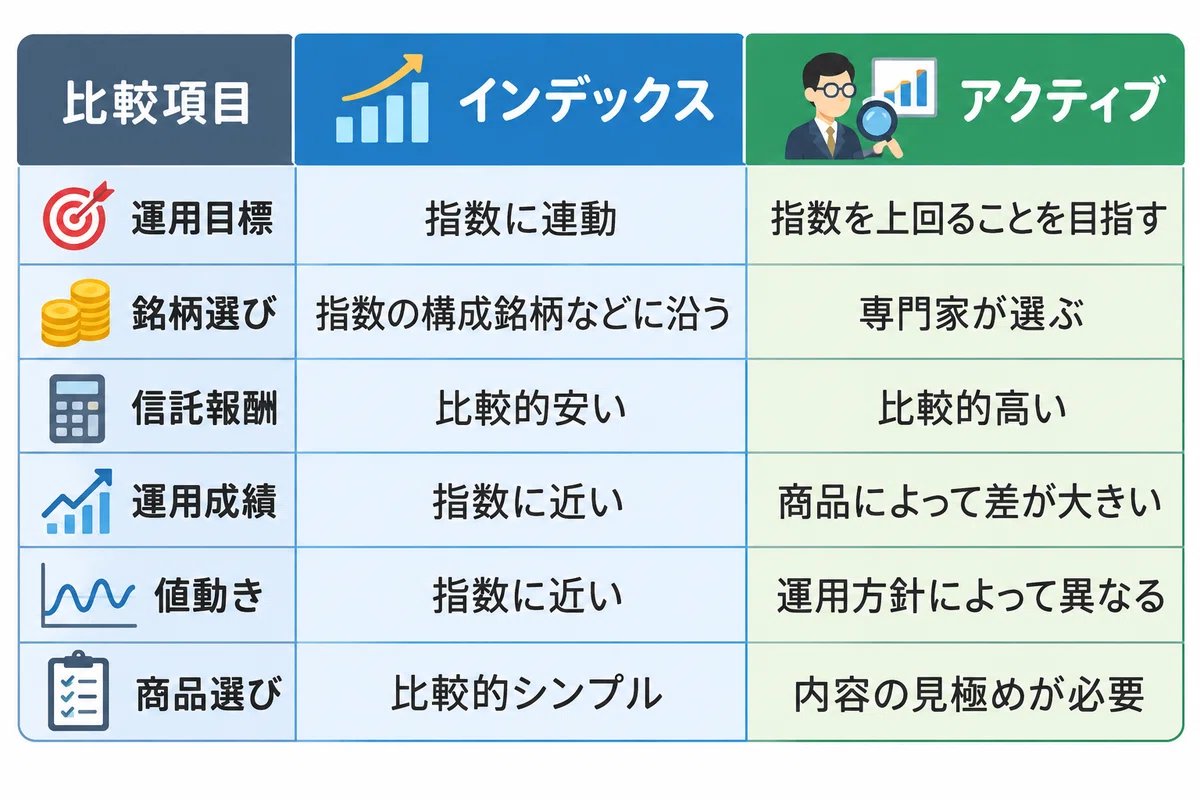
The major differences lie in management style and fees.
Let’s take a closer look.
① Fees (Trust Fees) Are Different
Mutual funds incur an expense called
the “trust fee” while you hold them.
This is a cost required for the management and administration of the fund.
Trust fees
are deducted daily from your invested assets.
Because of this, although we do not pay them separately each month,
they do impact investment returns.
Generally speaking, index funds
tend to have lower trust fees
because their management method is relatively simple.
Conversely, active funds
tend to have higher trust fees because costs
are incurred for corporate research, analysis, and stock selection.
This difference
can have quite a significant impact over the long term.
Let’s run a quick trial calculation.
Let’s compare a case of investing 1 million yen for 20 years
under the following conditions:
• Initial investment amount: 1 million yen
• Investment period: 20 years
• Annual return before costs: 5%
◆ Index trust fee: 0.1% per year
◆ Active trust fee: 1.5% per year
We assume costs and taxes
other than trust fees are not considered.
In this scenario, the annual returns after deducting trust fees are:
Index: 4.9% per year
Active: 3.5% per year
Comparing asset values after 20 years…
◆ Index: approx. 2.62 million yen
◆ Active: approx. 1.99 million yen
Surprisingly, a gap of about 630,000 yen opens up.
Of course, this is merely a simulation.
In reality, an active fund might achieve
higher performance
than an index fund.
However, even with identical investment performance,
higher fees mean that the amount of money left in your hands
will be smaller.
In long-term investing, you should be conscious not only of yield
but also of these cost differences.
② Can Active Funds Beat the Market Average?
Active funds are managed
with the goal of outperforming the market average.
So, does that mean they can actually beat the market average…?
Not necessarily.
Even when experts research, analyze companies, and manage the fund,
the desired results might not be achieved.
Far from outperforming the market average,
they can sometimes substantially underperform it.
Furthermore, a fund that performed well over a certain period
is not guaranteed to deliver similar results going forward.
Paying higher fees
does not always mean you will earn higher returns.
This is precisely what makes choosing an active fund
challenging.
③ Active Funds Also Have Their Appeals
Reading this far, you might feel that index funds
are simply better.
However, I do not believe active funds
are bad things.
While I personally hold index funds as my core holdings,
I also hold several active funds.
Active funds possess
appeals that index funds lack.
For example:
• You can invest in specific growth companies or sectors
• You can benefit from professional research and analysis in the portfolio management
• There is the potential to achieve returns exceeding the market average
• You can invest in companies or themes you personally care about
These are some of the advantages.
What kinds of companies are being invested in?
What philosophy guides their management?
Investing because you find value in those aspects
is certainly a valid option.
However, active funds
differ greatly in investment policies and performance depending on the product.
Is the performance worth the fee?
Are you satisfied with the holdings and management philosophy?
Checking these things thoroughly for yourself
becomes very important.
④ Which Is Recommended for Investment Beginners?
So, which one is recommended
for those starting out with investing?
In my view,
it is best to start
with index funds first.
The reasons are:
• The mechanism is relatively simple
• Many products have low fees
• It is easy to choose products diversified across a wide range of stocks
• It is straightforward to compare performance against the benchmark index
These are the key characteristics.
When you have just started investing,
there are already plenty of choices to get confused about just in selecting a product.
In such a situation,
researching corporate analysis and the fund manager’s
investment strategy to pick a product
can be quite demanding.
First, start with index funds, which are easy to understand, low-cost,
and easy to hold for the long term.
Then, as you learn more about investing,
if there are active funds that catch your interest,
you can consider adding them.
I believe that taking such a step-by-step approach is a great way to go.
In conclusion.
Index funds and active funds.
Both have their advantages and disadvantages,
and there is no absolute right answer.
What matters most is understanding the characteristics of each
and choosing an investment approach that suits you.
Investing is not a competition with anyone else.
Aiming solely for huge profits is not the only right way, either.
It is about using a method you are comfortable with
and continuing it sustainably over the long term.
Between index and active,
which one’s appeal attracts you more?