Robinhood (HOOD)’s Expansion into Wealth Management Could Bear Fruit in 2027
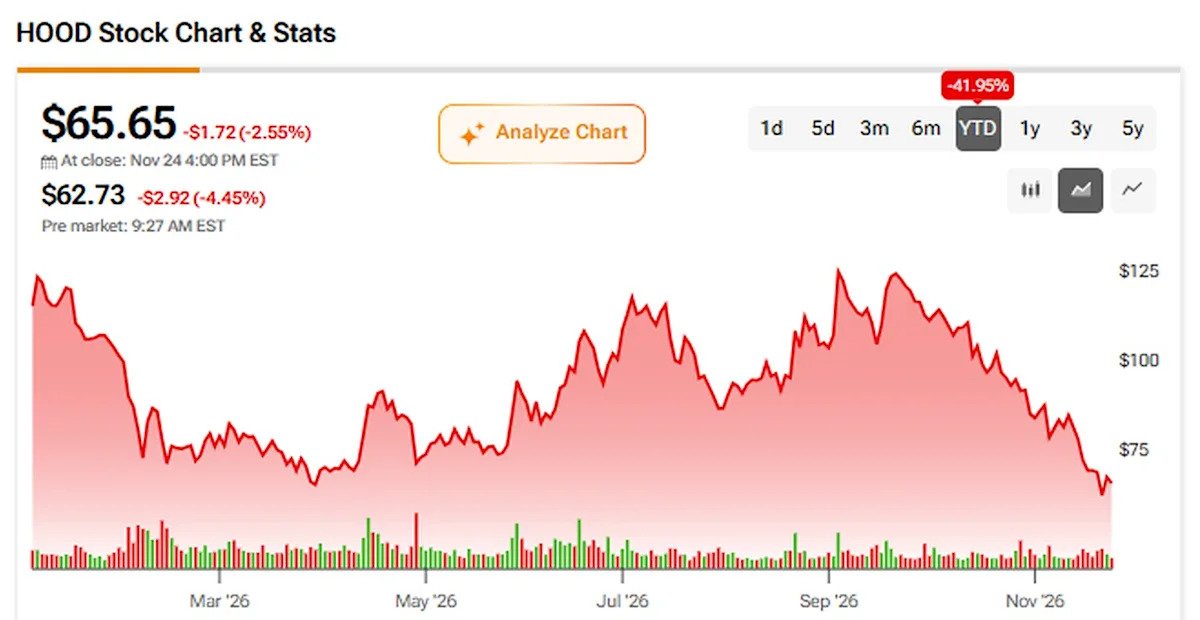
Robinhood’s (HOOD) expansion into wealth management could pay off in 2027. Shares of the low-cost brokerage firm have been under pressure in 2026, significantly underperforming peers such as Interactive Brokers (IBKR), which has managed to hold onto gains despite volatility in artificial intelligence (AI) stocks. While market volatility can boost trading activity in the short term, a prolonged downturn could eventually weigh on investor enthusiasm and brokerage activity.
Even so, Robinhood’s pullback follows a massive rally in 2025, resetting its valuation heading into 2027. At about 22.5x expected 2027 earnings per share (EPS) of $2.92, HOOD now trades largely in line with Interactive Brokers, carrying no valuation multiple premium despite projected EPS growth of roughly 40% next year. That earnings growth is backed by steady momentum in wealth management and banking, along with the non-recurrence of one-off items, such as unrealized mark-to-market venture losses that weighed on Q3 2026 results, as I will discuss below.
My Buy rating on Robinhood aligns with Wall Street’s Strong Buy consensus. The average 12-month price target of $127.95 suggests significant upside if the company delivers on its earnings growth expectations.
Robinhood delivered GAAP EPS of $0.51 in Q3 2026, down 16% relative to the prior-year quarter. Profits were impacted by a $0.07 per share loss related to the valuation of Robinhood Ventures Fund I, a listed closed-end fund that invests in private companies.
Because those fund valuations can swing sharply from quarter to quarter, Robinhood also started reporting non-GAAP earnings in Q3 to strip out such mark-to-market effects. Even on an adjusted basis, non-GAAP EPS stood at $0.60 in Q3 2026, still down 3% year-over-year.
The small decline was driven by a 16% increase in operating expenses, ahead of 12% revenue growth. The outsized expense growth was partially the result of elevated provisions for credit card losses, which can be quite volatile from one quarter to the next.
Taken together, Robinhood’s Q3 2026 earnings softness stemmed largely from one-off or variable items, specifically mark-to-market venture losses and higher credit provisions, rather than a breakdown in core demand.
Looking ahead, analysts expect Robinhood to return to strong bottom-line growth in 2027, projecting full-year EPS of $2.92 compared with $2.09 in 2026. That projected 40% earnings rebound is a central pillar behind my Buy rating on the stock.
Robinhood’s Changing Business Model
Looking at Robinhood’s changing business profile is key to understanding its future revenue and earnings potential. In Q3 2025, cryptocurrency holdings accounted for roughly 15% of Robinhood’s $333 billion in total platform assets. By Q3 2026, total platform assets climbed 19% year-over-year to $396 billion, but the absolute value of crypto assets declined to just $38 billion, representing less than 10% of total Robinhood platform assets. So, we see that the company is now less exposed to the overall growth of the crypto ecosystem.
In contrast, Robinhood is targeting growth in areas such as wealth management. Banking balances surged by 48% quarter-over-quarter, reaching $4.6 billion in Q3 2026. Likewise, Robinhood Strategies’ assets under management reached $2.1 billion, growing 133% year-over-year. This service is tailored for retail investors who prefer to delegate asset management decisions to Robinhood.
While not all growth investments will ultimately deliver, and in fact some may end up losing money, Robinhood continues to diversify its revenue streams, setting up the company for solid revenue growth over the medium term. Analysts expect the company to deliver revenues of about $6.88 billion in 2027, implying growth of about 29% relative to 2026.
That diversifying revenue mix underpins my Buy rating on Robinhood. However, investors should note that diversification into new business lines is not a guaranteed recipe for success. Goldman Sachs (GS), for example, ultimately decided to pare down its retail banking business after initially investing in the space to diversify its volatile investment banking business.
Robinhood Valuation
After recent declines, Robinhood stock trades at 22.5x expected 2027 EPS of $2.92. This is largely in line with direct low-cost brokerage peers such as Interactive Brokers, which also trades at 22.5x its expected 2027 EPS of $3.32. Most notably, Interactive Brokers is only projected to grow EPS by 23% next year, well below the 40% EPS growth analysts expect for Robinhood.
In essence, despite Robinhood’s superior earnings growth expectations, Robinhood stock is no longer trading at a premium to peers. Indeed, the market appears to have grown skeptical of Robinhood’s ability to deliver on lofty 2027 EPS expectations.
That caution carries real weight if AI volatility cools retail enthusiasm for buying stocks, since equities accounted for roughly 70% of Robinhood’s $396 billion in total platform assets at the end of Q3 2026.
Even so, my Buy rating rests on markets working through AI-related swings and posting modest gains in 2027. Growth may not match the steep gains seen after the 2022 bear market, yet a steady market backdrop should go a long way toward supporting Robinhood’s 2027 revenue and earnings outlook.
The alternative scenario, namely equity markets entering a full-blown bear market leading to Robinhood’s trading fees slumping, akin to what happened in 2022, cannot be ruled out. That said, I see the odds of a prolonged bear market as low, with investors potentially diversifying away from AI stock if volatility in the sector persists.
Wall Street’s Take on Robinhood
On Wall Street, Robinhood has a Strong Buy consensus rating, based on 20 Buy and three Hold ratings over the past three months. Notably, no analyst sees Robinhood as a Sell. According to TipRanks data, the 12-month average Robinhood price target is currently $127.95, implying 94.9% upside.
Conclusion
Robinhood shares have been under pressure in 2026, giving back part of the steep gains achieved in 2025. Although earnings growth stalled in Q3 2026, that slowdown stemmed largely from one-off factors such as mark-to-market venture losses and higher credit card loss provisions.
Looking ahead, analysts expect Robinhood’s earnings to grow by roughly 40% in 2027, supported by its expansion into areas such as wealth management and banking. Despite that growth outlook, the stock now trades at about 22.5x expected 2027 earnings, no longer commanding a valuation premium over peers such as Interactive Brokers.
A prolonged equity market downturn could still derail Robinhood’s earnings trajectory, much as it did in 2022. Even so, I expect 2027 to be a constructive year for stocks, although without a repeat of the outsized double-digit annual gains seen since the 2022 bear market. Against that backdrop, I view the pullback in Robinhood shares as an attractive buying opportunity.