
Amid the rapid growth of the domestic exchange-traded fund (ETF) market, controversy over the so-called “Copycat (imitation product)” with similar investment composition to existing products is growing. Four out of 10 industrial and theme-type ETFs in Korea overlap more than 70% of other products and incorporated stocks and proportions. It is pointed out that the number of ETF products is increasing rapidly, but the actual options of investors are not expanding as much.
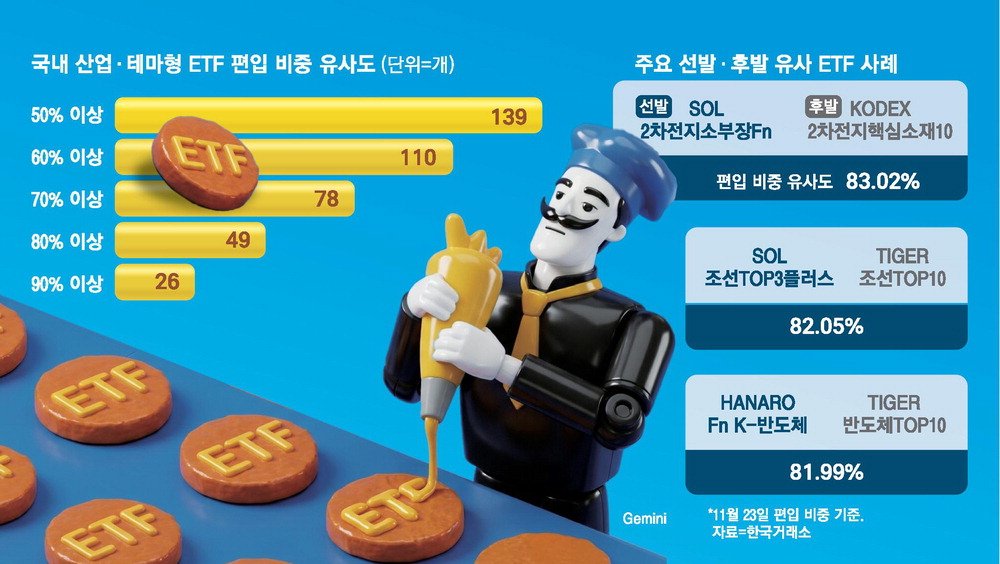
According to Mail Business’s analysis of 192 paid assets (PDF) of Korean industrial and themed ETFs listed on the Korea Exchange on the 29th, 78 products (40.6%) overlapped with other ETFs by more than 70%. Forty-nine (25.5%) products with more than 80% redundancy and 26 (13.5%) products with more than 90% redundancy. Even if the comparison range was narrowed to products with a time difference of 90 days or more, 59 (30.7%) were found.
The targets of analysis are domestic industrial and theme ETFs, excluding representative index products such as KOSPI 200 and KOSDAQ 150, general-purpose strategic products such as high dividends, growth stocks, and value stocks, and products that focus on investing in specific companies or business groups. Products with similar investment structures, such as leverage, inverters, synthetic types, and capsules, were also excluded.
The similarity between products was calculated by the “Weighted Portfolio Overlap” method, which is used to analyze overlapping investments and investment concentrations between funds. It is a method of converting the sum of the share of incorporation into 100% and adding the smaller value of the share of incorporation by company that the two ETFs have in common.
“Currently, competition in the domestic ETF market is excessively fierce, and most of them are pursuing strategies to quickly follow the short-term box office theme,” an asset management industry official said. “The diversity of new products in the domestic ETF market is decreasing.” A number of cases have also been confirmed in which large management companies jump into the investment theme, where small and medium-sized management companies entered first, as a latecomer. Of the 84 ETFs analyzed by Samsung Asset Management and Mirae Asset Asset Management, 13 (15.5%) were latecomers that overlap more than 70% of the selected products of other management companies.
However, transactions tended to be concentrated on products from large companies that followed. As a result of comparing 13 pairs of latecomers from Samsung and Mirae Asset Asset Management with 13 pairs of latecomers whose incorporation weight overlaps more than 70%, 10 pairs (76.9%) of latecomers exceeded the starting products from the 25th of last month to the 24th of this month.
In the flow of funds from individual investors, the joys and sorrows of selection and follow-up products were mixed. According to the combined net purchases of these 13 ETF pairs during the same period, individual investors net sold 34.9 billion won worth of ETFs from managers who entered the market first, while those of Samsung and Mirae Asset Asset Management, which belatedly launched similar products, net purchased 23.6 billion won.
Lee Hyo-seop, head of the financial industry division at the Korea Capital Market Research Institute, said, “Small and medium-sized operators are expected to be difficult to beat in the competition with low-paying products and institutional sales channels.”
Furthermore, competition between similar products can lead to lower remuneration and improved transaction convenience, but there are concerns that small and medium-sized companies’ incentives to develop their own products could weaken if the focus of large companies is fixed.
Experts point out that even if individual investors also invest in multiple ETFs, they can actually fall into the “optical illusion of diversified investment” of overlapping investments in the same company.
They say that only the number of new products has increased, but there is no significant difference in the composition, which can narrow investors’ choices and only increase fatigue in marketing new products.
Some voice the need to increase the institutional effectiveness to protect managers who have developed innovative ETFs. Currently, the Korea Exchange is operating an ETP new product protection system. It is a system that gives financial companies that have developed original products the right to be protected from the launch of similar products for a certain period of time.
Director Lee said, “There is a new product protection system, but it is not being used properly, so it is urgent to improve the system for wide use.”
[Reporter Lee Hojun]