


A rendering of the new stadium to replace The Diamond. (BizSense file images)
Just as news broke of a $40 million lawsuit against developers of Richmond’s Diamond District project, the City of Richmond secured financing for the project’s anchor baseball stadium.
The city announced Thursday that it has sold the $130 million in general obligation (GO) bonds it will use to finance the new ballpark with a bond sale that locked in a lower interest rate than expected, resulting in millions of dollars in savings for the city.
The deal was finalized Wednesday and is set to close July 30.
Later that day, local commercial real estate firm Thalhimer, whose development arm is leading the mixed-use portion of the Diamond District with Chicago-based Loop Capital, issued a statement responding to a $40 million lawsuit that’s been filed against them by their former partner on the project, D.C.-based Republic Properties.
Republic, which once led a previous iteration of the project’s development group, alleges in the suit that Thalhimer Realty Partners and Loop breached their venture partnership with the company when they formed a new entity and entered into a revised development agreement with the city. The new entity includes TRP and Loop but not Republic.

Lee Warfield
In his statement, Thalhimer President and CEO Lee Warfield called Republic’s claims “baseless.”
“After the project was initially approved by the City, Republic notified Thalhimer of its intent to exit the project and confirmed in writing that Republic would not continue to participate in the development,” the statement said. “Subsequently, the City began working on a solution with Thalhimer Realty Partners and others that would allow the Diamond development project to move forward.”
Warfield added: “We are confident that the facts will prove that this suit has no merit, and it should not be allowed to stand in the way of the development of Richmond’s new ballpark for the Flying Squirrels and VCU and the surrounding mixed-use development. Richmond has waited long enough.”
A formal response to the lawsuit, which was filed in Richmond Circuit Court last week, had not been filed as of Thursday.
Bond rate to cost city $11M less than expected
Richmond’s bond sale for the stadium – which comes two months after the city achieved its first AAA credit rating – locked in a true interest cost of 3.99 percent, lower than the 4.25 percent rate the city had estimated, according to the announcement. The lower rate means the city will avoid about $11.5 million in additional interest payments over the 32-year life of the loan.
The $130 million bond sale follows a separate sale of $40 million in lease revenue bonds for infrastructure improvements for the Diamond District’s first phase. That sale also secured an interest rate below 4 percent, Chief Administrative Officer Lincoln Saunders said.
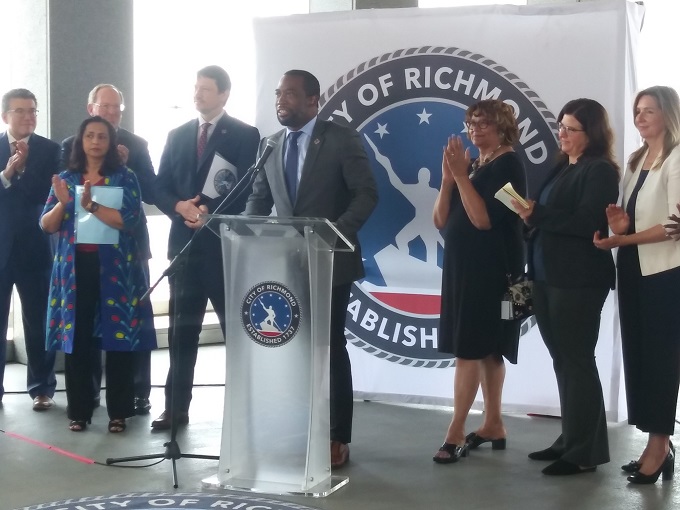
Officials announced the city’s AAA rating from Fitch in May.
The lower rates follow the city’s securing in May of its first AAA (vocalized as “Triple A”) credit rating, the highest possible, from Fitch Ratings, one of the big three U.S. bond rating agencies along with Standard & Poor’s Global Ratings and Moody’s Investor Service.
Richmond’s ratings with S&P and Moody’s remain AA+ and Aa1, respectively, leaving the city just below the so-called “Triple AAA” trifecta achieved by the neighboring counties of Chesterfield, Hanover and Henrico.
Favorable credit ratings allow the city to borrow money at lower interest rates and spend less on borrowing costs, saving taxpayer dollars that can then be put toward city services and other uses.
Fitch increased Richmond’s issuer default rating and outstanding general obligation as a result of it assigning AAA ratings to the $130 million stadium bond, as well as to a $121 million GO bond issued to refinance a portion of the city’s unfunded actuarial liability to the Richmond Retirement System for city employees.
The stadium bond issuance was delayed because of a separate lawsuit that challenged the city’s change in approach to financing the ballpark. Where it previously planned to use higher-interest bonds through a community development authority, Richmond opted instead, at the advice of financial adviser Davenport & Co., to issue its own bonds based on the city’s credit to secure the financing more quickly and at lower rates.
The pivot in financing was unable to secure $24 million in state sales tax incentives that expired July 1 but potentially could be revived in future legislative sessions. Saunders, the city CAO, said the stadium bonds couldn’t be issued until the lawsuit’s appeal window expired two days before the deadline.

A conceptual rendering of the Diamond District along Arthur Ashe Boulevard.
The stadium GO bonds are to be paid using tax revenue generated by the Diamond District development, while the infrastructure bonds are lease revenue bonds to be paid by the leases for the stadium.
Lease agreements with the stadium’s tenants, the Flying Squirrels and Virginia Commonwealth University, have yet to be signed. Those agreements would be with Richmond’s Economic Development Authority, which was scheduled to hold its regular monthly meeting Thursday. The meeting was canceled Wednesday.
Site work on the ballpark cannot start until the lease agreements and a stadium development agreement are signed. The city had been aiming to break ground on the stadium this month but is now aiming for August, according to Thursday’s announcement. Site work would follow with stadium construction to start in the fall, while hotel, retail and residential development would start early next year.
The city is aiming for the stadium to be completed and open in time for the 2026 baseball season. The venue, which would replace The Diamond, would satisfy new facility standards required by Major League Baseball for all pro baseball venues.