
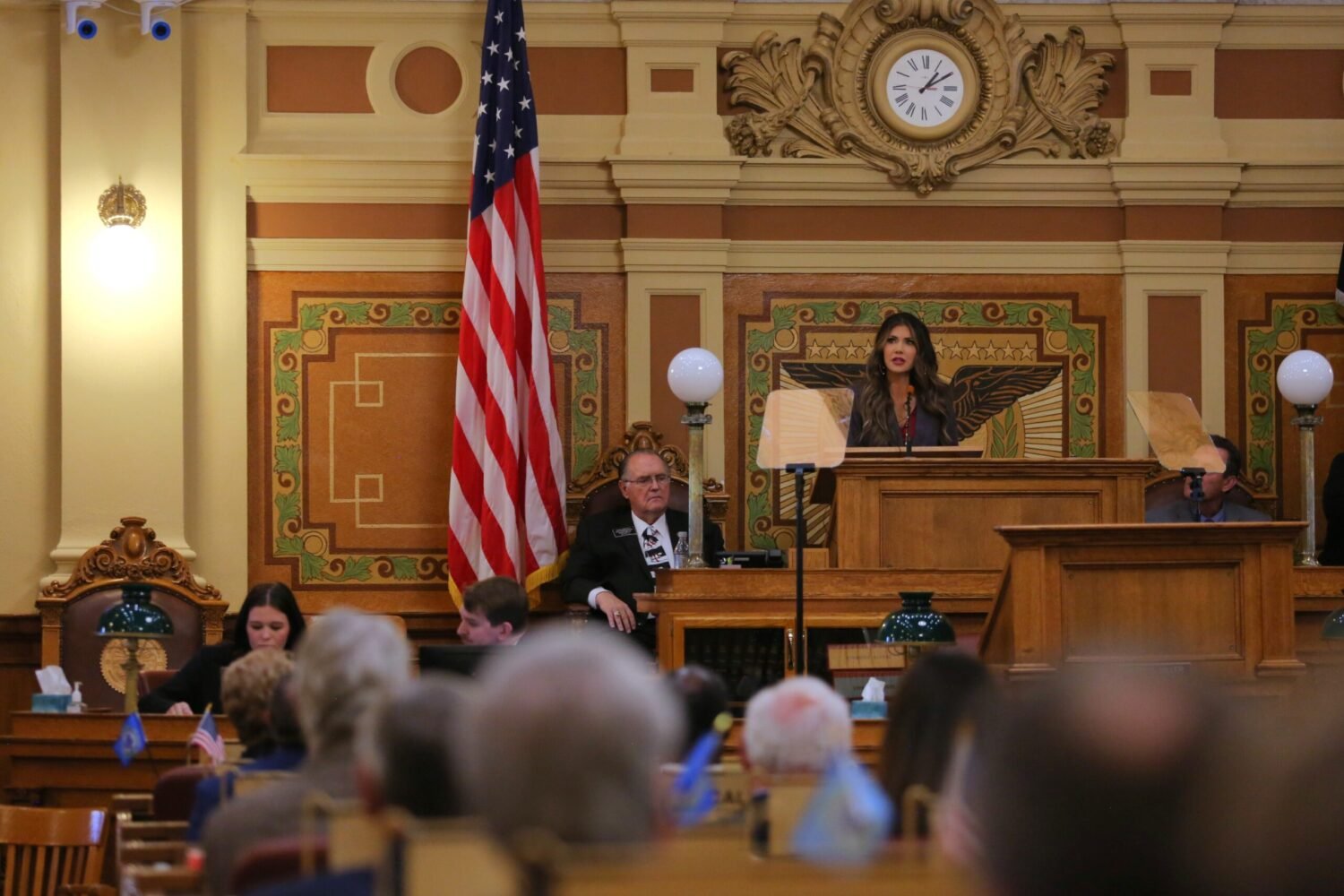
Opponents of a Nov. 5 ballot measure that would reduce state sales tax collections worry it could be the final straw that breaks South Dakota’s AAA bond rating — a criticism that the measure’s proponents dispute.
The measure is intended to repeal state sales taxes on groceries, but opponents say its imprecise language could broaden the impact to other goods and services. That uncertainty led the state’s Legislative Research Council to make a broad estimate of potential state government revenue losses from the measure, ranging from $134 million to $646 million annually.
That would exacerbate the budget impact of a temporary, across-the-board state sales tax reduction from 4.5% to 4.2% that legislators approved in 2023, with a sunset scheduled for 2027. The cost of that decision has been estimated to be more than $100 million annually while it’s in effect. The state’s total budget is about $7 billion.
Matt Michels, a Republican, helped the state achieve its AAA bond rating while he was Gov. Dennis Daugaard’s lieutenant governor from 2011 to 2019. Michels said the budget hole that would be created by the ballot measure and the resulting legislative battle to address it could result in a bond rating reduction.
“Money runs from instability,” Michels said.
Impact of grocery tax ballot measure could range from $134M to $646M, legislators told
On the other side of the debate, Augustana University economics professor and Sioux Falls Democratic state Sen. Reynold Nesiba supports the ballot measure and is not worried about its potential impact on the bond rating.
“Democrats care about fiscal responsibility, but we also care about the obligations the state has to South Dakota families,” he said. “It’s simply wrong to make people pay a tax before eating.”
Nesiba said if the measure passes, the Legislature should honor the measure’s limited intent to repeal state sales taxes on groceries. He said raising general state sales taxes back to 4.5% would leave little for credit rating agencies to be concerned about.
An independent expert, Donald Boyd, co-director of the State and Local Government Finance Project at the Center for Policy Research at the University at Albany in New York, said in an emailed statement that passing a tax cut with no plan to pay for it could affect ratings agencies’ views of the state.
“All else equal, that would be a negative in the eyes of the rating agencies,” Boyd said. “Whether it’s enough of a negative to affect the bond rating is a different question.”
Bond ratings explained
One of the ways governments finance public projects is by selling bonds to investors, and then paying the money back with interest over time.
Agencies such as S&P Global rate bond issuers for their creditworthiness, with the highest rating of AAA going to those with the strongest ability to repay. Governments with better ratings can get lower interest rates on their bonds, resulting in lower debt payments.
South Dakota’s ascent from AA+ to AAA happened under Republican Gov. Dennis Daugaard in 2015 and 2016, when all three major rating agencies made the change. The agencies attributed the upgrade to the state’s healthy savings, conservative fiscal approach, long-term financial planning, and fully funded state employee retirement fund.
“We knew by achieving that, we would save taxpayers a lot of money,” Daugaard said.
The ratings also benefit governmental subdivisions of the state, such as school districts. South Dakota school districts have saved over $33 million in interest on new construction, land purchases, and debt refinancing since the rating upgrade, according to South Dakota Department of Education spokesperson Nancy Van Der Weide.
Seventeen states have a AAA rating. The ratings are apolitical; South Dakota’s neighbor, Minnesota, which leans Democratic, has a AAA rating credited to a large and diverse economy and healthy savings and revenues. Nebraska and Iowa are the other South Dakota neighbors with AAA ratings.
Complicating factors
Rep. Tony Venhuizen, R-Sioux Falls, is Daugaard’s son-in-law and served him as chief of staff. He’s worried about the sales tax ballot measure’s impact on the state’s credit rating.
“Cutting out one of our most reliable sources of revenue in a public vote, with no plan to pay for the loss in revenue, does not look great to these credit agencies,” he said.
Nathan Sanderson, executive director of the South Dakota Retailers Association, is part of a coalition opposing the ballot measure and served as Daugaard’s director of policy and operations when the higher bond rating was achieved.
He said his former boss was able to overcome ratings agencies’ skepticism about South Dakota’s reliance on a single revenue source, the sales tax, for most of its income.
“What Daugaard did is show, yes, we only have a sales tax, but we’re really, really fiscally responsible,” Sanderson said. “Someone with limited income can get a large, low-interest-rate loan if they live within their means, build up a solid savings, and pay their bills on time.”
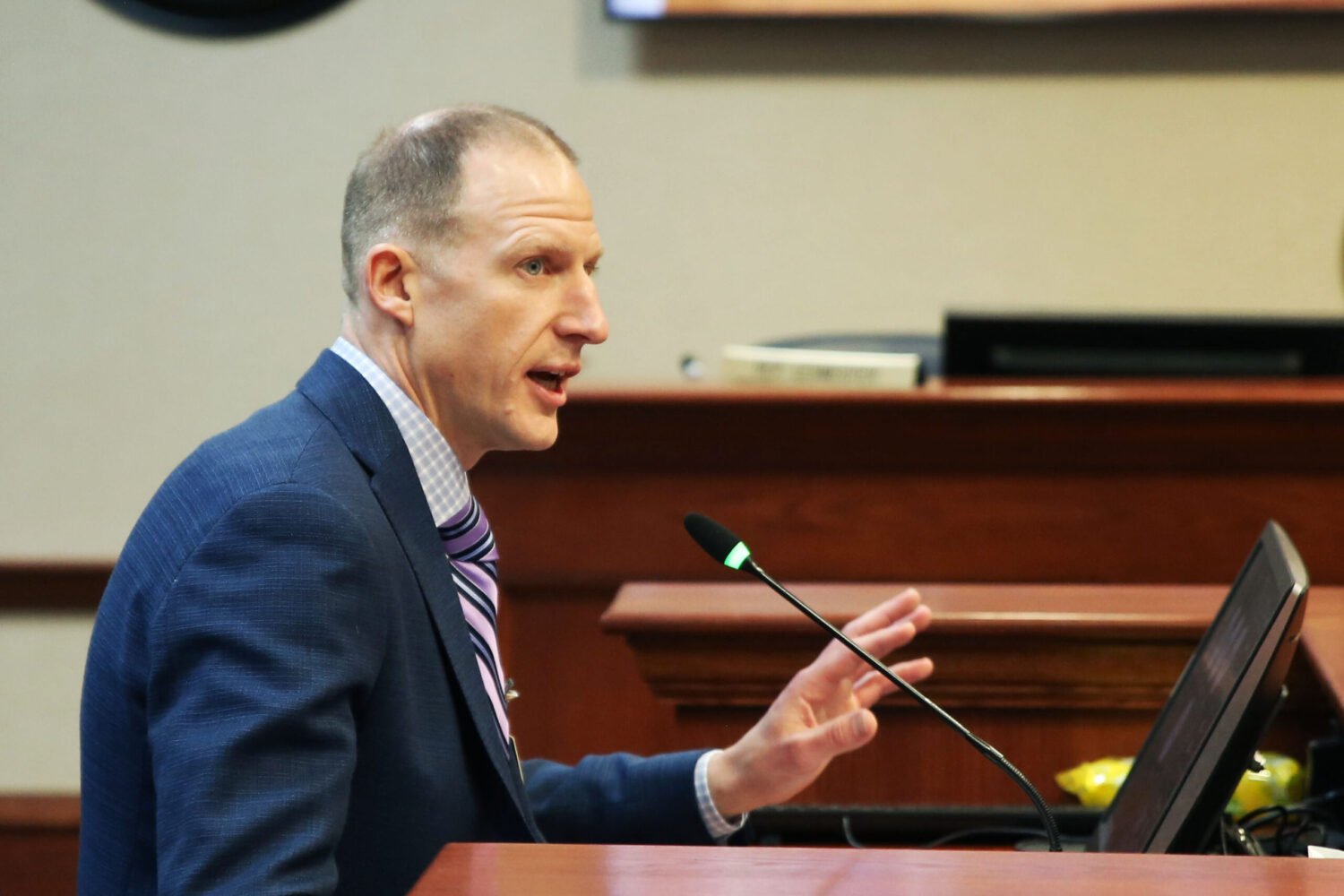
Sanderson worries that eliminating another large, reliable chunk of sales taxes could change ratings agencies’ views.
If the ballot measure passes, lawmakers could seek to limit its impact by amending the measure to ensure it only addresses state sales taxes on groceries. They could also seek to end the existing across-the-board sales tax reduction early, before its scheduled expiration date in 2027.
But that would be considered a vote to raise or impose a new tax, which requires a two-thirds majority of the Legislature, according to Michels.
“I think it would be pretty difficult to get the two-thirds,” he said.
If the ballot measure passes and lawmakers don’t immediately raise state sales taxes back to 4.5%, Michels said they would likely have to cut the budget or dip into the state’s reserve funds to meet the state constitutional requirement that they balance the annual budget.
Sanderson said the need for budget cuts or reserve spending would strain the state budget while it’s being weaned from several years of federal COVID-19 pandemic funding. The state’s most recently adopted budget was $7.3 billion. Of that, $3.2 billion was federal funding. Comparatively, he said, the state budget was $4.3 billion in 2019 and $1.4 billion was federal funding.
“This is happening as we’re already anticipating a decline in the budget,” Sanderson said.
In 2023, lawmakers decided to pass the temporary sales tax reduction instead of Gov. Kristi Noem’s proposal to reduce the state sales tax on groceries to zero percent. While lobbying for her proposal, Noem warned lawmakers that voters would pass a ballot measure repealing the state sales tax on groceries if the Legislature didn’t act.
Her office did not grant an interview but sent South Dakota Searchlight a statement.
“Governor Noem and her team are preparing for all potential scenarios depending on what the people of South Dakota decide at the ballot box,” her spokesperson Ian Fury wrote. “South Dakota will have a balanced budget next year, as we have for 135 years.”
Noem cabinet member and Bureau of Finance and Management Commissioner Jim Terwilliger said in an emailed statement that the state’s low debt levels, strong reserve funds, fully funded pension fund, strong economy, and long history of prudent budget management will not go away if the ballot measure passes.
“Those are all positive aspects of how we are rated as a state, and I do not expect those to change because of an initiated measure,” he said.
‘Do the right thing’
Nesiba alleged that Republicans including Michels, Venhuizen and Sanderson are essentially arguing that the Republican-dominated Legislature cannot be trusted to manage the budget if voters decide to repeal the state sales tax on groceries.
“They are arguing South Dakotans will choose to repeal the sales tax on groceries, and Republicans will then act irresponsibly, and that’s somehow the voters’ fault,” Nesiba said. “It would be a Republican leadership failure. The Legislature works for the people, so they need to make it work. If voters can’t trust Republican leadership, then we need new leadership.”
Nesiba said credit agencies would only downgrade South Dakota’s bond rating if they lose confidence in the Legislature’s ability to navigate the issue in a fiscally responsible manner.
“I trust that the Legislature will do the right thing,” he said.
Among the 45 states that collect a statewide sales tax, South Dakota is currently 36th in combined state and local rates, making it one of the lowest, according to the nonprofit and nonpartisan Tax Foundation.
GET THE MORNING HEADLINES DELIVERED TO YOUR INBOX