
Unlock the Editor’s Digest for free
Roula Khalaf, Editor of the FT, selects her favourite stories in this weekly newsletter.
Bonds and equity markets tumbled on Thursday as investors warned that the region faced a “protracted energy shock” following attacks on energy infrastructure in Qatar and Iran.
Government bonds on both sides of the Atlantic were hit as traders bet that central banks would have to respond to the inflationary surge triggered by war in the Middle East by lifting borrowing costs, while European stocks and precious metals slumped.
The Stoxx Europe 600 dropped 2.4 per cent on Thursday in a broad-based slide, with every sector except energy declining. The FTSE 100 also fell 2.4 per cent. Wall Street’s S&P 500 fell 0.7 per cent, extending the previous day’s sell-off.
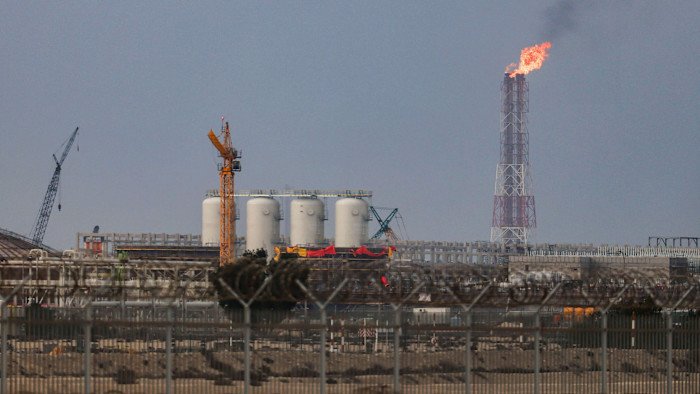
The declines came after Iran struck Qatar’s Ras Laffan gas complex, which in normal times provides a fifth of the world’s liquefied natural gas, causing a further surge in energy prices.
“Markets are starting to price in a protracted energy shock,” said Roger Hallam, global head of rates at Vanguard. “This is starting to feed through to longer-term inflation expectations. That will make central banks very uncomfortable.”
The moves accelerated after the Bank of England said it “stands ready to act” on inflation amid the war’s impact on energy prices, echoing Wednesday’s comments from US Federal Reserve chair Jay Powell that “higher energy prices will push up overall inflation” and that the possibility of an interest rate rise had “come up” in the Fed’s discussions. Both central banks held interest rates this week, as was expected.
Two-year US Treasury yields, which reflect Fed interest rate expectations, jumped 0.12 percentage points to 3.87 per cent.
Investors have reined in their bets on Fed interest rate cuts this week. A quarter-point cut by December was fully priced on Tuesday, but futures markets now suggest rates are on hold for the rest of the year.
UK government bonds were hit the hardest by the debt sell-off, with the yield on 10-year gilts rising 0.11 percentage points to 4.85 per cent, the highest level since the conflict started.

The sell-off has pushed UK borrowing costs close to their highest level since 2008.
David Rees, head of global economics at Schroders, said: “The current levels of oil and gas prices are already enough to add around 1 per cent to headline inflation in the coming months, while shortages of fertilisers could push food inflation higher later in the year.”
With the conflict escalating, there was now a “clear risk” of inflation above the BoE’s 2 per cent target “for the foreseeable future”, Rees added.
German two-year yields rose 0.12 percentage points to 2.57 per cent. The European Central Bank also held interest rates unchanged on Thursday.
European economies are heavily reliant on oil and gas from the Middle East, making the region’s markets especially vulnerable to a disruption in supply.

Europe’s gas benchmark, TTF, rose as much as 35 per cent to hit €74 per MWh on Thursday, its highest level since the conflict began, before partially recovering to €60.80 per MWh. The international oil benchmark Brent crude briefly rose as high as $119 a barrel before falling back towards $110.
“We are moving into the dreaded stagflation territory,” said Altaf Kassam, head of investment strategy for Europe at State Street Investment Management. “Stagflation is bad for all assets.
“Investors are starting to treat this as something longer lasting.”
The declines on Wall Street were more muted, with the US’s status as a net energy exporter helping Wall Street stocks to outperform European peers.
“The US still feels the pinch of higher costs, higher prices, but . . . its physical infrastructure is just not as reliant [as Europe] on the Middle East or on imports full stop,” said Peter Schaffrik, global macro strategist at RBC Capital Markets.
The sell-off also hit gold and other commodities, with bullion plunging almost 5 per cent to $4,585 a troy ounce. The metal, sometimes viewed as a safe haven in times of turbulence, has dropped more than 8 per cent since Monday, putting it on track for its worst week since the Covid sell-off.
The Middle East, which is among the world’s biggest hubs for gold trading, has seen buying activity plummet owing to the war, and bullion in Dubai is trading at a steep discount to the London benchmark as sellers dominate in the market.
Nicky Shiels, analyst at MKS Pamp, said that sovereign selling of gold by central banks or other institutions seeking to shore up their cash positions was one reason behind the drop in prices. “In times of war, it is about cash — dollars and guns are king, not gold,” she said. Some energy-stressed countries may consider selling gold reserves to safeguard against a looming energy crisis, she added.
Other metals also plunged on Thursday, with aluminium dropping more than 8 per cent and silver briefly falling 13 per cent before both clawed back part of their losses.