
Key Points
-
Three straight years of double-digit returns for the S&P 500 have many investors thinking about using leverage to capitalize on these returns.
-
The ETF industry has launched hundreds of new leveraged products to satisfy investor demand.
-
There are a number of situations where leveraged ETFs can lose money even if you happen to get the direction of the trade correct.
Leveraged ETFs are viewed by some people as a way to magnify your gains quickly. They can do that if you play your cards right. They can also do the opposite (and quickly).
These products have grown in leaps and bounds over the past couple of years. ETFs and mutual funds providing 2x and 3x leverage by issuers, such as ProShares and Direxion, have been around for decades. More recently, funds offering leverage on single stocks have exploded both in number and assets under management (AUM).
Will AI create the world’s first trillionaire? Our team just released a report on the one little-known company, called an “Indispensable Monopoly” providing the critical technology Nvidia and Intel both need. Continue »
That’s what three straight years of double-digit gains for the S&P 500 (SNPINDEX: ^GSPC) will do. If investors are already in a bullish mood, perhaps they’ll be tempted by the opportunity to enhance their returns even further.
But leveraged ETFs are aggressive in a best-case scenario and downright dangerous in the worst. Use them as intended, and you have an opportunity to enhance your returns. Use them improperly or fail to understand them first, and you could wipe out a good chunk of your capital.
Road sign with volatility ahead.
Image source: Getty Images.
Understanding how leveraged ETFs work
When investing in a leveraged ETF, in many cases you’re not investing in the underlying security. Instead, you’re investing in derivatives (most likely swap or futures contracts) designed to deliver a multiple of the security’s return on a daily basis.
Since their goal is to replicate a single day’s performance, the swap agreements and fund exposures need to be reset on a daily basis. That kind of frequent activity becomes costly, and it’s not unusual for leveraged ETFs to come with expense ratios of 1% or higher.
It’s this daily rebalancing and its impact on compounding that can create the most damage for shareholders. It can create what’s known as volatility decay, which is the idea that gains and losses compound asymmetrically. The wider the swings in a security’s price, the more that volatility decay can negatively impact returns.
This creates scenarios where you can lose money in a leveraged ETF even if you get the direction of the trade correct.
Volatility can create losses no matter what
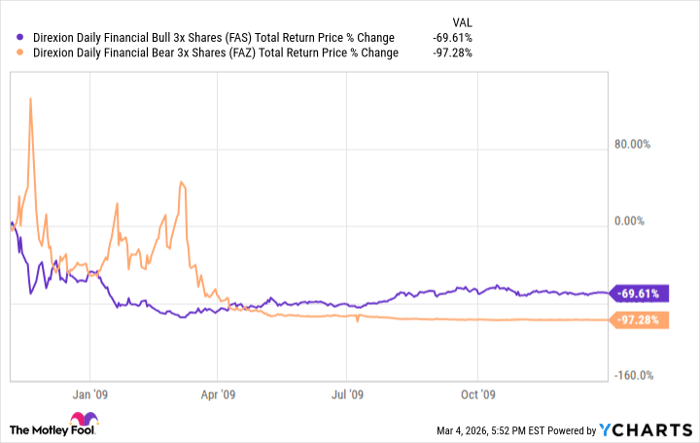
The best example of this occurred during the financial crisis. The Direxion Daily Financial Bull 3x Shares ETF (NYSEMKT: FAS) and the Direxion Daily Financial Bear 3x Shares ETF (NYSEMKT: FAZ) initially produced the returns that you might expect. As time wore on, however, the volatility of the stock market and this sector in particular took its toll. Within just a few months, both funds were sitting on massive losses.
FAS Total Return Price Chart
FAS Total Return Price data by YCharts
If the underlying security for a leveraged ETF experiences little volatility or can enjoy a slow, steady uptrend, the odds are better that the fund can enhance returns over a longer period of time. If volatility is high like it was during the financial crisis, it becomes very difficult to avoid losses over time.
In summary, if you have a high-conviction opinion on a short-term event or report, leveraged ETFs can be a way to capitalize on that if used properly. But if you hold the position for too long, get caught in volatile trades, or are just plain wrong with your idea, losses with leveraged ETFs can mount quickly.
Leverage can be useful, but be mindful of the dangers
For better or worse, the ETF industry reflects investor interest and demand. The fact that so many issuers have launched new leveraged products over the last year indicates that a lot of people want to amplify their investments.
Unfortunately, that often comes with a lack of education. Many investors don’t question things when prices go up. But they learn the hard way when prices fall.
In general, leveraged ETFs aren’t suitable for most buy-and-hold investors. A strategy built around diversification and low fees with the goal of long-term wealth creation is usually the best way to go.
Should you buy stock in S&P 500 Index right now?
Before you buy stock in S&P 500 Index, consider this:
The Motley Fool Stock Advisor analyst team just identified what they believe are the 10 best stocks for investors to buy now… and S&P 500 Index wasn’t one of them. The 10 stocks that made the cut could produce monster returns in the coming years.
Consider when Netflix made this list on December 17, 2004… if you invested $1,000 at the time of our recommendation, you’d have $522,791!* Or when Nvidia made this list on April 15, 2005… if you invested $1,000 at the time of our recommendation, you’d have $1,132,678!*
Now, it’s worth noting Stock Advisor’s total average return is 952% — a market-crushing outperformance compared to 191% for the S&P 500. Don’t miss the latest top 10 list, available with Stock Advisor, and join an investing community built by individual investors for individual investors.
*Stock Advisor returns as of March 11, 2026.
David Dierking has no position in any of the stocks mentioned. The Motley Fool has no position in any of the stocks mentioned. The Motley Fool has a disclosure policy.