

Our coverage of climate funds continues expanding. As of June of this year, we had identified more than 1,700 climate-focused funds, representing a wide and growing range of strategies that aim to meet varying investor preferences, from reducing climate-related risks in portfolios to investing in climate solutions. Global assets in climate-focused funds also continued to climb, surpassing $640 billion at the end of June, an increase of 8.5% over the year to date. All this is happening despite a backlash against environmental, social, and governance investing in the United States, as well as climate policy reversals.
Demand for climate funds is driven by the growing recognition that certain investments may be disadvantaged amid the transition to a low-carbon economy due to evolving regulations, technological advancements, and shifting consumer preferences. If mitigation efforts fail to accelerate, rising global temperatures and more frequent extreme weather events are expected to heighten physical risks to portfolios. At the same time, investors are actively seeking to capture opportunities by investing in companies that offer innovative solutions to mitigate or adapt to climate change, such as clean energy, electric vehicles, carbon capture and storage, and flood defenses.
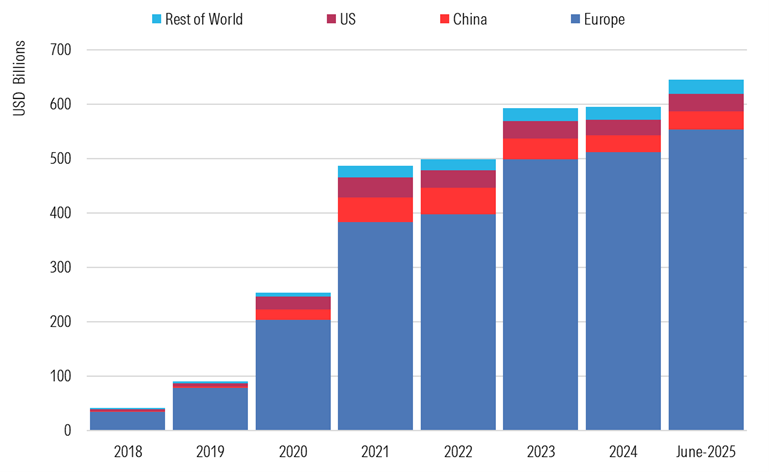
Asset growth in the first half of the year was recorded across all regions, which benefited from favorable stock market conditions. Europe remains by far the largest climate fund market, holding an 86% share and supported by its commitment to achieve net zero emissions by 2050. China and the US trail far behind, each holding around 5% of total assets. The rest of the world accounts for 4%, with South Korea, Canada, and Australia among the top markets.
Climate Funds Focused on the Transition Stand Out
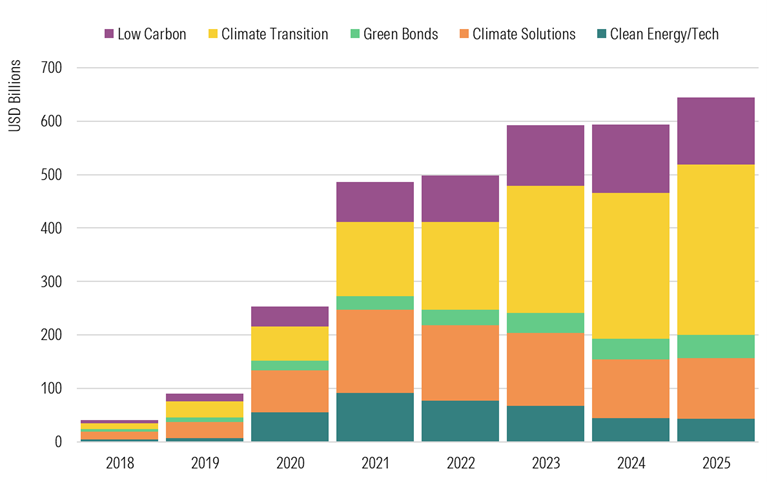
Funds targeting companies further along in their transition journey—specifically climate transition funds and green bond funds—stood out with continued growth in the first half of the year. Climate transition funds rose by 16%, reaching a global total of $318 billion. Green bond funds grew by 14%, with assets climbing to $44 billion. They now match the size of clean energy/tech funds, whose assets declined by 1.8% following years of underperformance.
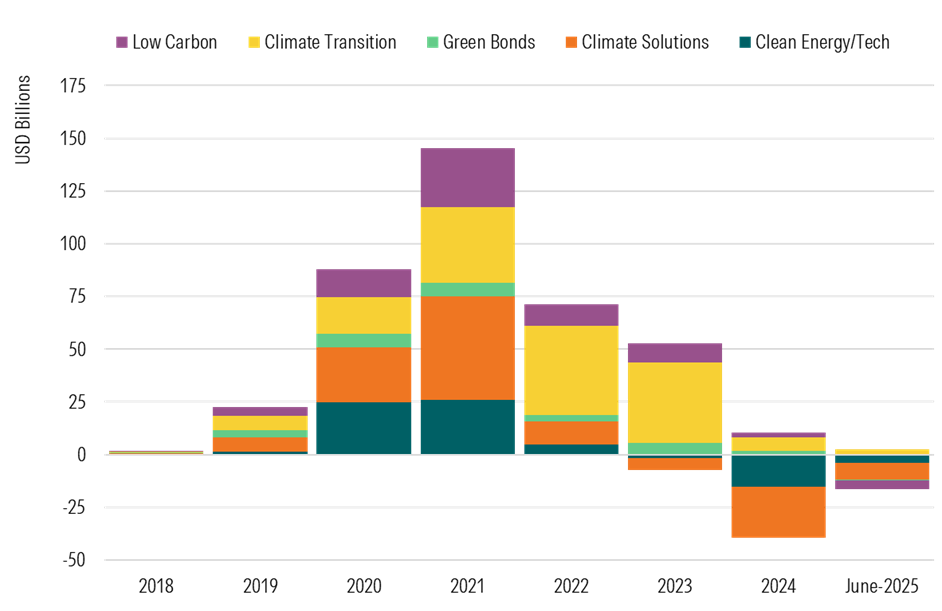
Investors poured $2.5 billion into climate transition funds in the first half of the year, even as the broader climate fund universe bled $13.8 billion. This reflects a growing intent among investors to not only decarbonize their portfolios, but also contribute to real-world emission reductions by supporting companies actively navigating the shift to a low-carbon economy. Increasingly, traditional core holdings are being replaced with strategies designed to remain resilient in a world in transition. This shift is consistent with investors’ net zero commitments.
Within transition funds, investors favored active strategies, which attracted almost $2 billion in new investments globally. Meanwhile, passive funds tracking Paris-aligned benchmarks saw $1.7 billion in outflows.
Clean Energy/Tech Funds Recover
Looking at $3.9 billion redemptions from clean energy/tech strategies over the past six months, it seems investors have missed a rebound in renewable energy companies, which are key transition enablers, after four years of underperformance.
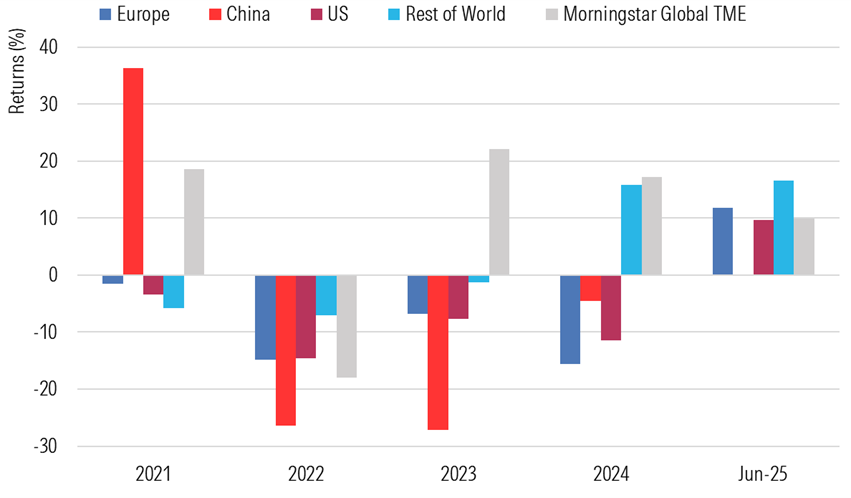
This rebound has been driven by rising energy demand, particularly from data centers powering artificial intelligence, and lower interest rates. It’s come despite new headwinds, including a stance against climate policy in the US and broader economic uncertainty.
European-based clean energy/tech funds achieved an average return of 11.8%, outperforming the Morningstar Global TME Index’s 9.9% gain. US-based clean energy/tech funds registered average returns of 9.6%, compared with 6.4% for the Morningstar US TME Index.
To download the full report, click here.
This is an update to an article last published on Nov. 22, 2024.
Correction: The article was updated to correct the amount of Climate Transition net redemptions to $530 million and Low Carbon to $260 million. The title for the final exhibit was corrected to indicate that it displays the flows into, not assets in, the Climate Transition funds subcategories.