Maybe Trump and Republicans are done being mad at index funds
Dec 10 – The opinions expressed here are those of the author, a correspondent for Reuters. This column is part of the Reuters Sustainable Finance Newsletter, which you can sign up for here:Reuters Sustainable Finance Newsletter
Financial executives and corporate leaders may learn soon if U.S. President Donald Trump will continue a Republican crusade against giant index funds.
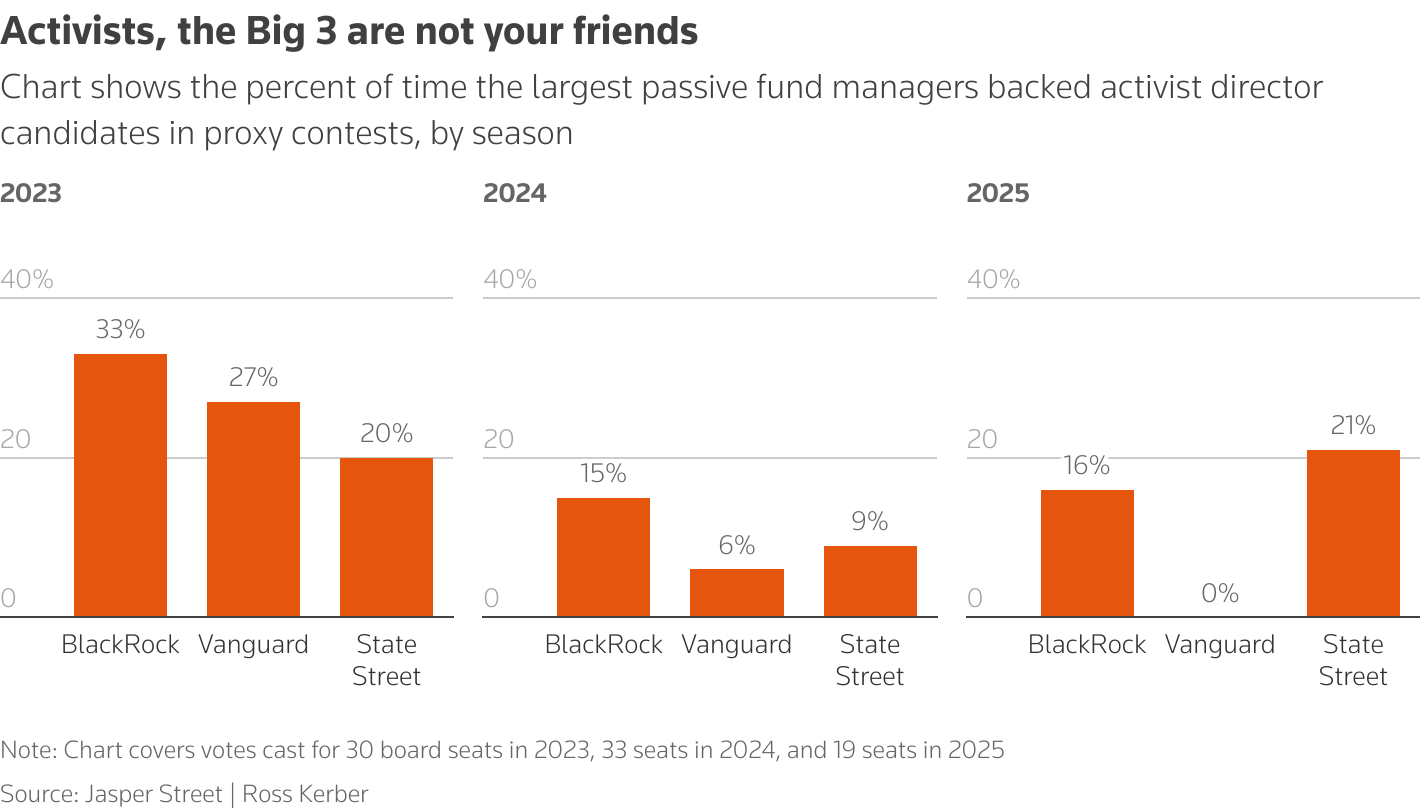
But the fund firms’ votes have shifted to become more pro-management since 2022. A question now is whether the old Republican gripes about index funds still apply.
Asked about a possible order, a White House official, speaking on condition of anonymity, said on Tuesday that “Until officially announced by the WH, discussion about potential executive orders is purely speculation.”
The situation has left corporate governance specialists to read tea leaves.
“Despite the rumors, most people are assigning low odds that something really drastic happens with an EO (executive order) as far as index fund voting,” said Jessica Wirth Strine, a managing partner at shareholder advisory firm Jasper Street.
She and others say diminishing index funds’ clout would empower environmental, social and traditional shareholder activists. “We all recognize that would be an odd thing to do – to strip the biggest and most corporate-friendly investors of their governance rights,” she said.
Top index fund managers backed fewer activist director candidates in recent years
THE NEW KINGMAKERS
Using low fees to attract a combined $31 trillion under management, the Big Three have emerged as kingmakers at annual shareholder meetings. They are among the top investors at most S&P 500 companies and influence questions like which directors to elect or how a company reports its carbon emissions.
Starting around 2020 big funds supported more environmental and socially focused shareholder resolutions, spurred on by the Black Lives Matter movement and efforts to mitigate climate change. Republican Senators led by Dan Sullivan of Alaska, who said the Big Three were diminishing energy investments including in indigenous communities in his state, responded by introducing the INDEX Act, opens new tab to have funds pass through voting preferences to their own investor clients.
The bill did not pass but has been reintroduced. On Tuesday Sullivan wrote on Facebook that “I commend the Trump administration for once again looking at policies, like the INDEX Act I’ve previously introduced, to fix this massive market distortion.”
As attacks mounted from skeptics of environmental and social causes, critical votes from the Big Three fell sharply from 2022 through this year, dooming many resolutions. Vanguard, for instance, supported no such resolutions this year and BlackRock backed just 2%, according to their reports.
The fund firms say they responded based on merits of new proposals after many companies made changes. They also have introduced “pass-through” vote programs as Sullivan seeks, although these remain limited for technical reasons.
BOARDROOM ALLIES
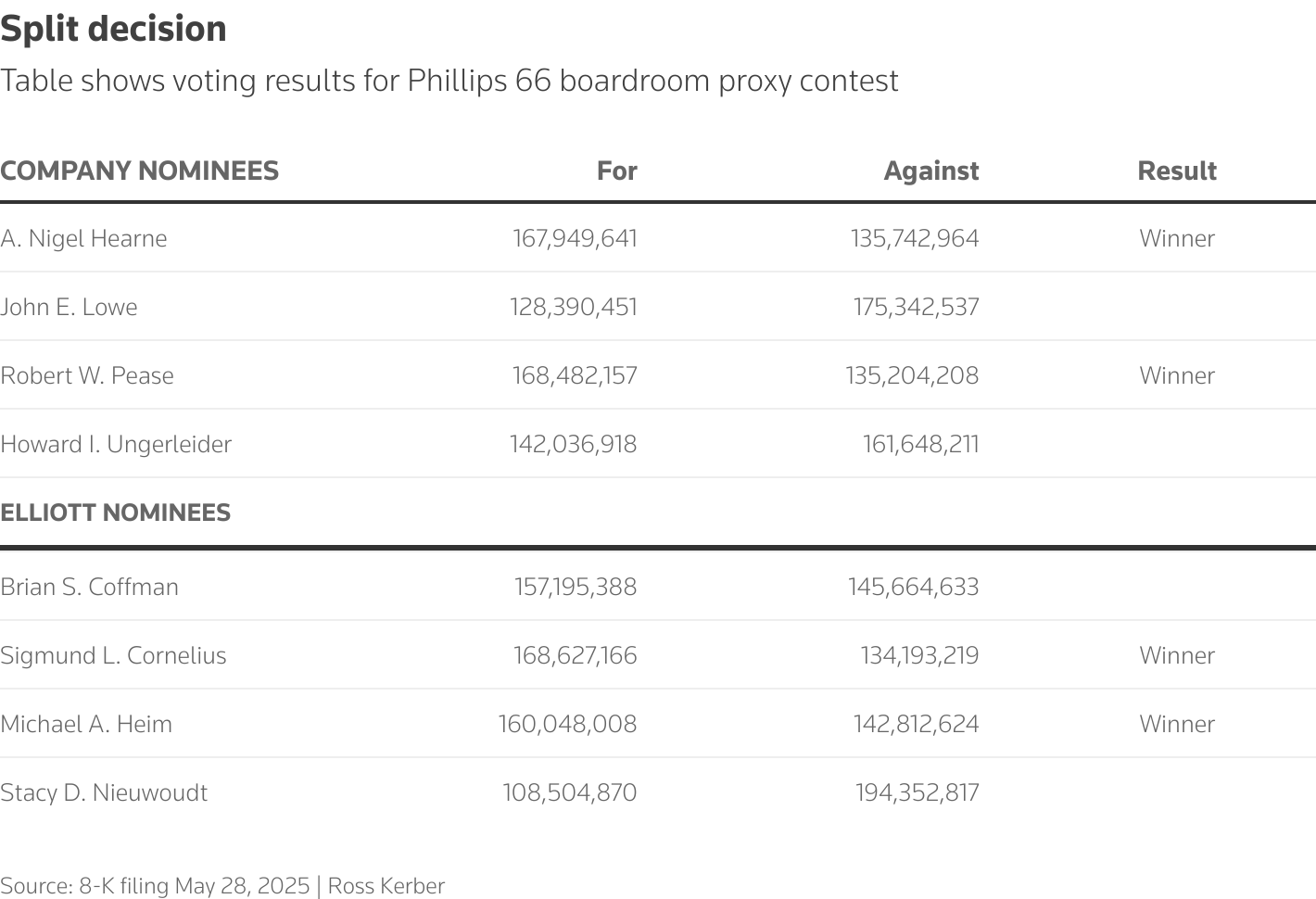
The Big Three also have emerged as friends of CEOs facing activist funds looking to replace directors in high-profile proxy contests. Consider one of the biggest boardroom battles this year, at Phillips 66 (PSX.N), opens new tab in May. The company and activist Elliott Investment Management each won two seats after a bitter campaign in which Elliott pushed for asset sales and management stood by its strategy.
The Big Three controlled about a third of all votes cast, and disclosures show they each backed all four Phillips 66 candidates. Absent the Big Three’s votes, the activist candidates would have all won.
Vote tallies show four contested board seats were split between two winners nominated by Phillips 66 and two winners nominated by activist Elliott Investment Management
Despite their recent pro-management stances, Copland said he still hopes for new restrictions on index fund voting. “Nothing stops them from reverting their voting again once the political winds shift,” he said.
State Street declined to comment. A Vanguard spokesman referred to a letter the firm sent banking regulators, opens new tab last year in which the Pennsylvania fund firm advocated for a single standard for “passivity” for index funds and said it plans to continue to expand its Investor Choice voting program.
A BlackRock spokesman declined to comment beyond remarks that CEO Larry Fink made at a New York Times DealBook conference last week, opens new tab, where he said limiting his funds’ voting would only empower other investors. “I can tell you almost every CEO who approaches BlackRock with this is frightened of that outcome,” Fink said.
Reporting by Ross Kerber; Editing by David Gregorio
Opinions expressed are those of the author. They do not reflect the views of Reuters News, which, under the Trust Principles, is committed to integrity, independence, and freedom from bias.
Ross Kerber is U.S. Sustainable Business Correspondent for Reuters News, a beat he created to cover investors’ growing concern for environmental, social and governance (ESG) issues, and the response from executives and policymakers. Ross joined Reuters in 2009 after a decade at The Boston Globe and has written on topics including proxy voting by the largest asset managers, the corporate response to social movements like Black Lives Matter, and the backlash to ESG efforts by conservatives. He writes the weekly Reuters Sustainable Finance Newsletter.