
A June report from Research for Action, a Philadelphia-based education research organization, shows that Pennsylvania’s cyber charter schools are banking taxpayer dollars at a far higher rate than public schools are.
Reforming the cyber charter funding system has been a topic for discussion in Pennsylvania for years. Previous Governor Tom Wolf pushed for it unsuccessfully, and current Governor Josh Shapiro proposed reforms at the beginning of 2025. Over 90% of Pennsylvania’s 500 school boards, from all across the political spectrum, have passed resolutions calling for reforms to funding rules that have not been substantively changed in over twenty years.
A report released in January 2022 by Children First found that of the 27 states with cyber charters, none fund them exactly as Pennsylvania does. In Ohio, for example, cyber schools are funded directly by the state, rather than by the local school districts, and use a single statewide rate for per pupil payments. While other states use a variety of formulas and oversight methods, Pennsylvania simply and generously funds cyber charters as if they were bricks and mortar charter schools. Pennsylvania spends the most but has the “weakest systems to ensure students and taxpayers are getting their money’s worth.” And taxpayers are not; reports repeatedly find that the cyber charters are underperforming.
Even the National Alliance for Public Charter Schools has called for cyber charter reform. Nationally, cyber charters have a low graduation rate; one report by the Education Week Research Center found that 73% of cyber charters have a graduation rate below 50%. A report from the National Alliance of Charter Schools shows that students stay in cyber-charters for an average of only two years.
Earlier this year, the Pennsylvania Department of the Auditor General led by Republican Timothy DeFoor released an audit of five of Pennsylvania’s cyber charter schools that was highly critical of the system. The House held a series of hearings focusing on cyber charter funding and passed a reform bill that has languished in the GOP-controlled Senate.
Pennsylvania charters compute the taxpayer-funded tuition based on the per-pupil costs in the sending district, with separate rates for students with and without special needs. That means that there are 1000 different tuition rates for students to attend exactly the same cyber charter; the bill proposes two single flat rates for the two types of students, regardless of their home district.
“That flat rate would put them out of business,” one Senator told me, and that has been the position of the cyber charter operators, who have refused to participate directly in this particular discussion. At one hearing, State Representative Peter Schweyer repeatedly expressed frustration that cyber charters have repeatedly declined invitations to appear before the education committee.
Commenting via email, Timothy Eller, Chef Branding and Government Relations Officer for Commonwealth Charter Academy (the state’s largest cyber charter), rejected the premise that 1000 different tuition rates are problematic, arguing that the wide range of tuition costs “simply reflects the wide disparity in education spending across the Commonwealth.” It does, but that does not address the question of why it makes sense for thousands of students to draw a different tuition cost for the same school.
Eller also asserts that the proposed $8,000 flat rate “would force the closure of most cyber charter schools.” I asked what number CCA viewed as appropriate for a flat rate; Eller did not answer that question.
The idea that cyber charters are operating close to the financial edge is challenged by the RFA report findings.
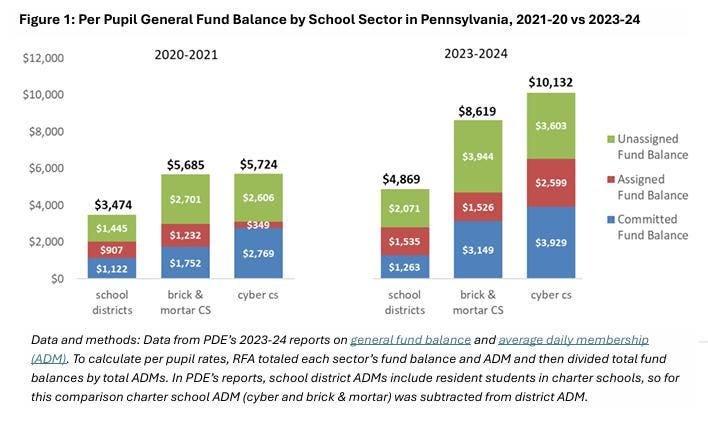
To make an apples-to-apples comparison, RFA broke down the banked funds on a per pupil basis. Looking at Pennsylvania Department of Education data, RFA found that cyber charters are hanging onto far more dollars per pupil than public schools.
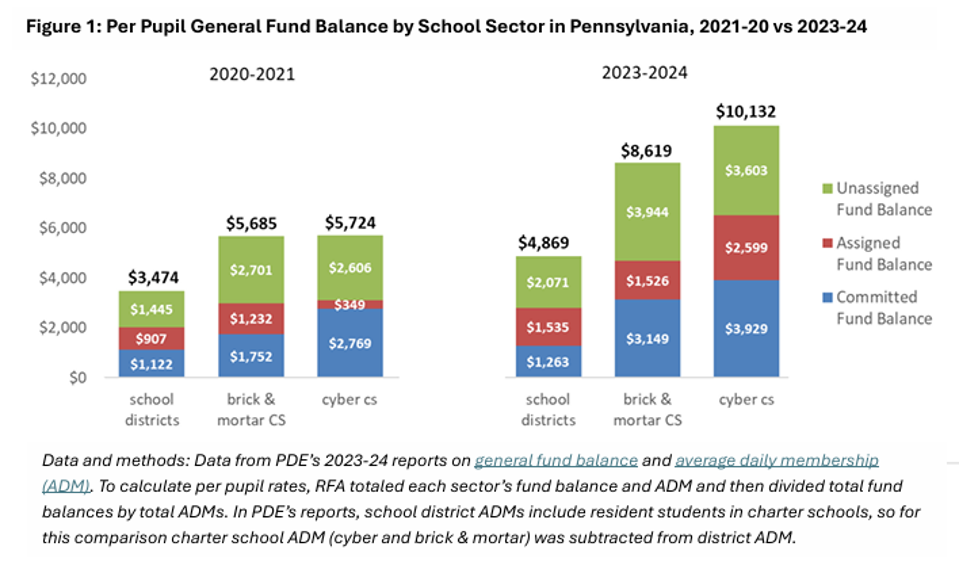
Per pupil general fund balance by school sector in Pennsylvania
Research for Action
The report follows three distinct types of fund balances: committed fund balance, assigned fund balance, and unassigned fund balance. In the 2023-24 year, school districts had on average $1,263 in committed funds, $1,535 in assigned funds, and $2,071 in unassigned funds, for a total of $4,869. Cyber charters in that same year banks an average of $3,929 in committed funds, $2,599 funds, and $3,603 in unassigned funds, for a total of $10,132.
Of the thirteen cyber charters operating in Pennsylvania, only one had a total fund balance lower than the average fund balance for school districts. That single cyber charter was Commonwealth Charter Academy, which has spent millions and millions of taxpayer dollars buying and building real estate across the commonwealth. As the auditor general reported, CCA moved $354.3 million into its Capital Projects Fund, “of which $196 million was spent to purchase and/or renovate 21 buildings.” As Schweyer pointed out at one hearing, the state had set aside $100 million for school construction in the entire state.
The questions behind calls for cyber charter funding reform remain the same. If operating margins are so narrow for cyber charters, why do they have so much money left over to put in the bank (as well as spending on other areas like marketing)? And given that all of that money comes from the taxpayers, should cyber charters be allowed to continue to collect such large amounts?
Eller says, “What truly needs to happen is for the governor, lawmakers, and school district advocates to listen to families about why they are choosing cyber charters over their local schools,” and while that may well be a good conversation to have, it does not address the question of how much Pennsylvania taxpayers should be paying to support that choice.