

Diversification is key to successful investing. By holding a variety of financial assets – and ensuring any exposure to equities is through a mix of investment funds and shares – you strike a balance between risk and reward.
Increasingly, one of the best ways to get added diversity into your investment portfolio is to use a particular type of passive fund known in financial circles as ‘smart beta’ or ‘factor’ funds.
Don’t be put off by their baffling titles (stay with me, dear reader). If employed wisely, these new-wave funds could seriously improve your long-term wealth while helping to protect it when markets are in retreat.
In simple terms, they don’t track a stock market index as most long-standing passive funds do – for example, the FTSE 100 in the UK or the S&P 500 in the United States.
Instead, they use the stocks that make up these indices to build portfolios based on a clearly defined and rigid investment process that they never veer from.
The result may be a fund where all the companies in a particular index are held, but equally – as opposed to by market size, which is the way with a traditional passive fund. In other words, the risk is spread.
Or it could be a fund built around US companies drawn from the S&P 500 which have grown their dividends year in, year out for many years. Appealing to income seekers.
As far as investors are concerned, these funds provide clarity in terms of the investment process that underpins them. They’re also cheap as chips in terms of annual management charges, a result of the fact they are essentially run by computers as opposed to by expensive human fund managers.

Traditional passive funds – often referred to as index trackers – are great building blocks for investors’ portfolios
But most importantly, in a world where the prices of financial assets are increasingly volatile, and where stock markets, particularly in the US, are becoming heavily dependent on a small pool of mega stocks, these funds can help mitigate (not eradicate) investment risk.
They have their fans among the experts. Kate Marshall, lead investment analyst at investing platform Hargreaves Lansdown, is one of them.
Although Marshall believes traditional passive funds – often referred to as index trackers – are great building blocks for investors’ portfolios, she says the more nuanced versions are a super way to ‘address market concentration’.
She explains: ‘Equity markets, particularly in the United States, have become increasingly narrow with returns driven by a small group of technology stocks centred around the “magnificent seven” companies – Alphabet, Amazon, Apple, Meta, Microsoft, Nvidia and Tesla. Many of these new-wave passive funds offer investors targeted diversification away from this market dominance.’
So, which of these new breeds of funds should you be casting your eye over with a view to including them within your portfolio?
I asked financial experts to identify the best of the bunch.
Nearly all are traded on the London Stock Exchange, so their share prices can be easily monitored. They have their own market ticker and are often referred to as exchange traded funds (ETFs).
Others are set up as unit trusts, with their buy and sell prices readily available. All can be bought and sold via an investing platform such as AJ Bell, Bestinvest, Hargreaves Lansdown and Interactive Investor.
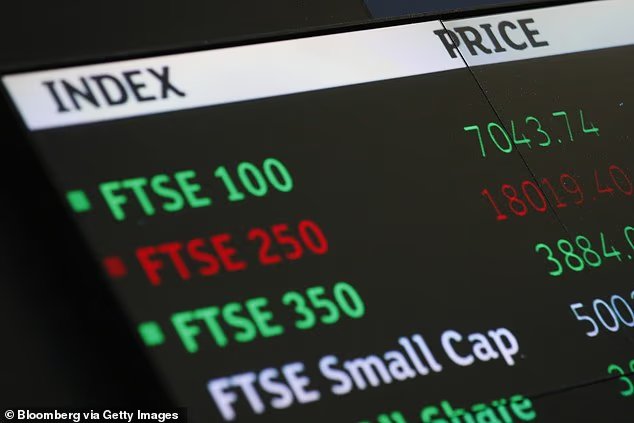
Nearly all passive funds are traded on the London Stock Exchange, so their share prices can be easily monitored
US market diversifiers
Many passive funds provide investors with exposure to the S&P 500 Index. But a few do it differently.
Instead of allocating money based on a company’s stock market size as traditional index tracking funds do, they invest an equal amount in every stock in the index.
Jason Hollands, managing director of Bestinvest, says these provide a more risk-averse route into the US equity market.
He says: ‘By reducing exposure to any single stock or sector, equal weighting provides genuine diversification across the US market.
‘This approach would have helped cushion the impact of the bursting of the dotcom bubble in early 2000 and could do so again if investor enthusiasm for artificial intelligence were to fade.’
Funds that invest in the S&P 500 Index in such a way (with their market tickers, where applicable, and annual charges in brackets) include: Invesco Markets S&P 500 Equal Weight Index (SPEX, 0.2 per cent); Legal & General S&P 500 US Equal Weight Index (0.15 per cent) and Xtrackers S&P 500 Equal Weight (XDWE, 0.2 per cent).
Of course, there is a flipside. While equal weighted funds ameliorate the impact of the ‘magnificent seven’ for investors when their share prices are sliding – they curb them when they are in the ascendency.
For example, over the past five years Xtrackers S&P 500 Equal Weight has delivered a return of 48 per cent compared to the near 85 per cent gain from the SPDR 500 UCITS fund (SPX5) which tracks the index and has 34 per cent exposure to the magnificent seven.
An alternative US market diversifier is fund Invesco FTSE RAFI US 1000 (PSRF, 0.39 per cent).
This invests in the US’s 1,000 largest companies, but then weights individual holdings according to analysis of key financial numbers. They include a business’s five-year average sales, cash flow, dividends and book value (its net worth – assets minus liabilities).
Hollands says: ‘The result of this methodical approach is an emphasis on solid, profitable businesses, trading on reasonable valuations and less exposure to speculative companies.’
Although the fund’s top-ten holdings include Alphabet, Amazon, Apple and Microsoft, the stakes are not as large as represented in the S&P 500. Five-year returns are 76 per cent.
For payback, go global
For income seekers who don’t want to be dependent on the UK stock market for dividends, there are low-cost passive funds which provide income from international companies.
One such fund is SPDR S&P Global Dividend Aristocrats (GBDV, 0.45 per cent).
Tom Bigley, fund analyst at Interactive Investor, says: ‘It tracks the performance of the S&P Global Dividend Aristocrats Index which is built around companies that have maintained or increased their dividends for a minimum ten years.
‘For investors, it means exposure to stable income-generating stocks drawn from around the world.’
Some 45 per cent of the fund’s portfolio is invested in US stocks with the biggest holding being in tobacco giant Altria (18 years of dividend growth). The fund offers a dividend yield equivalent to 3.9 per cent a year.
An alternative is Vanguard FTSE All-World High Dividend (VHYL, 0.29 per cent) which provides a 2.6 per cent yield.
Hargreaves’ Marshall says: ‘It’s invested in companies that make up the FTSE All-World Index, and which have above average dividends. As a result, it has lower exposure to the US market than the index and greater emphasis on sectors such as income-friendly financials, healthcare, and energy. In a nutshell, it offers both income and diversification benefits.’
Spread your exposure
As with plain vanilla US passive funds, most global index funds are heavily invested in US tech stocks.
An alternative approach, which dials down this exposure, is provided via fund Invesco MSCI World Equal Weight (MWEP, 0.2 per cent). It invests an equal amount in every stock in the index (MSCI World) which means exposure to 23 stock markets and 1,320 companies. Vaneck Morningstar Global Wide Moat fund (GOGB, 0.52 per cent) uses the investment research expertise of analysts at Morningstar to invest in just over 70 companies deemed to have both competitive advantages over rivals, and shares trading at attractive valuations.
Interactive’s Bigley says: ‘The fund is inspired by legendary US investor Warren Buffett who liked companies with a so-called economic moat – a business advantage allowing them to fend off competitors. It’s less biased towards mega-cap stocks and has just 29 per cent exposure to the US, less than half that of the MSCI World Index. It’s a portfolio differentiator.’
Hargreaves’s Marshall says Vanguard Global Small-Cap Index (0.29 per cent) provides investors with the opportunity to access an ‘overlooked area of stock markets’.
It tracks the performance of the MSCI World Small Cap Index. The result is a fund invested across more than 3,800 companies with just over half the assets invested in the US.
The industrial sector accounts for 21 per cent, financials 14 per cent, with IT, healthcare and consumer given less weighting.
‘Such a fund,’ adds Marshall, ‘can help investors diversify portfolios that have become heavily skewed towards large-cap stocks.’
Mix and match
According to Bestinvest’s Hollands, investors shouldn’t look at passive and actively managed funds as alternatives. Both, he argues, have a role to play in ensuring your portfolio is sufficiently diversified.
In the UK, for example, you would assume that a fund tracking the FTSE All-Share Index gives investors broad exposure to a mix of large, medium (mid-caps) and small companies.
After all, of the index’s 539 constituents, 250 (46 per cent) are mid-caps while 189 (35 per cent) are small companies.
Yet, as a result of the index being weighted by size – capturing more of the performance of FTSE100 stocks – mid-cap exposure falls to just 11 per cent while small companies are reduced to a mere 1.4 per cent.
Hollands adds: ‘In effect, investors in a FTSE All-Share index tracking fund end up with around five times more exposure to pharmaceuticals giant AstraZeneca than they do to all the smaller companies combined.
He says an excellent way for investors to address this imbalance is to adopt a ‘core and satellite’ approach – using a combination of passive and actively managed UK funds to provide a broad exposure to UK plc.
The passive fund, says Hollands, could be one tracking the FTSE100 Index – the largest companies listed in the UK. For example, iShares Core FTSE100 UCITS (0.07 per cent).
This could then be complemented by the purchase of an actively managed UK investment fund which has a greater focus on small and medium- sized businesses.
Suitable candidates, says Hollands, would be investment trusts Mercantile (MRC, 0.48 per cent) and Fidelity Special Values (FSV, 0.7 per cent).
The £1.8 billion Mercantile fund is managed by JPMorgan Asset Management and invests primarily in a mix of UK medium and smaller companies. Its biggest holdings include FTSE250 stocks Serco and Bellway.
Fidelity Special Values is more broadly invested across the UK stock market, with about 40 per cent of its portfolio in FTSE 100 stocks.
But the £1.4 billion fund also has healthy exposure to both FTSE250 and small cap stocks.
The icing on the cake is that these two trusts have respectively delivered 12 and 16 years of consecutive annual dividend increases.
And finally…
Passive funds can also provide portfolio diversification by investing in particular themes such as defence, healthcare, cyber security and precious metals.
Those worth considering include: VanEck Defense UCITS (DFNG, 0.55 per cent); Xtrackers MSCI US Health Care (XSHC, 0.12 per cent) and iShares Physical Gold (SGLN, 0.12 per cent) and iShares Physical Silver (SSLN, 0.2 per cent).
Unlike actively managed precious metals funds which invest in companies, the two iShares’ funds track the price of gold and silver, respectively.