
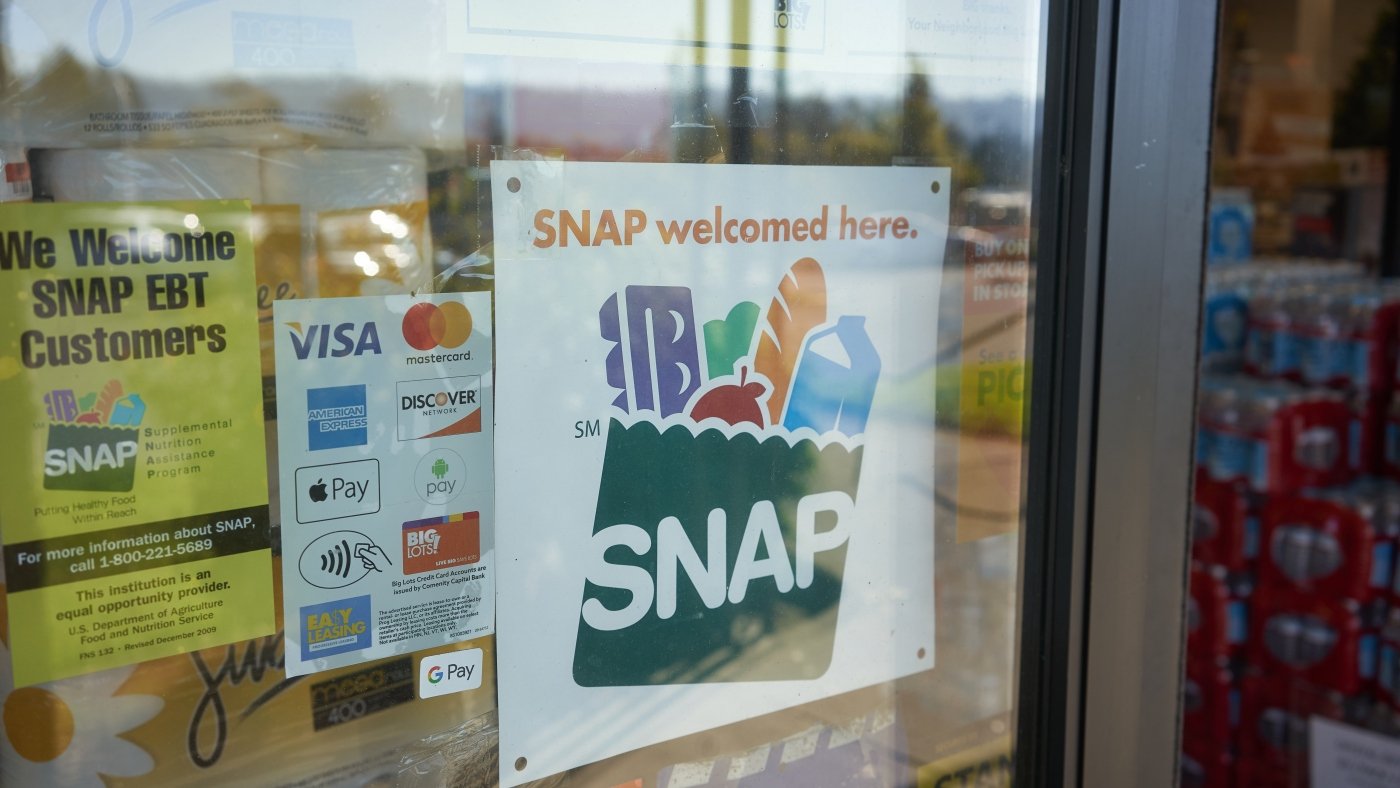
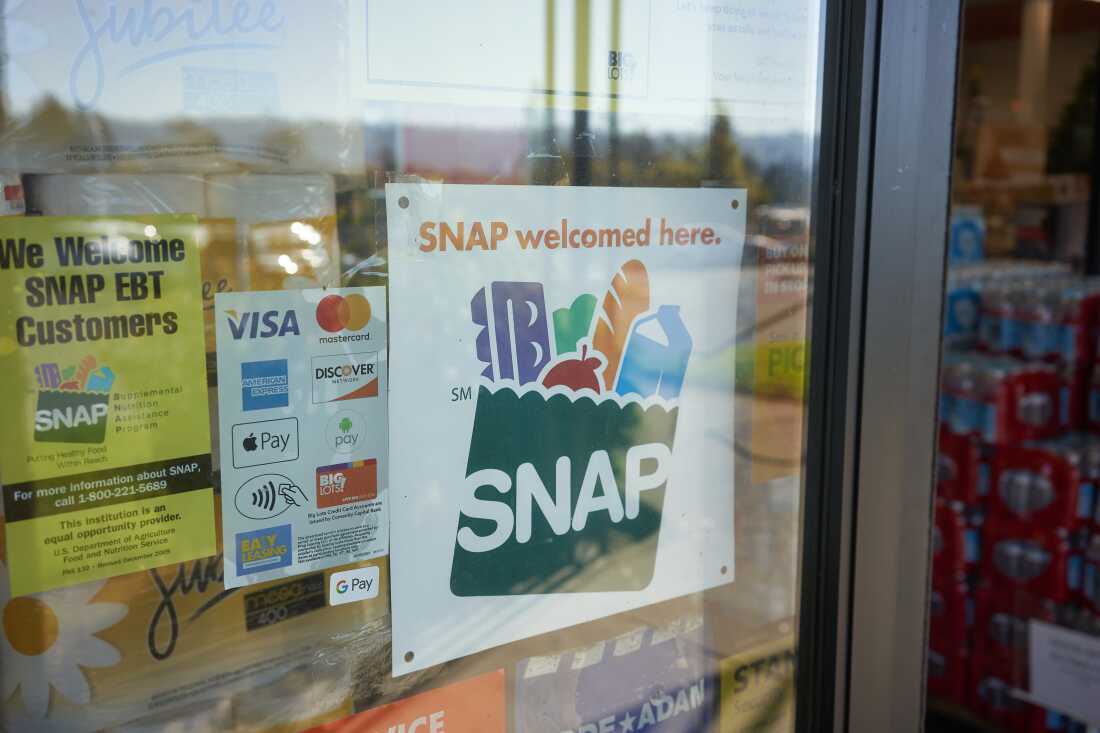
“SNAP welcomed here” sign is seen at the entrance to a Big Lots store in Portland, Oregon on Oct 28, 2020. The Supplemental Nutrition Assistance Program (SNAP) is a federal program.
Hapabapa/Getty Images
hide caption
toggle caption
Hapabapa/Getty Images
The Trump administration says it will not use emergency funds to send out federal food aid at the beginning of November, blaming Democrats for not working to reopen the government.
Millions of Americans are expected to lose their benefits this week – leaving states scrambling to pitch in and pay the difference, even as some have already notified recipients not to expect their monthly food assistance.
The Supplemental Nutrition Assistance Program (SNAP) is an entitlement program that provides about 1 in 8 U.S. residents an average of $187 a month in food aid. But the roughly $8 billion a month to fund SNAP benefits comes through annual Congressional appropriations, which lapsed on Oct. 1.
A new banner atop the U.S. Department of Agriculture’s (USDA) website published Saturday says “the well has run dry” and that Senate Democrats are responsible for the department’s decision not to send out benefits on Nov. 1.
It’s one of several politicized messages posted on the websites of federal agencies during the shutdown in ways that experts say could be a violation of federal ethics laws.
USDA memo says contingency funds can’t be used during shutdown
A USDA memo provided to NPR on Monday argues that SNAP contingency funds “are only available to supplement regular monthly benefits when amounts have been appropriated for, but are insufficient to cover, benefits.”
The contingency fund is not available to support FY 2026 regular benefits, the memo says, because the appropriation for regular benefits no longer exists.”
Yet this assessment by the USDA is a departure from the agency’s shutdown lapse plan released before Oct. 1, which says “Congressional intent is evident that SNAP’s operations should continue” in the case of a shutdown, citing the multi-year contingency funds that were created to help cover administrative expenses for states “to ensure that the state can also continue operations during a Federal Government shutdown.”
“These multi-year contingency funds are also available to fund participant benefits in the event that a lapse occurs in the middle of the fiscal year,” the USDA shutdown plan continued.
That plan has since been removed from the USDA’s website.
The White House did not respond to NPR’s questions about why the lapse plan was removed or the apparent change in SNAP funding guidance.
Funding decisions affect who can access benefits
Many budget experts disagree with the administration’s assessment that the SNAP contingency funds cannot be used during the shutdown and tell NPR that SNAP funding is being used as a political cudgel in the ongoing shutdown.
“If you have an entitlement to something, and you have money that can fill that use, then you must fill that use,” Bobby Kogan with the center-left Center for American Progress said. “When they say ‘Oh, no, it’s not for benefits.’ What do you think SNAP is? What do you think a program operation for SNAP is other than benefits?”
Kogan also points to the administration’s transfer of $300 million to continue funding the Special Supplemental Nutrition Program for Women, Infants, and Children, also known as WIC, as a pathway to keep SNAP benefits going.
According to federal budget documents, the Trump administration transferred the $300 million for WIC from a state child nutrition programs account that is funded in part by a portion of customs duties collected during the prior calendar year.
Those Section 32 funds are separate from the increased revenue generated from sweeping tariffs imposed by President Trump in recent months. That $23 billion is also a source that the administration says it won’t tap for SNAP, arguing it would jeopardize money for school meals and infant formula.
The Trump administration has taken several steps throughout the shutdown to move money around to fund priorities, such as a directive to pay active-duty military members using unexpired defense research funds.
A White House memo directed Defense Secretary Pete Hegseth to find money within the department’s budget that had “a reasonable, logical relationship to the pay and allowances of military personnel, consistent with applicable law.”
Devin O’Connor with the left-leaning Center on Budget and Policy Priorities said that the USDA lapse plan and the way previous potential SNAP shortfalls were handled shows that the contingency fund accounts are supposed to be used for a case like this.
Those contingency funds, which currently total just under $6 billion, are intended by law “for use only in such amounts and at such times as may become necessary to carry out program operations.”
Still, O’Connor said the federal government and its programs are not designed to withstand a lapse in funding.
“When you shut down the government, bad things happen, and the longer the government is shut down, the more bad things will happen,” he said. “And even with the Trump administration taking relatively aggressive actions to try to prevent certain harms over time, it’s just going to grow and it’s going to become more and more painful.”