

Knowing these will help you avoid making suboptimal investing decisions.
Once you’re attuned to the ebbs and flows of the healthcare sector, there are a few dead ringers that’ll send a chill up your spine in anticipation of your investments losing value, and soon.
In keeping with the Halloween spirit, investors should thus be on the lookout for these three spooky signs that foretell a looming downturn in their healthcare stocks.
1. You invested right after a period of windfall profits or event-driven growth
Boom times don’t occur all the time. Often, booms incur a hangover on shareholders, especially those who invested at the boom’s peak, when companies are raking in windfall profits. Once the trends driving the good times begin to fade, the market tends to dump the winners, as the remaining days of rapid growth become fewer.
Take Teladoc (TDOC -0.35%) and Pfizer (PFE -0.66%) as a pair of recent examples, as shown in this chart:
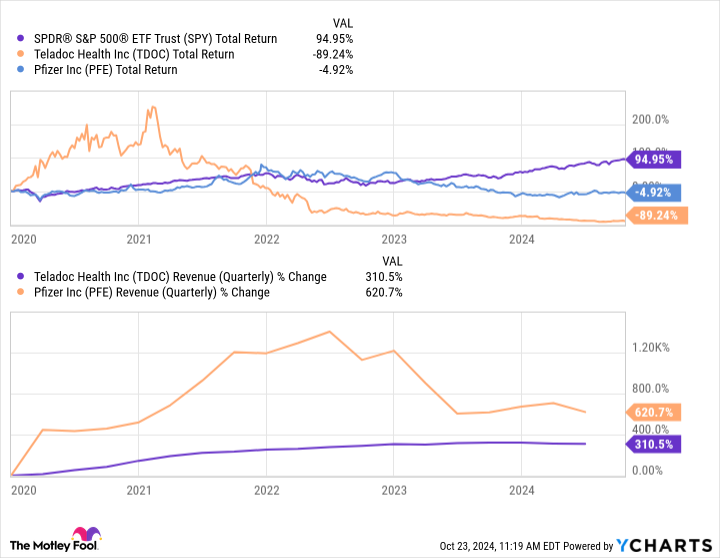
SPY Total Return Level data by YCharts.
As the pandemic disrupted people’s access to in-person healthcare and generated a tremendous demand for vaccination and telehealth services overnight, both companies saw their shares soar, as they produced solutions to those issues. Their top lines increased significantly as a result of serving the demand.
Then, soon after, their markets became saturated, and, in Pfizer’s case, actually shrank significantly. People got their jabs, got their boosters, and ultimately got tired of getting poked in the arm once the peak risk of infection appeared to be behind them.
Likewise, Teladoc’s rapid rollout of telehealth capabilities hit a ceiling, in part because many medical issues are better addressed with an in-person visit than with a phone call with a provider. And both businesses, despite being the first major competitors to enter those markets, were forced to split the post-boom leftovers with a handful of other players.
The lesson here isn’t to avoid buying Teladoc or Pfizer stock. The lesson is to focus on the long-term prospects of the companies you choose to invest in, rather than on the short-term drivers of their performance in isolation.
In hindsight, it’s obvious that neither of these companies could have kept stacking revenue growth as aggressively over the long term as they did for a time, when the stars temporarily aligned in their favor. Next time you see a business raking in cash from a one-off event, or conditions that are bound to change, use your foresight to determine whether it’ll likely be giving that growth back, or whether it has a real chance of retaining its outperformance for the long haul.
2. Management’s timelines keep getting pushed back
Shareholders rely on management to provide them with accurate estimates of when the company’s major initiatives are expected to advance and eventually yield earnings.
In healthcare, delays are common and inevitable thanks to the need for businesses to navigate interactions with slow-moving entities they have no control over, like government agencies, insurers, and hospitals. Similarly, key activities like research and development (R&D) and recruiting for clinical trials often take a bit longer than anticipated, as it can be difficult to find patients that match the qualification criteria. There usually isn’t a reason to believe that a stock’s value is at risk if management reports a delay stemming from these causes.
In contrast, repeated delays, even after management’s assurance that things are moving along, are a surefire sign that the stock is at high risk of going down.
Take Novavax‘s (NVAX -1.76%) troubled launch of its coronavirus vaccine. Due to problems with its complicated manufacturing process, it faced a protracted back-and-forth with regulators. During this time, management reassured investors that first the jab’s approval, and later its supply scaling up, were both right around the corner. Each new report of the issues sent the stock price down and pushed the timetable back further.
By the time the company sorted out its issues, competitors had been on the market for years. Shareholders and potential new buyers didn’t have as much trust in management. So be mindful of when timelines are repeatedly not being met, as you could be in for a difficult ride.
3. The company just pivoted into doing the latest and greatest thing… again
It’s normal for companies to want to enter into hot new areas to capture growth. Especially in biopharma, there’s always a lot of basic research being conducted that can reveal opportunities previously thought to be impossible or otherwise unavailable. But if you’re a shareholder in a biopharma that seems to always be launching a new pipeline program with every new fad in drug development, the odds are good that the stock is going to fall. Here’s why.
The odds of successfully developing a new drug tend to be the highest when a company is performing R&D activities within its focus area.
It’s true that there are many opportunities for a focus area to be relevant in seemingly disparate contexts. Take the once-hot field of immuno-oncology (immune system-regulating therapies for treating cancer), for example. The biotechs that have the scientific leadership, scientific staff (immunologists), clinical connections, research relationships, equipment, and intellectual property (IP) to make drugs that treat allergies could credibly claim to be using the same assets to make drugs that treat cancer, as there’s a well-established connection between dysregulations of the immune system and cancer.
But, if a biotech focusing on developing drugs for something like dry skin suddenly announces that, much like many other pre-revenue biotechs in its era, it’s starting a very fashionable new program to treat a totally unrelated condition like excessive daytime sleepiness, the odds are much higher that shareholders will see losses. That’s doubly true if in the next week, the company announces a new program in another unrelated area.
Drug development is hard enough when there’s a laser-focused confluence of specialized people and resources. Beware of players that complicate a challenging task even further by targeting territory that’s clearly outside their core competency.