
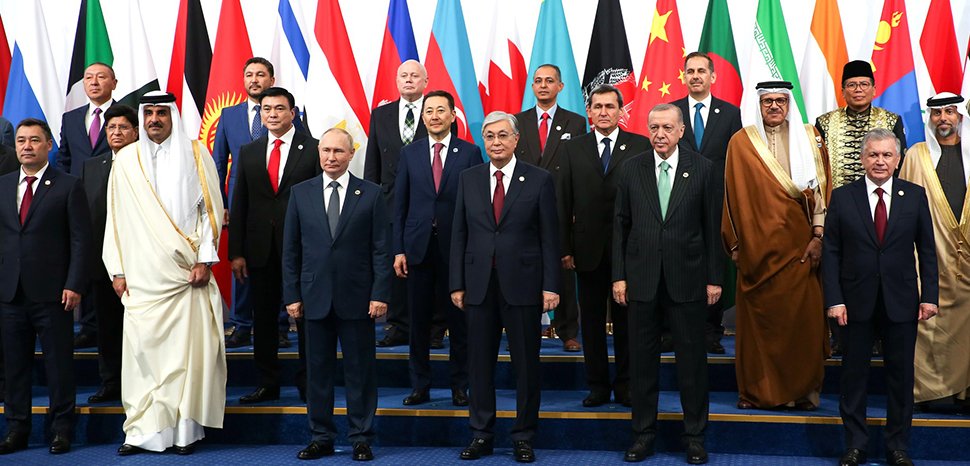
The new Middle East, unconstrained by ongoing great power conflicts, is looking to capitalize on enthusiasm from Central Asian leaders eager to diversify their economies away from historical reliance on China and Russia. Such investing brings with it a host of business and geopolitical tensions, though: interregional competition may arise due to these investments, and the first movers of this new wave of business activity must be aware of what their investment strategies mean for great power politics.
China and Russia have historically dominated Central Asia, both politically and economically. China’s Belt and Road Initiative (BRI) began in Central Asia in 2013, with Kazakhstan and Kyrgyzstan being the two largest recipients of Chinese-backed BRI investments. Russia, in addition to its Collective Security Treaty Organization and trade ties with Central Asia, has historically been the primary destination for Central Asian migrant laborers.
However, Central Asian countries have begun reducing their reliance on Russia and China as the West and its partners continue to isolate the two states, signaling the readiness of Central Asian leaders to pursue independent foreign and investment policies. Though Central Asia’s leaders attended China’s first-ever Central Asia Summit in Xi’an in May 2023, the same leaders then met with US President Joe Biden on the sidelines of the UN General Assembly four months later to push for greater trade and security measures in the region. This meeting with Biden comes as the United States continues to enjoy strong diplomatic relations with Central Asian states through C5+1. All the while, these Central Asian states have been filling their coffers with the profits derived from re-exporting ‘dual purpose’ sanctioned goods, such as drones and microchips, to Russia.
Meanwhile, Middle Eastern states have been looking to Central Asia for geostrategic benefit and economic prosperity. Their Central Asian partners share this vision, seeking to be as politically risk-averse as possible by diversifying their business environment. Uzbekistan has secured projects totaling over US $34.2 billion in investment from Turkey and Saudi Arabia while encouraging Qatar and Saudi Arabia to support its push for green energy. In early June, Turkey hosted the “Uzbek-Turkish Strategic Relations – Comprehensive Perspectives for the Future” symposium, celebrating the 260 joint ventures established between the two states in 2023. In April, Uzbekistan hosted the second ministerial meeting between the Gulf Cooperation Council (GCC) and Central Asia, where trade and investment were the top points. Azerbaijan was an observer to the summit.
Two things are at stake with the Middle East increasingly enticed by cooperation and collaboration with Central Asia.
First, with the Middle East encroaching on China and Russia’s historic areas of economic and political hegemony in Central Asia, Beijing and Moscow could try to shape investor behavior with changes to their Middle East policies. Though the GCC and Arab League broadly support Chinese and Russian influence in their region, there are a few sticking points: Iran, Syria, and China’s commitment to counterterrorism – all of which could provide sources of retribution if Middle Eastern investment in Central Asia upsets China or Russia. With over 70% of Chinese investment in the Gulf going to Saudi Arabia’s energy sector between 2020-2023, Riyadh is especially vulnerable to retributive action by China.
Second, Central Asian investment opportunities may be another arena for Turkey-GCC tensions. While Turkish President Recep Tayyip Erdogan has taken a softer approach to GCC states over the past few years, mainly due to the urgent need for foreign investment to subdue a crashing domestic economy, Turkey has not been shy in competing with Gulf states for influence in strategic markets, such as the Horn of Africa. During the Gulf diplomatic crisis from 2017-2021, Turkey’s unabated support for Qatar spilled into the Horn of Africa, where Turkey was a first mover in Somalia and supported Qatari policies in the region, often to the distaste of the UAE and Saudi Arabia, other heavyweights. Even after the Qatar blockade ended with the Al Ula Statement, the legacy of Turkey’s strong support continues to irk Qatar’s neighbors. Turkey’s continued advances in Somalia – where they seek further military influence over the Bab al-Mandeb strait, risk threatening relations with Ethiopia and the UAE, which are both investing massively in the Ethiopia-Somaliland port.
The inclusion of Azerbaijan is particularly notable in the GCC-Central Asia Summit. Turkey is reliant on Azerbaijan for the effective delivery of Central Asian energy through pipelines that cut across the Caspian Sea and Azeri territory. With Azerbaijan included in the Summit, Turkey’s fraternal relationship could be compromised as GCC states have greater capital and investment mobility compared to the fiscally weaker Turkey.
GCC countries looking to expand their influence in ways supplementary to their domestic diversification strategies must consider the Turkish counterpart that seeks political gain simultaneous to economic advantage.
Ultimately, the Middle Eastern push for investment and influence in Central Asia is another sign of a more independent Middle East, unconstrained by ongoing conflicts between the United States, Europe, China, and Russia. With opportunities rife in the Central Asian markets, coupled with strategic enthusiasm from Central Asian leaders, Middle Eastern states have the possibility for economic and geopolitical success. However, Middle Eastern investors in Central Asia must tread carefully, as opportunity in the region comes with real geopolitical risk.