
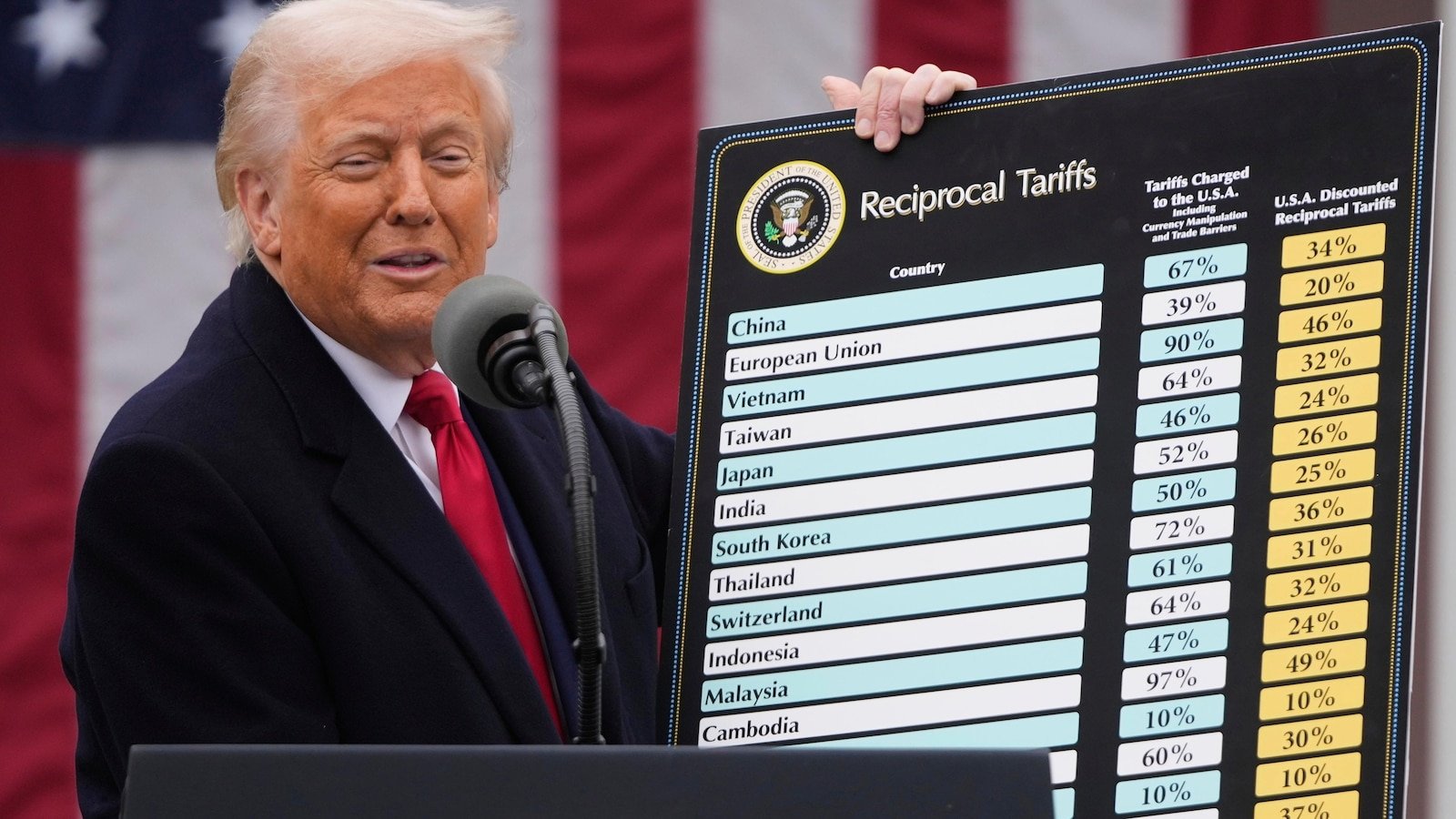
WASHINGTON — WASHINGTON (AP) — The economic boom promised by President Donald Trump centers on a single number: $17 trillion.
That’s the sum of new investments that Trump claims to have generated with his tariffs, income tax cuts and aggressive salesmanship of CEOs, financiers, tech titans, prime ministers, presidents and other rulers. The $17 trillion is supposed to fund new factories, new technologies, more jobs, higher incomes and faster economic growth.
“Under eight months of Trump, we’ve already secured commitments of $17 trillion coming in,” the president said in a speech last month. “There’s never been any country that’s done anything like that.”
But based on statements from various companies, foreign countries and the White House’s own website, that figure appears to be exaggerated, highly speculative and far higher than the actual sum. The White House website lists total investments at $8.8 trillion, though that figure appears to be padded with some investment commitments made during Joe Biden’s presidency.
The White House didn’t lay out the math after multiple requests as to how Trump calculated $17 trillion in investment commitments. But the issue goes beyond Trump’s hyperbolic talk to his belief that the brute force of tariffs and shaming of companies can deliver economic results, a strategy that could go sideways for him politically if the tough talk fails to translate into more jobs and higher incomes.
Just 37% of U.S. adults approve of Trump’s handling of the economy, according to a September poll by The Associated Press-NORC Center for Public Affairs. That’s down from a peak of 56% in early 2020 during Trump’s first term — a memory he relied upon when courting voters in last year’s election.
Adam Posen, president of the Peterson Institute of International Economics, said the public commitments announced by Trump do represent a “meaningful increase” — but one that amounts to hundreds of billions of dollars, not trillions. Even then, that comes with long-term costs as countries might be less inclined to invest with the U.S. after being threatened to do so.
“It is a national security mistake because you’re turning allies into colonies of a sort — you’re forcibly extracting from them things that they don’t see as entirely in their interest,” Posen said. “Twisting the arms of governments to then twist the arms of their own businesses is not going to get you the payoff you want.”
The Trump administration is betting that tariffs are an effective tool to prod other countries and international companies to invest in the United States, a big stick that other administrations failed to wield. Trump’s pitch to voters is that he will play a role in directly managing the investment commitments made by foreign countries — and that the allocation of that money starting next year will revive what has been a flagging job market.
“The difference between hypothetical investments and ground being broken on new factories and facilities is good leadership and sound policy,” said White House spokesman Kush Desai.
The White House said that Japan will invest $1 trillion, largely at Trump’s direction. The European Union will commit $600 billion. The United Arab Emirates made commitments of $1.4 trillion over 10 years. Qatar pledged $1.2 trillion. Saudi Arabia intends to pony up $600 billion, India $500 billion and South Korea $450 billion, among others.
The challenge is the precise terms of those investments have yet to be fully codified and released to the public, and some numbers are under dispute, potentially fuzzy math or, in the case of Qatar, more than five times the annual gross domestic product of the entire country. The White House maintains that Qatar is good for the money because it produces oil.
South Korea already has misgivings about its investment commitment, which is $100 billion lower than what the White House claims, after immigration agents raided a Hyundai plant under construction in Georgia and arrested Korean citizens. There are also concerns that an investment that large without a better way to exchange currencies with the U.S. could hurt South Korea’s economy.
“From what I’ve seen, these commitments are worth about as much as the paper they’re not written down on,” said Jared Bernstein, who was the chairman of the Council of Economic Advisers in the Biden White House.
As for the $600 billion committed by European companies, that’s based on those businesses having “expressed interest” and having stated “intentions” to do so through 2029 rather than an overt concession, according to European Union documents.
So far, there has yet to be a notable boost in business investment as a percentage of U.S. gross domestic product. As a share of the overall economy, business investment during the first six months of Trump’s presidency has been consistently bouncing around 14%, just as it was before the pandemic.
But economists also note that Trump is double-counting and relying on investments that were initially announced during the Biden administration or investments that were already likely to occur because of the artificial intelligence build out.
For example, the White House lists a $16 billion investment by computer chipmaker Global Foundries. But of that sum, more than $13 billion was announced during the Biden administration and supported by $1.6 billion in grants by the 2022 CHIPS and Science Act, as well as other state and federal incentives.
Similarly, the White House is banking on $200 billion being invested by the chipmaker Micron, but at least $120 billion of that was announced during the Biden era.
For their part, White House officials largely credit Trump’s tariffs — like those imposed on Oct. 1 on kitchen cabinets, large trucks and pharmaceutical drugs — for forcing companies to make investments in the U.S., saying that the risk of additional import taxes if countries and companies fail to deliver on their promises will ensure that the promised cash comes into the economy.
On Tuesday, Pfizer CEO Albert Bourla endorsed this approach after his pharmaceutical drug company received a three-year grace period on tariffs and announced $70 billion in investments in the U.S.
“The president was absolutely right,” Bourla said. “Tariffs is the most powerful tool to motivate behaviors.”
“The tariffs played a big role,” Trump added.