
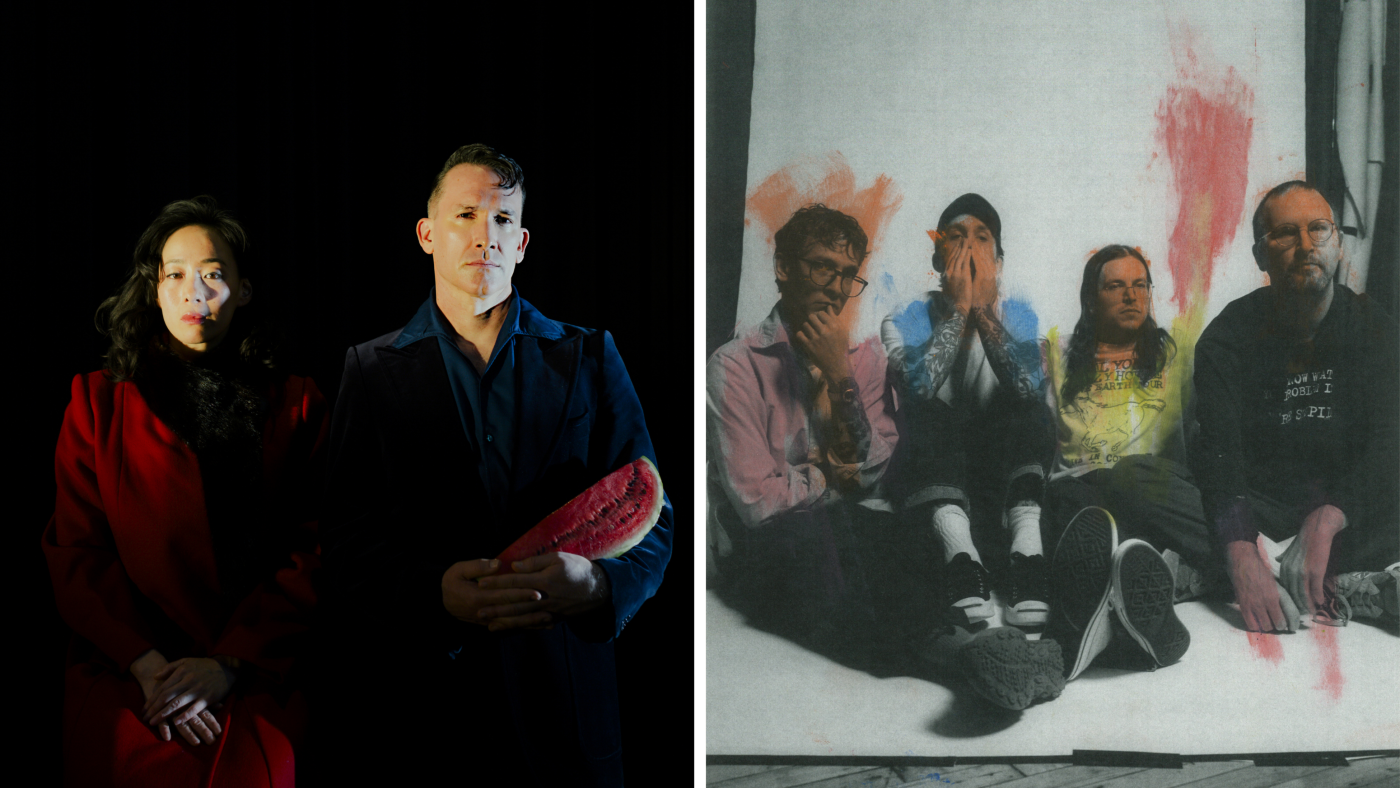
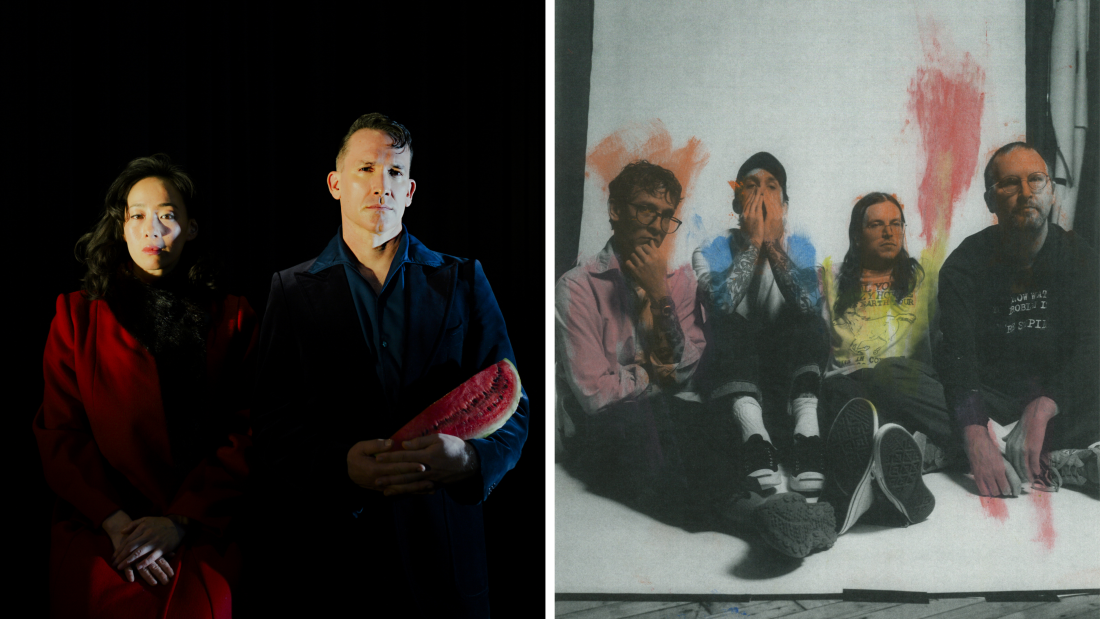
Bands like Xiu Xiu (left) and Hotline TNT (right) recently pulled their music off Spotify, the world’s largest streaming service.
Eva Luise Hoppe; Graham Tolbert
hide caption
toggle caption
Eva Luise Hoppe; Graham Tolbert
Over the summer, a slew of bands began to make similar announcements on social media: They’d be pulling their music off Spotify, the largest streaming service in the world.
It started in June with indie rock quartet Deerhoof. Within weeks, groups like Xiu Xiu, King Gizzard & the Lizard Wizard and Hotline TNT followed suit. The wave of departures continued into September; most recently, The Mynabirds, WU LYF, Kadhja Bonet and Young Widows have all decided to leave Spotify. So why are musicians — many of them independent — removing their songs from the most popular streamer globally, which has nearly 700 million users?
All artists cite Spotify CEO Daniel Ek’s ties to Helsing, an artificial intelligence defense company with a mission to “attain technological leadership so that democratic societies are free to make sovereign decisions and control their ethical standards.” In 2021, Ek’s venture capital firm Prima Materia invested more than $100 million into the German startup. This past June, Prima Materia raised more than $700 million for Helsing, where Ek is now also chairman. He told The Financial Times that Prima Materia is “doubling down” on its investments in light of the role that AI plays in Russia’s war on Ukraine. The Financial Times reported that Helsing is now producing its own drones, aircraft and submarines.

It’s not the first time artists have decided to cut ties with Spotify. In 2013, Thom Yorke removed his solo albums from the streaming service to protest low royalty payouts (his music has since reappeared on the platform). The following year, Taylor Swift wrote an op-ed in The Wall Street Journal arguing that “music should not be free” and pulled her songs from Spotify; three years later, she returned her discography to all streaming services. In 2022, Neil Young and Joni Mitchell left Spotify in objection to the company’s exclusive relationship with Joe Rogan, citing concerns that Rogan was spreading COVID-19 vaccine misinformation on his massively successful podcast, The Joe Rogan Experience. Young and Mitchell ended their boycott in 2024 after Rogan’s podcast became available on multiple streaming platforms.
But this most recent exodus, which began shortly after the June fundraising news, marks a new wave of artist-led protests against Spotify.
“We don’t want our music killing people. We don’t want our success being tied to AI battle tech,” Deerhoof wrote in a statement shared with NPR. “Deerhoof is a small mom and pop operation, and know when enough is enough. We aren’t capitalists, and don’t wish to take over the world. Especially if the price of ‘discoverability’ is letting oligarchs fill the globe with computerized weaponry, we’re going to pass on the supposed benefits.”
Spotify and Helsing declined to comment on artists leaving the platform in protest of Ek’s investments. But several artists NPR spoke with say their concerns with Spotify span far beyond how the CEO spends his earnings.
“The sound quality is horrible. The disposable-ness of music has become almost culturally endemic, and then obviously the financial aspect of it is a joke,” says Jamie Stewart of the experimental rock group Xiu Xiu. “It has not done anything good for bands. It has done good things for itself.”
Xiu Xiu formed in California in 2002. Stewart says the rise of file-sharing and iTunes caused a near-immediate decline in royalties, but in the last decade and a half, the popularization of streaming platforms like Spotify has significantly worsened financial compensation. In a statement shared with NPR, a Spotify spokesperson explained how the company’s payout model is structured.
“All of the major streaming services use the same pro rata model for payouts to rightsholders, and we pay the most,” the statement reads. “In this model, payouts are based on streamshare, not a per-stream rate. That means if an artist’s catalog accounts for 1% of total streams, it would earn 1% of total royalties. It’s not a coincidence that the least popular streaming services, where people listen the least, have the highest per-stream rates, as lack of user engagement is exactly what drives a higher per-stream rate.”
Spotify’s annual economic Loud & Clear report found that the company paid out $10 billion to the music industry in 2024, the most out of any streaming service. The number of people uploading music to Spotify has also grown, which means “the fraction who find success appears smaller over time.”
Stewart says Spotify is a large source of digital revenue for Xiu Xiu, and they’re expecting to feel an impact from exiting the platform. “We don’t make very much money at all to begin with, but it’s enough that it’s a noticeable amount that we will not be making anymore,” they explain. “It’s not going to make any difference to Spotify. But it is a very, very small way of standing up to what tech companies have become.”
Searching for alternatives
According to the Recording Industry Association of America, recorded music revenue has been growing consistently for nearly a decade, and streaming is the largest driver of that growth. But a survey conducted in 2024 by MusiCares — the nonprofit founded by the Recording Academy to support the financial, mental and physical well-being of musicians — found that 69% of respondents cannot cover expenses from working in music alone. The artists NPR spoke with expressed frustration that despite record-breaking profits for both the recording industry and streaming services, that money does not seem to always trickle down to the artists.

“It’s really hard to have superhigh principles at this point with how problematic so many of these companies are,” says Seth Hubbard, director of Xiu Xiu’s label, Polyvinyl Records. “If you start looking under the hood a bit, a lot of it is problematic. And then where do you draw the line?”
For singer Kadhja Bonet, the answer is clear. After negotiating an early exit from her former label, Bonet announced in August that all future releases, including her upcoming EP Battlewear, out Sept. 18, will not be available on Spotify, Apple, Deezer, Amazon or YouTube.
“We give these tech giants power by furnishing them with all of our best ideas and driving business their way,” Bonet wrote in a statement shared with NPR. “I put a lot of thought and love into the music I make, so it’s only right to put the same thought into the way it’s delivered.”
She recommends alternative platforms and digital stores like Qobuz and Bandcamp. The indie rock band Hotline TNT, which announced its departure from Spotify in August, is also focusing on substitute revenue streams. On Sept. 5, singer and guitarist Will Anderson hosted a 24-hour livestream on Twitch, YouTube and Instagram to promote sales of the band’s latest album, Raspberry Moon. Anderson, who started Hotline TNT as a solo project several years ago, sold over 300 copies of the album on Bandcamp alone, which he says accounts for more profit in 24 hours than the band usually makes in months of Spotify streams. He says fans have been supportive of the group’s decision to part ways with Spotify, leading record sales to triple on tour.
“I would like to see consumer spending habits drift back into ownership over this rental system we have right now,” Anderson says. “When someone buys one of our records at a show, no one’s going to take the music off their shelf overnight like we just did with Spotify.”
A new reality
For some artists, a push toward that ownership model works. In January, folk-pop chameleon Caroline Rose announced that her new album, year of the slug, would not be available on any streaming platforms. Instead, with Rose inspired by a similar release model used by artist Cindy Lee, the album would be available for purchase on Bandcamp or directly from Rose on a solo tour of all-independent venues.

“You have to try ever so slightly harder, or you have to come to a show and get an album,” she says. “We only had a limited number of vinyl that we were selling, so once it sold, it sold. I miss that feeling that something was special, that there was a limited amount of it.”
Rose says the rollout was the culmination of years of frustration with the industry’s emphasis on profits and numbers, all of which was exacerbated during the COVID-19 pandemic, when label and tech executives continued to make money while artists canceled tours and struggled to get by.
“It just felt like we were being overlooked and forgotten and everybody else was just kind of biding their time until they could go back to work and everything would be normal again,” she says. “It felt catastrophic, and that feeling has only become bigger.”
When her label contract ended, Rose says, she breathed a sigh of relief and decided to try something different. In February, year of the slug came out as a completely independent project; it’s also her most profitable record to date because it’s the only one she fully owns. More importantly, she says, the feedback from fans has been overwhelmingly supportive.
Rose admits that there are drawbacks — this kind of release doesn’t lend itself to discovery by new rather than existing listeners, and it would become much more difficult to financially sustain a tour with a full band rather than by herself. But for now, it was the break she needed.
“It’s been extremely fulfilling, and personally, I needed this just to feel a little bit more connection to my fans and to the audience. I meet people. We have drinks together. It feels very communal,” says Rose. “I want a career of quality rather than any and everything quantifiable. I don’t want to be hounded by stats and money and how many ticket sales I’m selling. It’s not a quality life to me.”