
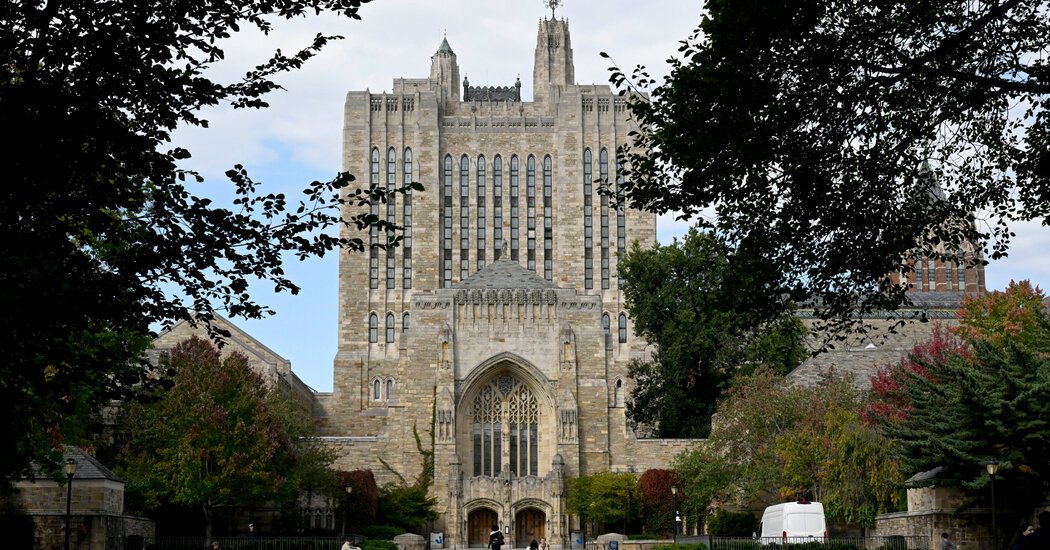
Yale University’s famed endowment has been trying to offload one of the largest portfolios of private equity investments ever in a single sale, a move that reflects the pressures on both Wall Street and higher education under the Trump administration.
The Ivy League school has sought buyers for up to $6 billion in stakes in private equity and venture funds, according to three people briefed on the sales process, amid uncertainty about its federal funding and the reality that many of these investments have not delivered the outsize returns that Yale expected.
Yale is now close to completing a sale of roughly $3 billion of the portfolio and is selling the assets at a slight discount, one of the people said.
“This is a big deal,” said Sandeep Dahiya, a professor of finance at Georgetown University who has conducted research on the performance of endowments. “The investor that was the lead architect of investing in the private equity markets is pulling in its horns.”
For decades, Yale has been regarded as a pioneer for shifting its investments away from stocks and bonds into longer-term holdings managed by private equity and venture capital firms. But last year, Yale’s $41 billion endowment generated returns of just 5.7 percent, underperforming the S&P 500 and other major indexes. Yale said its 10-year return averaged 9.5 percent annually.
Private equity investments typically generate cash for endowments and other investors after they sell or take public the companies in which they have invested. But lately, private equity and venture firms, which make up about half of Yale’s endowment, have struggled to sell their stakes in companies and return cash to investors. That has driven down returns.
Yale’s quest to exit investments in both well-known firms like Bain Capital and lesser-known ones like Golden Gate Capital, Clayton Dubilier & Rice and Insight Partners is a sharp U-turn for an endowment that has long proselytized the value of private equity and other long-term investments.
Knowing that some stakes would be harder to sell than others, Yale’s bankers offered potential bidders two separate lists of funds: “core” funds, the ones they most wanted to sell, and “sweeteners,” the better-performing ones, according to two of the people briefed on the sale.
While buyers would receive only a small discount of about 5 percent on the private equity stakes, Yale willingness to sell assets that were once highly desirable at less than full value reflects the industry’s challenges.
The sale comes at a critical juncture for universities. While President Trump has spared Yale the kind of punitive funding cuts he has leveled against other Ivy League schools such as Harvard, Yale is grappling with decreases in federal research funding that have hit higher education broadly. Republicans in Congress have also proposed steep tax increases on endowments.
Yale is on track to spend roughly $2.1 billion from its endowment in 2025, which accounts for just over one-third of its annual budget.
In a statement provided to The New York Times, a representative for the Yale endowment acknowledged the sale, but called private equity “a core element of our investment strategy.” The statement added, “We are not reducing our long-term target to private equity.” The university said it was also looking to invest in other private equity firms.
Yale’s bankers tried to keep the process discreet by giving the sale the code name Project Gatsby. (Two of the main characters in F. Scott Fitzgerald’s novel set in the roaring 1920s went to Yale.) But Yale’s move is widely viewed on Wall Street as a harbinger.
At least two other large universities are preparing to sell some private equity assets, and dozens of U.S. and Asian pension funds are also looking at exits.
Lawrence Siegel, a former director of research at the Ford Foundation, called Yale’s move “a wake-up call” for investors.
“It’s also Yale trying to get out before everyone else,” Mr. Siegel said.
The Swensen Model
When David Swensen, a former Lehman Brothers banker, joined Yale as its chief investment officer in 1985, the university’s endowment was valued at about $1.3 billion. (Harvard’s had $2.7 billion.)
During 2021, the year that Mr. Swensen died, Yale’s endowment had swelled to $42.3 billion, behind Harvard but billions ahead of almost every other university endowment.
To achieve that, Mr. Swensen shifted Yale’s investments from a traditional portfolio of 60 percent stocks and 40 percent bonds. After getting to know fund managers in private equity and venture firms, Mr. Swensen moved a relatively large slug of Yale’s endowment into long-term assets, often investing in those funds for decades.
Other universities watched Yale’s returns and started to follow the Swensen Model, as it came to be known.
Yale’s early affection for private equity provided the perfect advertisement for an industry looking to attract new investors.
“Do you want to be smart like Yale?” said Ludovic Phalippou, an economist at the University of Oxford, in describing the pitch.
University endowments now invest an average of about 17.1 percent of assets in private equity funds, according to studies by the National Association of College and University Business Officers. That’s up from just 5.4 percent in 2007 before the financial crisis.
Universities and private equity firms have developed a symbiotic relationship. Endowments typically pay private equity firms roughly 2 percent of the money they manage and 20 percent of the profits they generate.
Those fees have helped mint slews of billionaires, many of whom sit on university boards and make large donations to the schools.
Yale’s senior trustee, for example, Joshua Bekenstein, has worked at Bain Capital since its inception in 1984, four years after he graduated from Yale. The Boston-based firm was one of the earliest to jump into the buyout business. It scooped up companies like Dunkin’ Donuts, Clear Channel Communications and Gymboree, added debt and then tried to sell them for a profit. Gymboree, a children’s clothing retailer, filed for bankruptcy seven years after Bain bought it.
Bain now manages $185 billion, including at least roughly $1 billion for Yale.
For more than a decade after the financial crisis, U.S. private equity firms reliably generated average returns, on paper, in the mid- to high teens, according to the data provider PitchBook. But the firms generated average returns below 10 percent in 2022 and 2023, and just over 10 percent in 2024.
Another challenge: Deal making has been slow for several years, and private equity firms have had difficulty selling stakes in companies and returning cash to investors at levels reached in previous years. Despite optimism that the second Trump administration would spur a deal-making resurgence, the volatility around tariffs has made companies wary.
In 2024, the firms returned about 15 percent of the value of their funds to investors in cash, compared with between 25 and 35 percent in prior years, PitchBook data shows.
The winnowing returns come after private equity firms, from 2021 to 2024, raised record sums from pensions, endowments and sovereign wealth funds, PitchBook data shows.
Steven Meier, chief investment officer for the New York City Retirement System, acknowledged that returns for private equity “haven’t been great.”
The system, which manages a $280 billion investment portfolio for the pensions of teachers, firefighters and other public employees, just sold $5 billion of its stakes in private equity firms. Mr. Meier said the city would continue investing in private equity but was looking to pay lower fees.
He added that the funds’ recent returns to pensions and endowments had also been “disappointing.”
Project Gatsby
When Yale’s bankers at Evercore Partners began shopping the endowment’s private equity portfolio in April, they didn’t disclose the seller’s identity.
But they left a clue: They called the sale Project Gatsby.
Bidders were asked to select funds from a combination of the “sweetener” and the “core” pool of assets and to name their price by May 6, with Yale’s bankers aiming for a June 30 closing, according to sales documents viewed by The Times.
Some details of Yale’s sale were reported earlier by Secondaries Investor and Bloomberg.
The biggest single position that Yale has been shopping is a roughly $600 million stake in a 2007 fund run by Golden Gate Capital, a San Francisco-based private equity firm known mostly for investing in retailers like Ann Taylor, Eddie Bauer and PacSun. Two people familiar with the sale said Yale did not expect to sell the entire stake.
The Golden Gate stake was marketed as part of the core portfolio, among the assets that the bankers most wanted to sell.
Evercore’s bankers also offered stakes in Insight Partners and General Catalyst. At least one stake that was labeled a “sweetener,” Clayton, Dubilier & Rice, was not expected to be sold because Yale has been able to get the price that it wanted on other stakes, according to two people familiar with the sale.
Yale has also been offering to sell nine funds managed by Bain Capital, with a total value of about $1 billion. A person familiar with the deal said the school was on the verge of selling about $500 million worth of those Bain stakes.