
Global conflicts have always unsettled financial markets. When geopolitical tensions escalate into war, uncertainty spreads across economies, trade routes, commodity supplies, and currency markets.
Investors quickly react to these developments, often leading to sharp volatility in stock markets. Equity indices may swing within days as news flow shifts sentiment from optimism to caution.
Such phases can feel unsettling because portfolio values fluctuate unpredictably. However, historically, wars and geopolitical crises may trigger short-term market disruptions, but they rarely alter the long-term trajectory of wealth creation.
A challenge for investors is not predicting the outcome of global conflicts but managing their portfolios with discipline during uncertain periods.
This editorial outline mutual fund strategies to follow during war and market uncertainty…
Understanding How War Impacts Financial Markets
Before discussing investment strategies, it’s essential to understand why markets react strongly during wars or geopolitical conflicts.
War creates uncertainty in the global economic system. Trade routes may be disrupted, particularly if conflicts occur in regions critical to global shipping lanes or energy transportation. Commodity prices, especially oil, natural gas, and metals, often become volatile as supply concerns emerge.
For example, the recent escalation in tensions involving Iran and Israel has blocked the Strait of Hormuz– a key shipping route through which approximately 20% of crude oil passes. WTI crude oil is up 26.3% over the last week. Even natural gas is trading 10.7% higher.
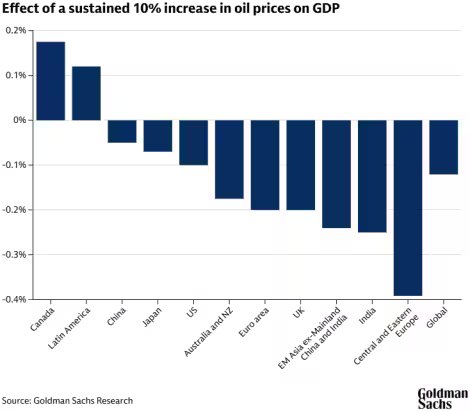
As a result, inflation expectations may rise as energy costs increase. According to the Reserve Bank of India, a 10% increase in international crude oil prices could raise India’s headline inflation by around 20 basis points.
This, in turn, influences interest rates and central bank policies. Not only that, but higher crude oil prices have an even greater impact on GDP growth.
Source: Goldman Sachs
Investors tend to seek the safety of the dollar, leading to sharp reactions in currency markets. This is because investors sell emerging market equities and reroute funds to the US equities.
As a result, the dollar strengthens and other currencies, especially emerging-market equities, weaken. This week, the India rupee depreciated 0.7%, while the dollar index gained 0.8%.
Collectively, these factors are negatively impacting equity markets. This week saw declines across indices: The South Korean Kospi (8.7%), the Japanese Nikkei (3.3%), the Nifty 50 (1.8%), and the Nasdaq (0.7%).
In such situations, sectors linked to global trade, exports, aviation, or logistics may experience pressure, while industries such as defence or refining companies may see temporary gains.
However, such market movements are rarely permanent. While the initial reaction is driven by fear, markets gradually shift their focus back to earnings and liquidity. Investors who react impulsively during crises often miss the recovery phase.
Focus on Asset Allocation Instead of Predictions
One of the biggest mistakes investors make during uncertainty is trying to predict market movements.
When war-related news dominates headlines, many investors attempt to rapidly shift investments (or, at worst, exit completely) between asset classes based on short-term expectations.
In practice, these decisions are extremely difficult to execute successfully. Markets are forward-looking and often react faster than individual investors can respond. By the time investors reposition portfolios, much of the market movement may already have occurred.
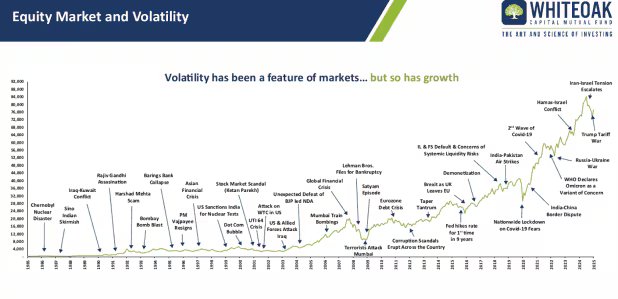
How Markets Behaved During Previous Wars
Source: Whiteoak Capital Mutual Fund
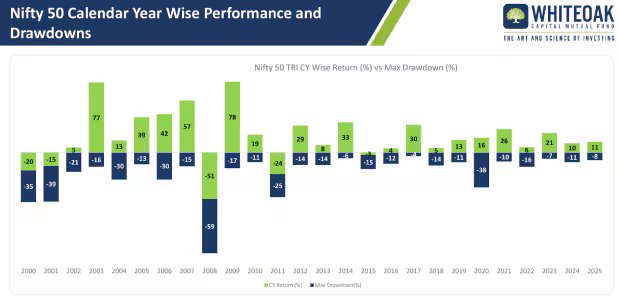
Volatility is a characteristic of stock markets and often acts as a precursor for future gains. Such volatility occurs every year, but even then, drawdowns even out in the long run.
Source: Whiteoak Capital Mutual Fund
Thus, a more reliable strategy is to maintain a balanced asset allocation. Diversification across equity, debt, and gold helps portfolios absorb shocks when one asset class experiences volatility.
For instance, as of 6 March 2026, gold has shown a significantly higher return over the last year, with a 76.3% gain, compared with the Nifty 50’s 8.4% gain.
But gains are not linear. Equity mutual funds provide exposure to long-term growth opportunities but are highly volatile. Debt funds play a stabilising role, cushioning volatility when equity markets turn turbulent. Gold funds act as a hedge during uncertainty, as investors shift toward safe-haven assets during crises.
When these asset classes are combined within a portfolio, their different reactions to market events help reduce overall volatility. Instead of relying on predictions, investors benefit from diversification.
Your SIP Investments Amid Market Volatility
What investment strategies can be adopted for mutual funds during periods of market volatility?
Systematic Investment Plans (SIPs) play a crucial role during uncertain market phases.
However, this is also the time when many investors are tempted to pause or stop their SIPs. This reaction is largely driven by fear. When markets decline sharply, investors worry that further losses may follow. As a result, they stop investing just when market valuations become more attractive.
The power of SIP investing lies in its ability to average purchase costs over time. When markets fall, the same monthly investment buys more units. When markets rise again, these additional units contribute to higher returns. Historical market cycles have shown this in action.
Additionally, the risk of loss is directly proportional to the holding period. A shorter holding period increases the risk of losses, whereas a longer investment horizon has progressively reduced this risk. So, investors who continued SIPs during volatility ultimately benefited when markets recovered.
Stopping SIPs during market corrections disrupts this compounding process. Thus, many investors choose to continue SIPs during such periods, as this allows them to average purchase costs.
Diversified Equity Funds Offer Stability
During periods of geopolitical tension, certain sectors may experience sudden gains while others face pressure. Defence or energy stocks may rise sharply during conflicts, whereas sectors linked to global trade or discretionary consumption may face short-term declines.
Attempting to capture these sector movements through direct stock or sector fund investments can be risky. Market reactions are often unpredictable and short-lived.
Diversified equity mutual funds provide a more balanced approach. These funds invest across multiple industries and companies, reducing dependence on any single sector.
Large-cap funds typically hold established companies with strong balance sheets and stable earnings. These companies often weather economic disruptions more effectively than smaller businesses.
Flexi-cap funds offer additional flexibility. Fund managers can adjust exposure across large-cap, mid-cap, and small-cap stocks depending on market conditions. This dynamic allocation helps navigate changing economic environments.
Mid and small-caps can offer growth despite higher drawdowns over the long-run. By investing through diversified funds, investors benefit from professional portfolio management and sector diversification without constantly monitoring market developments.
Hybrid Funds Provide Built-in Risk Management
Hybrid mutual funds combine equity and debt investments within the same portfolio. This structure makes them particularly useful during uncertain market conditions.
When equity markets become volatile due to geopolitical developments, the debt component helps reduce overall portfolio fluctuations. At the same time, equity exposure ensures that investors remain positioned for long-term growth.
Balanced advantage funds take this concept a step further. These funds actively adjust their equity and debt allocation based on market valuations and risk indicators.
When markets appear expensive or risk levels rise, the fund may reduce equity exposure and increase debt allocation. Conversely, when markets decline and valuations become more attractive, the fund gradually increases equity exposure.
This dynamic allocation approach helps manage volatility without requiring investors to make frequent portfolio adjustments themselves.
Gold Funds as a Hedge During Global Uncertainty
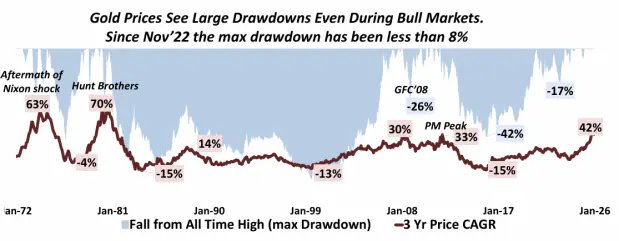
Gold has historically played an important role during geopolitical crises. When global uncertainty rises, investors often move capital toward assets perceived as safe stores of value.
This increased demand can push gold prices higher during periods of conflict or economic instability. As a result, gold often moves differently from equity markets.
Mutual fund investors can access gold exposure through gold ETFs or gold mutual funds. These funds track the price of gold and allow investors to participate in its performance without purchasing physical gold.
A modest allocation to gold can help balance portfolio risk during uncertain periods. However, gold should not dominate a portfolio because it does not generate income or earnings like equities. It also often comes with a higher drawdown.
Thus, it works best as a complementary asset that offsets equity volatility during global crises.
Source: DSP Netra February 2026 Edition
Avoid Emotional Decision-Making
Market volatility triggered by geopolitical events often leads to emotional investment decisions. Sharp declines can create panic, while sudden rallies may trigger fear of missing out.
Both reactions can harm long-term investment outcomes. Panic selling during market corrections locks in losses and prevents investors from benefiting when markets recover. At the same time, chasing short-term market trends can lead to poorly timed investments.
Successful investing during uncertain periods requires discipline. Investors should focus on long-term financial goals rather than reacting to daily news headlines.
Mutual funds help maintain this discipline by allowing professional fund managers to make portfolio adjustments based on research and market analysis.
Periodic Portfolio Review and Rebalancing
Although long-term discipline is important, investors should still review their portfolios periodically.
Market movements during uncertain periods can shift asset allocations away from their intended levels.
For example, if equity markets decline significantly, the proportion of debt investments within a portfolio may increase automatically. Conversely, a strong equity rally may leave a portfolio overly exposed to stock market risk.
If a portfolio originally targeted 60% equity but rallies push the allocation to 70%, trimming exposure restores the intended risk balance. Rebalancing helps restore the intended asset allocation.
This process involves reducing exposure to assets that have grown disproportionately and increasing investments in those that have declined.
Rebalancing forces investors to follow a disciplined approach, selling high and buying low, rather than reacting emotionally to market movements. Many investors review their portfolios annually or when allocations deviate significantly from their original targets.
Keep the Long-Term Perspective
Geopolitical conflicts often dominate global news cycles and create the impression that markets may remain unstable for extended periods.
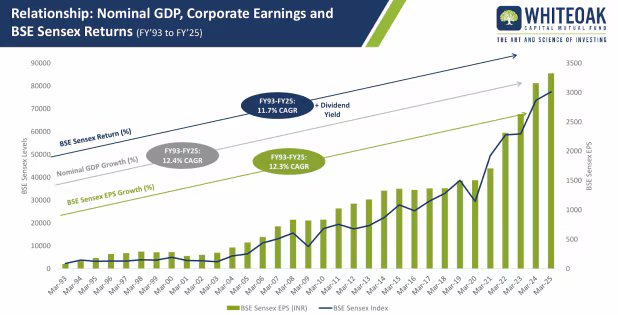
However, as stated above, historical data suggests otherwise. Financial markets have endured numerous wars, geopolitical crises, and economic disruptions over the decades. Long-term market trends have continued to reflect economic growth, innovation, and corporate expansion.
Source: Whiteoak Capital Mutual Fund
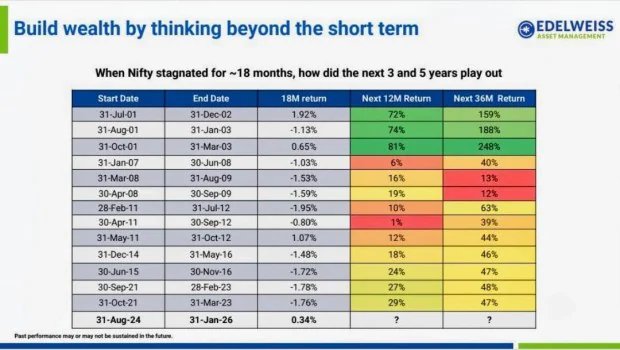
Investors who remain patient during uncertain periods profit from market recoveries when stability returns. The key is to avoid making drastic investment decisions based on short-term fear or speculation.
Source: Edelweiss Asset Management
Conclusion
Wars can create sharp market volatility, making investors anxious about their portfolios. Headlines amplify this anxiety giving the impression that markets may remain unstable indefinitely.
However, history consistently shows that markets eventually adjust to geopolitical realities and resume their long-term growth trajectory. For mutual fund investors, the most effective response is not to predict geopolitical outcomes but to maintain disciplined investment strategies.
A diversified portfolio that includes equity and debt funds, with limited exposure to gold, can help manage volatility during uncertain periods. Continuing SIP investments, avoiding emotional decisions, and periodically rebalancing portfolios help investors stay aligned with their financial goals.
Ultimately, wealth creation in financial markets depends more on patience and discipline than on reacting to short-term events. Investors who remain focused on long-term strategies are better positioned to navigate uncertainty and benefit when stability gradually returns.
Happy investing.
Disclaimer: This article is for information purposes only. It is not a stock recommendation and should not be treated as such. Learn more about our recommendation services here…
The website managers, its employee(s), and contributors/writers/authors of articles have or may have an outstanding buy or sell position or holding in the securities, options on securities or other related investments of issuers and/or companies discussed therein. The content of the articles and the interpretation of data are solely the personal views of the contributors/ writers/authors. Investors must make their own investment decisions based on their specific objectives, resources and only after consulting such independent advisors as may be necessary