
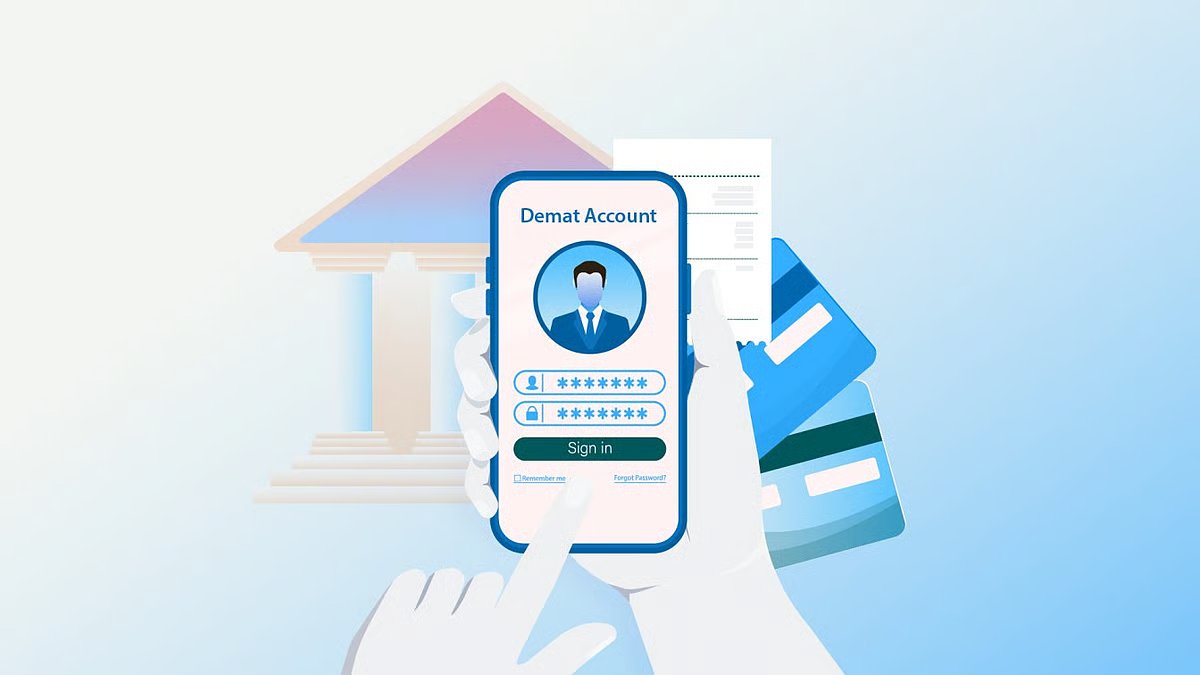
Smart investing begins with proper infrastructure and proper mindset. For many Indian investors, opening a demat account is basically the first step towards investing in financial markets – whether it is stocks, ETFs, or mutual funds held in demat form. Apart from opening a demat account, selecting proper mutual funds as per your risk profile, goals, and duration of investment is just as crucial.
In this article, you will learn the step-by-step procedure to open a demat account, get some valuable tips on choosing mutual funds, and understand the significance of the brokerage calculator and mutual fund appraisal tool to plan your investment journey.
What is a Demat Account?
A demat account, which is shorthand for dematerialised account, is an electronic account utilized by investors to store financial securities, including stocks, bonds, ETFs, and units of mutual funds. A demat account is an important replacement for traditional physical paper forms and streamlines investing and settlement procedures. Although recent modifications by SEBI made transferring mutual funds simpler without a demat account, most investors find it preferable to invest in either equities/ETFs through a demat account.
A Demat account is normally an integrated account (to purchase/sell securities) facilitating access to Stocks, Mutual Funds (without any commission), IPOs, ETF, Commodities (MCX), Futures, & Options.
Step-by-Step: How to Open Demat Account in India
Creating a demat account today is simpler and more technology-driven than ever before. Here’s how to do it:
1. Select a Depository Participant (DP)
It is a mandate to in collaboration with a Depository Participant (DP). The DP is usually a banking institution and stockbroker registered with the SEBI, like 5paisa.
Tip: Before picking one over the other, compare fees, usability of platforms, customer service, and available research facilities by both. It is as if you are comparing mutual funds; different persons may prefer different companies.
2. KYC Process – Know Your Customer
You will be required to provide necessary documents to verify KYC:
Many of the brokers use online e-KYC facilities, which allows video verification.
3. Complete Account Opening Form
The demat application form can be filled either online, through the broker’s website or mobile application, or offline at their branches. Ensure that your personal details are in accordance with these documents to prevent a delay in the process.
4. In-Person Verification
Under SEBI regulations, there is a provision of In-Person Verification (IPV) to check the authenticity of the individual’s identity, and this needs to be conducted by brokers, either through an online video session or at a branch office.
5. Sign Agreement & Receive Credentials
Once your application has been accepted and your papers verified, you may proceed as follows
-
You will be given a Demat Account number, also known as a Client ID
-
Setup login credentials
-
Link your demat account with your bank account for transactions
Your demat account is now ready to be used for storing securities.
Mutual Funds and Your Demat Account
Demat accounts are commonly known for holding stocks and ETFs, but they can hold units of mutual funds too, in case they are held in demat form. But SEBI has recently allowed transfer of mutual fund units from one investor to another, even without a demat account, making it optional for mutual fund accounts only.
For new investors, the units of a mutual fund can be held in the form of a Statement of Account (SoA) with the mutual fund itself without the need for a demat account.
However, assuming that you wish to invest in market securities as well as mutual funds, a demat account would help manage everything from a single source, and it may also allow you to invest in ETFs or other listed mutual funds.
How to Select the Correct Mutual Fund Options
Once you are ready with your demat account (or even if you decide to not use it while doing transactions involving mutual funds), the next important step is to zero in on the right mutual fund schemes, based on your requirements.
1. Define Your Financial Goals
Beginning with questions such as:
-
What is your investment timeframe: Short term/Mid term/Long term?
-
Are these savings for your retirement, your kids’ education, or wealth generation?
-
Do you feel comfortable at a risk level of:
Your responses will help determine which option, equity, debt, hybrid, and/or tax savings funds of mutual funds will help your portfolio.
2. Know the Types of Mutual Funds
Here’s a quick rundown:
-
Equity Funds: Invests in stocks for long-term growth; higher returns but also involves a high degree of risk. Suited for investing for 5+ years.
-
Debt Funds: Emphasis on bonds and fixed income, providing stability and relatively lower risk, suited for short to medium-term objectives.
-
Hybrid Funds: Combine equity and debt funds to manage risk and returns
-
Index Funds/ETFs: These are passive investment instruments that track a market index. They are generally less expensive
3. Evaluate Risk Tolerance
Assess how you respond to market fluctuations:
-
Aggressive: More equity and mid/small cap funds
-
Moderate: A combination of large cap mutual fund schemes and hybrid mutual fund schemes.
-
Conservative: Debt or liquid funds predominate
This corresponds with allocation guidance that financial experts recommend within a portfolio
4. Assessing Investment Fund Performance and Management
Consider:
-
Consistency over 3–5 years
-
Expense ratios
-
Fund manager’s track record
-
Use comparison tools such as Morningstar data or fund rating systems
This is a process of comparison akin to evaluating the performance of brokers using a – you are essentially comparing costs and performance to make the optimum decision.
5. Diversification
Diversification across categories (equity, debt, index, and thematic funds) also assists in risk protection and capitalizing on growth opportunities. Diversification of mutual funds in portfolio is similar to other forms of portfolio diversification, including stocks, bonds, as well as ETFs.
In Summary
Here’s a basic journey map:
-
Open Demat Account: Complete the KYC process. Provide the necessary documents. Select the DP. Check the costs. Calculate the costs using the brokerage calculator.
-
Decide whether mutual funds should be held in demat form; perhaps the SoA route is suitable for some, whilst for combined tracking with stocks/ETFs, the demat option could be best.
-
Pick mutual fund types and schemes, depending on objectives, risk tolerance, and the time horizon.
-
Invest in SIPs or lump sum investment – SIPs diversify risk by rupee cost averaging and are suited for long-term goals.