

4 min readMumbaiUpdated: Apr 13, 2026 10:00 PM IST
Systematic investment plans (SIPs) in mutual funds were discontinued in March, more than they were registered by investors. The trend comes as the West Asia crisis has rattled the markets, making retail participants nervous.
However, despite the sell-off, SIP inflows scaled a record high, reflecting some resilience in mutual fund participation even as volatility weighed on the sentiment.

This divergence suggests that weaker-handed investors exited their SIP commitments, while more conviction-driven participants stepped up contributions, seeing the market correction amid war-related fears as an opportunity to invest, fund managers said.
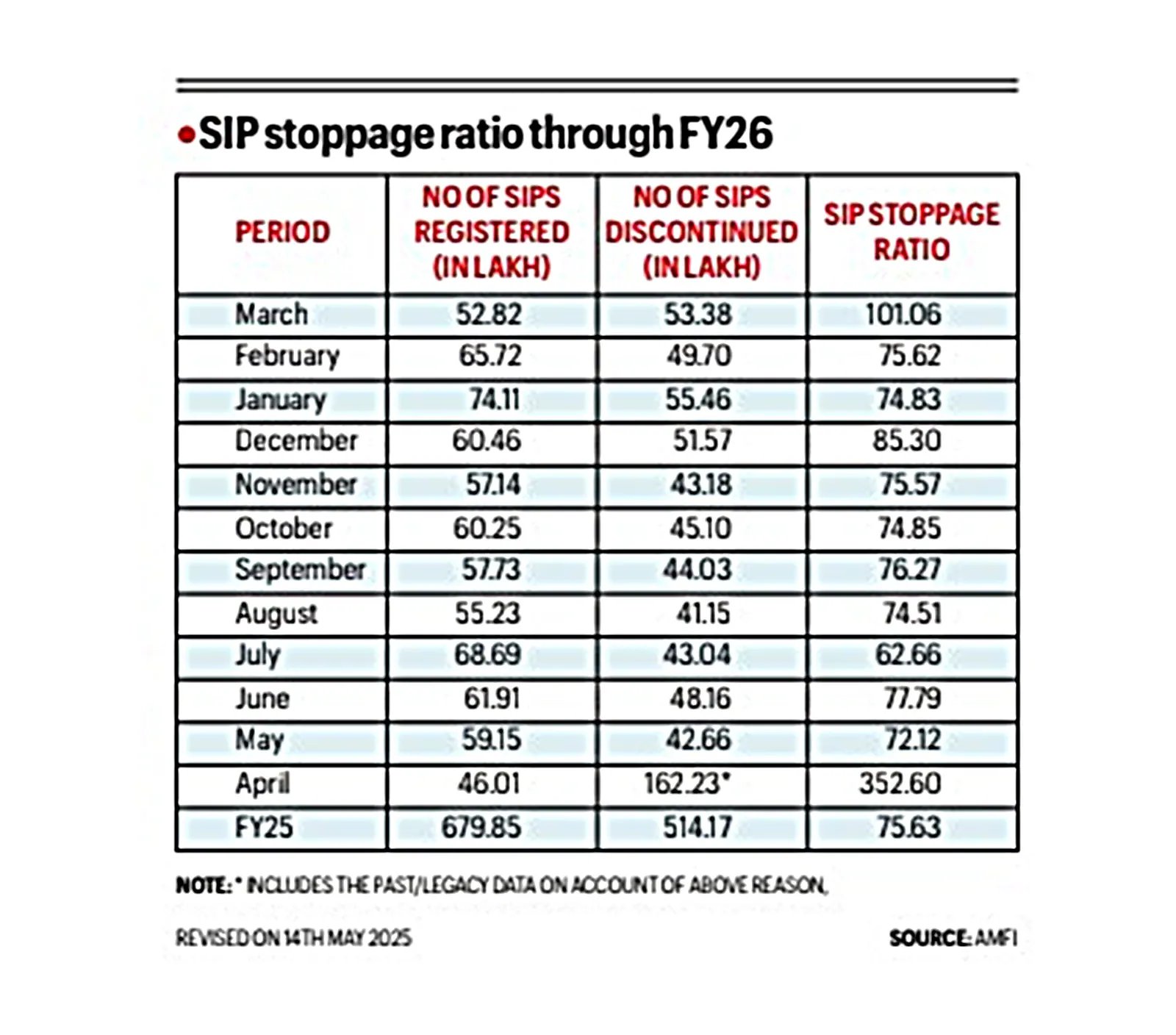
In March, around 52.82 lakh new SIPs were registered, while about 53.38 lakh SIPs discontinued, according to data from the Association of Mutual Funds in India. This pushed the SIP stoppage ratio, calculated as discontinued SIPs divided by those that were added, to 101.
While the number of SIPs discontinued was broadly within the range seen over the past three months, new SIPs registered lagged the three-month average of around 66.76 lakh, reflecting the nervousness among retail investors.
“The market sell-off has sharply eroded the value of investors’ holdings in schemes, triggering panic and prompting many retail investors to discontinue their SIPs. My sense is that the bulk of SIP contributions through SIPs in March likely came from high-net-worth individuals and family offices,” said an analyst with a research firm.
Since the conflict began, the benchmark indices fell 11% from their pre-war levels due to high crude oil prices and persistent selling by foreign investors.
However, Venkat Chalasani, Chief Executive of AMFI, said a higher stoppage ratio is not a major concern, as it may reflect investors reallocating across schemes or exiting upon achieving their financial goals.
Story continues below this ad
“When it comes to SIPs, our focus is on the number of contributing accounts and the monthly inflows, as these provide a clear view of retail investor behaviour,” he said in an interaction with The Indian Express. The more important indicators are the growth in overall contributions and the expanding base of contributing investors, he said.
 Despite the higher SIP stoppage ratio, contributions through SIPs rose to a record of Rs 32,087 crore in March, up 7.5% month-on-month. (Source: AMFI)
Another argument is that a surge in discontinued SIPs often does not reflect declining sentiment in retail investors, as the data includes people who have shifted to other products or people who have missed three straight instalments, or it could also be caused by a cleanup in the system to get rid of inactive accounts. Thus, the number of contributing SIP accounts may be a better benchmark in such cases, said an expert.
Despite the higher SIP stoppage ratio, contributions through SIPs rose to a record of Rs 32,087 crore in March, up 7.5% month-on-month. While SIP assets fell by 9.2% to Rs 15.11 lakh crore during the month due to the underperformance of the equity market, it constituted 20.5% of the total industry’s AUM, compared to 20.3% in February. The count of contributing (active) SIP accounts rose by 3% to 9.72 crore in March, AMFI said in its monthly note.
The higher stoppage ratio in March may have been due to new investors being cautious about starting SIPs during volatile market conditions, while existing investors possibly saw the correction since the war started as an opportunity to make returns. “My sense is since the market is volatile, some people who are well seasoned or are informed in terms of how the market behaves would have increased their contribution. To initiate new SIPs in such an environment could be difficult, since there is always a bearing of trailing returns on new investors,” said George Thomas, equity fund manager at Quantum Asset Management Company.
Story continues below this ad
While the stoppage ratio crossing 100 on a single occasion is not particularly concerning, retail investors may turn cautious if the markets remains range-bound for an extended time, leading to lower returns, Thomas said. Markets have been broadly range-bound since the bull run seen back in August 2024, with the Nifty 50 roughly cycling between 22,000-26,000 points during that period.
Equity mutual funds saw good participation in March, with net inflows into such funds rising 56% month-on-month to Rs 40,450 crore, the highest level since July 2025. This was led by segments such as flexi-cap, mid-cap, and small-cap. Equity funds are, by far, the biggest category in the industry, constituting 43% of the total AUM of the industry.