

Close Menu
Fund Focus News
    Facebook X (Twitter) Instagram
    Trending
    • Bitcoin ETFs Lose Accumulation Momentum Despite Short-Term Inflow Spikes
    • Small-Cap ETFs: ISCB Outperforms, but SPSM Yields More
    • 2 Vanguard Funds That Can Turn $450 Per Month Into $1 Million in 30 Years
    • Private credit investors pull $7bn from Wall Street’s biggest funds
    • Debt mutual funds v/s tax-free bonds: Which is safer?
    • Top Mutual Funds for 2026 As Per Perplexity AI Picks
    • Active ETFs Face New Cost Pressure as Schwab Weighs Distribution Fees: JPM – ARK Innovation ETF (BATS:ARKK), PIMCO Active Bond Exchange-Traded Fund Exchange-Traded Fund (NYSE:BOND)
    • ICICI Prudential Mutual Fund Launches Two Offerings Under The iSIF Segment
    Facebook X (Twitter) Instagram
    Fund Focus News
    • Home
    • Bonds
    • ETFs
    • Funds
    • Investments
    • Mutual Funds
    • Property Investments
    • SIP
    Fund Focus News
    Home»Mutual Funds»Passive multicap funds: Low cost, broad exposure without fund manager risk | Personal Finance
    Mutual Funds

    Passive multicap funds: Low cost, broad exposure without fund manager risk | Personal Finance

    August 19, 2024


    3 min read Last Updated : Aug 19 2024 | 10:22 PM IST


    Multicap funds continue to attract mutual fund investors. According to the Association of Mutual Funds in India (Amfi), these funds saw inflows of Rs 7,084 crore in July 2024, the highest among diversified equity schemes. Traditionally, the mutual fund industry has offered actively managed multi-cap schemes. 


    However, recent days have seen a surge in passive fund offerings within this category, including Navi Nifty 500 Multicap 50:25:25 Index Fund, HDFC Nifty 500 Multicap 50:25:25 Index Fund, and Mirae Asset Nifty 500 Multicap 50:25:25 Exchange-Traded Fund (ETF).  “With the markets scaling fresh highs in July 2024, passive multi-cap funds can be a good choice for investors since they provide a well-distributed exposure to large, mid, and small companies. They have a moderate risk-return profile and are less risky than pure midcap and smallcap funds,” says Siddharth Srivastava, head – ETF product and fund manager, Mirae Asset Investment Managers (India).


    The multicap universe
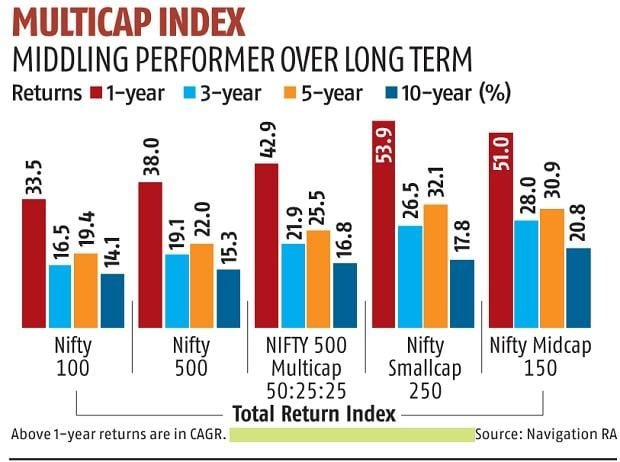
     

    Multicap schemes allocate at least 25 per cent each to large, mid, and smallcap stocks, with the remaining 25 per cent invested at the fund manager’s discretion. “This diversification reduces risk, as the fund is not overly exposed to any single market segment,” says Ravi Kumar TV, founder, Gaining Ground Investment.

    Chart


    As of July 31, 2024, 26 multi-cap schemes managed assets worth Rs 1.68 lakh crore, according to Amfi data. The performance of these schemes is often benchmarked against the Nifty Multicap 50:25:25 Total Return Index, which includes 503 stocks across large, mid, and smallcap companies, weighted at 50 per cent, 25 per cent, and 25 per cent, respectively. The top three sectors in the index are financial services, capital goods, and information technology, with weights of 25.1 per cent, 8.8 per cent, and 8.3 per cent, respectively.


    Active vs passive funds


    Passive funds eliminate fund manager risk. “In the past three years, active multicap funds have allocated 37-44 per cent to large caps, 21-27 per cent to mid caps, and 25-30 per cent to small caps. In contrast, the ETF-based Nifty 500 Multi-cap 50:25:25 Index provides a fixed 50 per cent exposure to largecap and 25 per cent each to midcap and smallcap segments. Being rule-based, there is no risk of over or under-allocating to a market cap segment, sector, or stock based on the fund manager’s view,” says Srivastava. 


    However, passive funds have limited flexibility in adjusting holdings according to market conditions. “If certain sectors underperform, passive funds cannot shift away. Investors miss out on the alpha that active multicap funds generate. Exposure to mid and smallcap stocks introduces volatility and risk compared to largecap funds,” says Ravi Kumar.


    Best for the undecided


    Multicap schemes are beneficial for investors unsure about their allocation within equities. They make rebalancing across market cap segments tax-efficient and smooth. Individuals may find it challenging to rebalance on their own. “Passive multicap funds suit investors who prefer a long-term, hands-off approach and are content with market-matching returns. Those seeking to benefit from broader market changes, as captured by active fund managers, should consider active multicap funds,” says Ravi Kumar. “Cost-conscious investors may favour a passive multicap product like an ETF, which carries no exit load and can be traded on exchanges just like stocks,” adds Srivastava.

    First Published: Aug 19 2024 | 10:22 PM IST


    Source link

    Share. Facebook Twitter Pinterest LinkedIn Tumblr Telegram Email

    Related Posts

    Debt mutual funds v/s tax-free bonds: Which is safer?

    January 16, 2026

    ICICI Prudential Mutual Fund Launches Two Offerings Under The iSIF Segment

    January 16, 2026

    Mutual Fund Assets Triple in Three Years on Strong Domestic Inflows TechJuice

    January 16, 2026
    Leave A Reply Cancel Reply

    Top Posts

    The Shifting Landscape of Art Investment and the Rise of Accessibility: The London Art Exchange

    September 11, 2023

    Charlie Cobham: The Art Broker Extraordinaire Maximizing Returns for High Net Worth Clients

    February 12, 2024

    The Unyielding Resilience of the Art Market: A Historical and Contemporary Perspective

    November 19, 2023

    Bitcoin ETFs Lose Accumulation Momentum Despite Short-Term Inflow Spikes

    January 17, 2026
    Don't Miss
    ETFs

    Bitcoin ETFs Lose Accumulation Momentum Despite Short-Term Inflow Spikes

    January 17, 2026

    TLDR: Bitcoin ETF holdings have moved sideways since early 2025, signaling stagnation rather than renewed…

    Small-Cap ETFs: ISCB Outperforms, but SPSM Yields More

    January 17, 2026

    2 Vanguard Funds That Can Turn $450 Per Month Into $1 Million in 30 Years

    January 17, 2026

    Private credit investors pull $7bn from Wall Street’s biggest funds

    January 17, 2026
    Stay In Touch
    • Facebook
    • Twitter
    • Pinterest
    • Instagram
    • YouTube
    • Vimeo
    EDITOR'S PICK

    Pretty purple flowers and pretty purple sips in Ipswich this Jacaranda season

    October 25, 2024

    Singapore strata office transactions to hit S$1B in 2024

    August 26, 2024

    Active ETFs hit the spot with investors

    July 20, 2024
    Our Picks

    Bitcoin ETFs Lose Accumulation Momentum Despite Short-Term Inflow Spikes

    January 17, 2026

    Small-Cap ETFs: ISCB Outperforms, but SPSM Yields More

    January 17, 2026

    2 Vanguard Funds That Can Turn $450 Per Month Into $1 Million in 30 Years

    January 17, 2026
    Most Popular

    🔥Juve target Chukwuemeka, Inter raise funds, Elmas bid in play 🤑

    August 20, 2025

    💵 Libra responds after Flamengo takes legal action and ‘freezes’ funds

    September 26, 2025

    ₹10,000 monthly SIP in this mutual fund has grown to ₹1.52 crore in 22 years

    September 17, 2025
    © 2026 Fund Focus News
    • Get In Touch
    • Privacy Policy
    • Terms and Conditions

    Type above and press Enter to search. Press Esc to cancel.