

Did you know just 27 mutual fund schemes, out of a universe of over 1,900, each manage more than ₹50,000 crore in assets? Together, these giant funds account for nearly ₹21 lakh crore, or about a quarter of the industry’s total Assets Under Management (AUM) of ₹82 lakh crore as of February 2026. Of these 27, 11 are actively managed equity funds, including behemoths such as Parag Parikh Flexi Cap (₹1.34 lakh crore), HDFC Flexi Cap (₹1 lakh crore), and HDFC Mid Cap (₹94,257 crore), which incidentally are bigger than many listed firms.
As equity fund AUM swells, some schemes are becoming too large to ignore. That revives an old question: does size hurt performance? As funds grow, deploying money gets harder, agility falls, and returns can suffer, especially in mid- and small-cap segments where liquidity is thinner. But does the data support this perception? A bl.portfolio analysis of the largest schemes across key active equity categories over the past five years suggests that size, by itself, is not a handicap.
What we studied
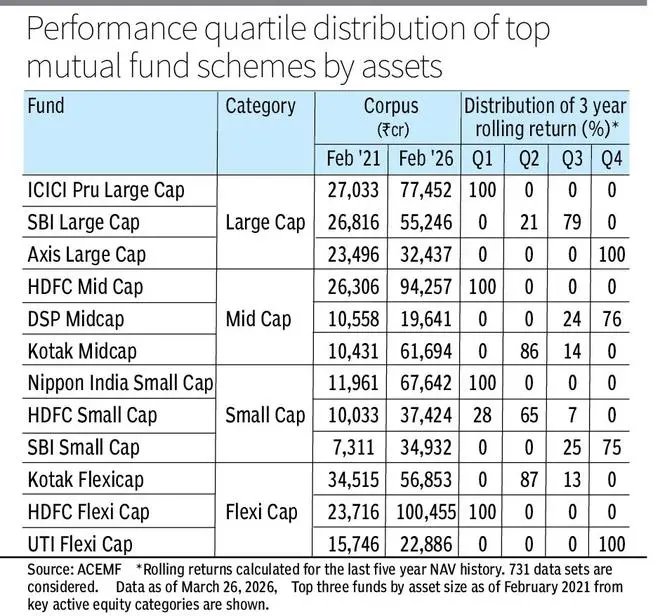
The study aims to understand how large-sized funds perform compared with their peers in actively managed equity categories such as large-cap, mid-cap, small-cap, and flexi-cap. To do this, we selected the top three funds by assets as of February 2021 and tracked their performance over the following years against other funds in their categories. The analysis covers 27 large-cap funds, 24 mid-cap funds, 22 small-cap funds, and 24 flexi-cap funds. At the time of selection, the chosen funds had assets ranging from ₹7,311 crore to ₹34,515 crore, which were considered sizeable given the market depth then.
We then evaluated their performance relative to peers over the next five years, from March 2021 to March 2026, using rolling returns. Both one-year and three-year rolling returns were computed and ranked into quartiles, from the top quartile (Q1) to the bottom quartile (Q4), to assess relative performance within each category. A quartile divides a group into four equal parts of 25 per cent each. For instance, SBI Large Cap Fund, based on 1,462 one-year rolling return observations, had about 50 per cent of instances in Q1, 19 per cent in Q2, 7 per cent in Q3, and 24 per cent in Q4.
Results
First, the largest fund in each category delivered strong and consistent performance. ICICI Pru Large Cap Fund had 100 per cent of its three-year rolling returns in the top two quartiles (Q1 and Q2, which lie above the category average). Similarly, HDFC Mid Cap and Nippon India Small Cap recorded all their observations in the top two quartiles, while Kotak Flexicap had 87 per cent of its returns in these segments. This indicates that scale, in itself, has not hindered performance.
Second, when the analysis is expanded to include the top two and top three funds by assets, outcomes become more varied. While some funds consistently dominate top-quartile rankings, others lag. For example, UTI Flexi Cap, Axis Large Cap, and DSP Midcap saw all their three-year returns fall in the lower quartiles (Q3 and Q4, which lie below the category average). In these cases, the chosen investment style may not have translated into favourable outcomes. Among the 12 largest funds studied, five consistently outperformed, four delivered mixed results, and three underperformed, based on both 1-year and 3-year rolling returns. Overall, performance among large sized funds across categories remains a mixed bag, with no clear evidence that higher AUM leads to weaker outcomes.
Third, several funds that were relatively small in 2021 have scaled up significantly while delivering strong returns. Parag Parikh Flexi Cap Fund grew from ₹7,452 crore to ₹1.34 lakh crore, Nippon India Growth Mid Cap from ₹8,990 crore to ₹43,000 crore, Motilal Oswal Mid Cap from ₹1,902 crore to ₹33,689 crore, Bandhan Small Cap from ₹930 crore to ₹20,474 crore, and Quant Small Cap from ₹135 crore to ₹27,654 crore. This highlights how sustained performance can drive rapid asset growth.
Growth drivers
Consistent outperformance remains the key trigger for inflows, as investors and distributors gravitate towards funds with strong track records.
Market cycles also play a role, with mid- and small-cap funds attracting higher inflows during bullish phases. Distribution strength further amplifies growth. Funds backed by large AMCs, with wide distributor networks and strong brand recall, tend to attract steady SIP flows. In addition, star fund managers, favourable ratings, and media visibility help channel incremental capital. At the core, flagship schemes are carefully and deliberately nurtured by fund houses through strong research, disciplined portfolio construction, and continuous monitoring. Examples include Parag Parikh Flexi Cap and Kotak Flexi Cap Fund. These schemes receive sustained attention from experienced investment teams, helping them build long-term track records and investor confidence, which in turn drives steady asset growth for the AMC.
Size edge
Large funds benefit from advantages that smaller peers may lack. Big AMCs also have deeper research capabilities and stronger engagement with company managements.
The impact of size, however, varies across market cap segments. In large-cap and flexi-cap funds, size is less of a constraint. In some cases, strategy plays a key role.
In mid- and small-cap funds, capacity constraints are more relevant. Deploying large inflows into relatively illiquid stocks can raise entry costs. In large funds, even a 1 per cent allocation can amount to ₹300 crore, making it difficult to build positions without influencing prices. Managers may respond by diversifying across more stocks or favouring relatively liquid names, which can moderate alpha. Large schemes such as Nippon India Small Cap Fund, for instance, maintain highly diversified portfolios (244 stocks as of February 2026). That said, experienced fund managers mitigate these challenges through staggered deployment, liquidity discipline, and robust portfolio construction. Hence, several large funds continue to deliver strong performance despite having scale.
Takeaways
Size alone is not a red flag. The biggest fund in each category generally held up well. But that pattern did not carry across all large funds, where results were far more mixed. In many cases, good performance seems to have created size, not the other way round.
Several funds scaled up sharply over the period while still delivering strong returns. What matters more than corpus, is what scale does to the strategy. That is more relevant in mid- and small-cap funds, where liquidity can shape portfolio choices.
Lastly, size usually becomes a problem only when market conditions turn and liquidity tightens. Until then, strong returns can mask rising capacity stress.
So, investors should judge not just returns, but whether a fund can stay true to its strategy as it gets bigger.
it
Published on March 28, 2026