
Amanda Berg/For Spotlight PA
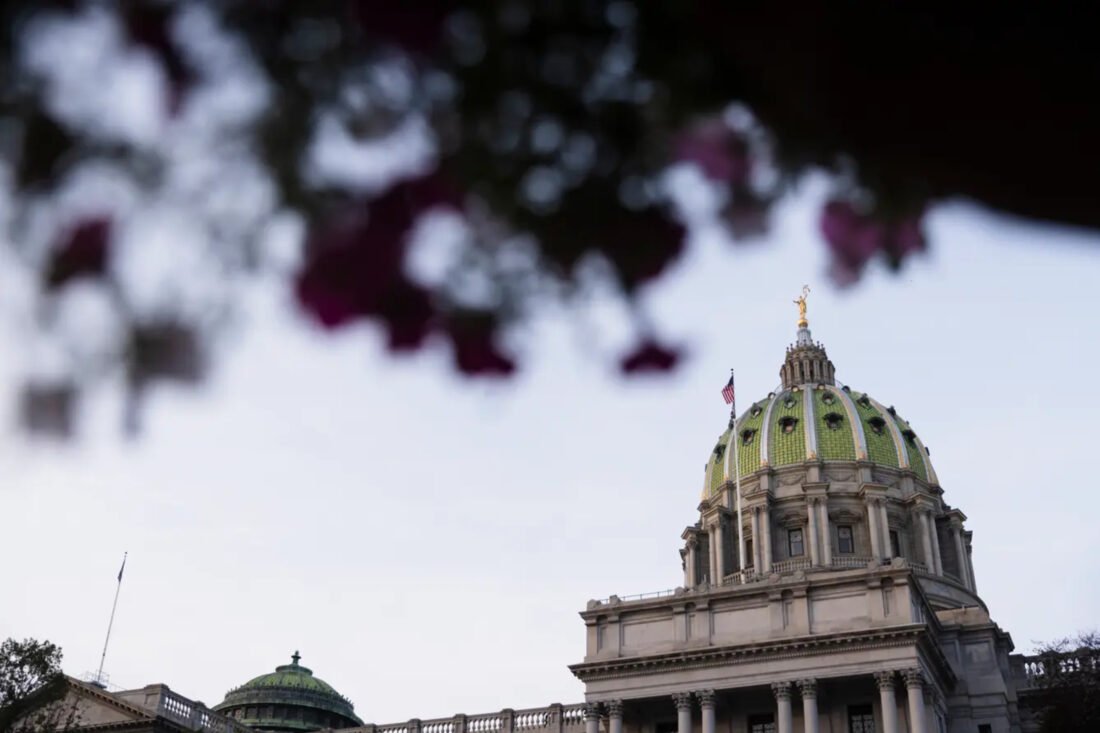
The Pennsylvania Capitol in Harrisburg is pictured.
HARRISBURG — Pennsylvania lawmakers have passed a $50.1 billion budget that makes additional investments in public schools, creates a new tax credit for lower-income people and ends the state’s participation in a climate program.
The bills that made up the final package won bipartisan approval in the state House and Senate on Wednesday. Democratic Gov. Josh Shapiro signed the legislation Wednesday afternoon.
The deal ends a four-month budget impasse that stopped the flow of billions of state dollars to schools, counties and nonprofits that provide critical public services. It includes a mix of compromises designed to win enough support in the divided General Assembly.
Among what Democrats touted as wins: a $178 million reduction in public school districts’ reimbursements to cyber charter schools and more than $500 million in new funding for the poorest schools to help close an “adequacy gap.”
Republicans, meanwhile, celebrated the end of Pennsylvania’s participation in the Regional Greenhouse Gas Initiative, a key climate program that caps carbon pollution.
The impasse was primarily driven by deep, partisan disagreements about state spending. While Pennsylvania is flush with cash built up during the pandemic, its annual bills for services like Medicaid and education regularly outstrip the state’s annual revenues.
The final deal leaves the state’s $7.4 billion rainy day fund untouched, but does use almost $4 billion from other reserves.
Democrats had also sought new, recurring revenue to stabilize the state’s public transit agencies, including SEPTA in Philadelphia. Ultimately, SEPTA was allowed to tap a special state fund, and Democrats dropped the demand.
Both sides spent the months since the June 30 deadline trading private proposals and increasingly harsh rhetorical broadsides as closed-door talks ebbed and flowed with no results.
All the while, the consequences of the impasse continued mounting.
Public schools across the commonwealth cut programs, spent down their reserves or took out loans as the state failed to make billions in critical payments. The strain also extended to safety net programs like rape crisis centers, nonprofits like those that run early childhood intervention programs and county-administered services such as foster care and homeless assistance.
Ultimately, the final budget deal was more than a billion dollars less than what Shapiro initially wanted and more than $2 billion over what the GOP had advanced.
“If we were just going to spend $50 billion,” state Sen. Dawn Keefer (R., York) told reporters Tuesday, “why didn’t we do it four months ago?”
Education spending
The budget provides $565 million to aid schools that were found to be inadequately funded under a 2023 court ruling.
“For two straight years, a bipartisan commitment to adequacy signals that lawmakers have made this a non-negotiable priority until full constitutional compliance is achieved,” PA Schools Work, a coalition including the plaintiffs in that suit, said. “That represents progress and integrity.”
Those dollars will mostly flow to schools in low-income communities with students who need extra help or that face high property taxes.
The budget also includes $125 million for school facilities and $100 million for school mental health and safety, but otherwise only boosts the state’s general school district subsidy by $105 million, or 1.3%
Instead, districts will collectively save $178 million through a change to how the state’s cyber charter schools are reimbursed, a longtime bipartisan priority.
Pennsylvania school districts must pay tuition to charter schools for any students within their borders who opt to attend one. Districts pay online-only cyber charter schools the same rate that it does for brick-and-mortar schools, despite the former’s lower overhead costs.
The budget received immediate pushback from cyber charter school officials, who argued that the toll to their finances may be even higher than estimated.
“Fair funding cannot be a right reserved only for students in brick-and-mortar school districts,” Karla Johnson, CEO at Pennsylvania Leadership Charter School, said in a statement. “It must also belong to the more than 65,000 children who attend Pennsylvania’s public cyber charter schools, and depend on them for their education and their future.”
The deal also included another bipartisan cyber charter school reform: mandating weekly wellness checks on students, wherein a teacher or administrator must be able to visibly see the student to ensure their well-being. The original legislation was spurred, in part, by the death of a 12-year-old cyber charter student.
No new revenue sources
Lawmakers were unable to agree on any new revenue sources.
So-called “sin taxes” on marijuana or gaming tend to be the most popular options, but even passing those proposals requires navigating major ideological differences within the General Assembly and powerful special interests.
For instance, increasing taxes on sports betting and online gaming to fund public transit was recently raised during closed-door talks, one source familiar with negotiations told Spotlight PA. However, the idea received major pushback from sports betting firms, including social media videos by influencers and prime-time TV ads. The source said this spooked state Senate Republicans, and the plan was shelved.
Other options, like new or increased taxes on businesses, personal income or sales, could raise more revenue but have few champions in the legislature.
Still, the budget won’t dip into the state’s rainy day fund. Instead, it taps unused funds in multiple state agencies’ coffers from previous years and draws down funding from dozens of special funds established over the years.
For example, the fiscal code specifies that the unspent funds that were earmarked for avian flu relief initiatives in last year’s budget can be returned to the state’s general fund.
In total, the state will use about $3 billion that state Senate Majority Leader Joe Pittman (R., Indiana) said was pulled from the “couch cushions of bureaucracy.”
New family tax credit
Lawmakers created a new state tax credit that mirrors the federal earned income tax credit, which benefits low and moderate-income individuals.
Pennsylvanians will be able to claim the state’s Working Pennsylvanians Tax Credit if they claim the federal tax credit in the same year. The state’s version would be equal to 10% of the federal tax credit.
In 2025, individuals who made up to $62,000 or married couples who earned up to $69,000 were able to claim up to around $8,000, depending on whether and how many kids they had.
Democratic and Republican lawmakers in both chambers lauded the creation of the tax credit, saying that it would help make life more affordable for everyday Pennsylvanians.
“We put money back into the pockets of low-income, working Pennsylvanians,” state Senate President Pro Tempore Kim Ward (R., Westmoreland) said on the floor of the chamber. “They can take that money and they can use it for shoes, food, long-term care, daycare, anything they want to use it for that helps them maintain their quality of life.”
Relief for some harmed
by impasse
The deal includes some aid for counties, certain educational programs and specific nonprofits that took out a loan offered by Treasurer Stacy Garrity.
The deal allows Garrity, challenging Shapiro for governor next year, to waive interest on those loans. The language also prevents a similar program in any future budgets.
State Senate Republicans previously passed the proposal through the upper chamber, but House Democrats never took up the measure.
The end of RGGI
A key item that helped seal the deal was Democrats’ willingness to use the Regional Greenhouse Gas Initiative as a bargaining chip to bring state Senate Republicans back to the table.
Republican lawmakers have been pushing the state to leave the program since the state first began the process of joining it in 2019.
The interstate program caps the amount of carbon that companies are allowed to emit. Then-Gov. Tom Wolf directed the state to join the initiative through an executive order, though lawsuits from Republican lawmakers and energy producers prevented the state from participating in the program.
The budget deal also includes several Democratic energy priorities, including an additional $25 million for a popular grant program that provides schools with money to install solar panels. It also authorizes the spending of federal funding for solar panel construction, previously frozen money.
The budget deal also includes permitting reform sought by Senate Republicans, mandating faster response times for specific air quality and water quality permits.
——
Spotlight PA is an independent, nonpartisan, and nonprofit newsroom producing investigative and public-service journalism that holds power to account and drives positive change in Pennsylvania.