

Global markets opened the week on the back foot after U.S. and Israeli strikes on Iran heightened tensions in the Middle East and rattled investors.
In the U.S., equities futures were trading lower ahead of Monday’s opening bell. S&P 500 futures were down 1.1% shortly after 8:15 a.m. ET, with Nasdaq 100 futures down 1.5% and Dow Jones Industrial Average about 1.1% lower.
In Europe, all major regional bourses were in negative territory, as the pan-European Stoxx 600 fell almost 1.8% during Monday’s session. The oil and gas sector was the sole positive in the region’s sell-off.
Earlier, Asian markets started the day lower across the board, with major markets in the region in negative territory. However, some losses were partially offset by gains in oil and gold mining stocks, particularly in Australia.
Here are all the notable moves in financial markets as the Middle East conflict plays out.
Energy stocks surge
Energy prices surged as investors priced in the risk of a broader Middle East conflict.
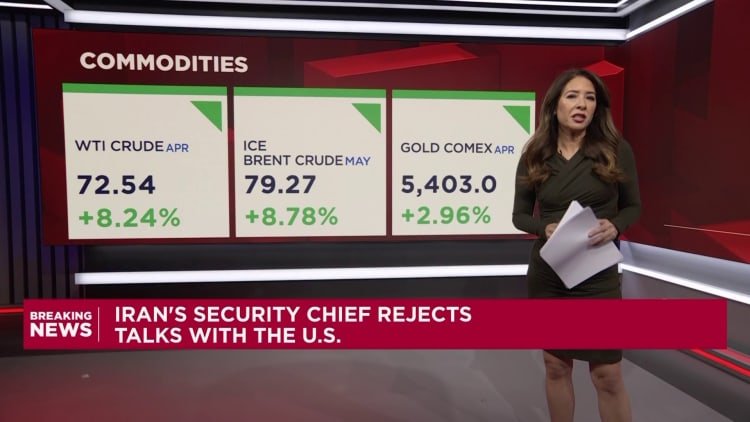
U.S. crude oil was around 7.2% higher at 8:15 a.m. ET, trading around $71.84 a barrel. Global benchmark Brent jumped 7.8%, and was last seen trading around $78.63.
Oil markets are now focused on the Strait of Hormuz, the world’s most critical energy chokepoint.
While the waterway has not been formally closed, tanker traffic has slowed to a near standstill amid surging war-risk insurance premiums and shipping suspensions, JPMorgan said in a note, forcing an “immediate repricing of geopolitical risk rather than a measured response to fundamentals.”
The bank also warned that if disruptions extend beyond three weeks, Gulf producers could exhaust storage capacity and be forced to shut in output, a scenario that could push Brent into the $100–$120 range.

Brent crude.
Airline stocks remain grounded
Airline stocks were the largest losers across the board, with all major Asian and European airlines looking at losses.
According to Circium, over 50% of global flights heading to the Middle East region have been cancelled as of 6.30 a.m. Singapore time. The data provider said that this figure could be higher as “some airlines have not updated their schedules to officially cancel flights, or have simply not flown the flights.”
In Europe, International Consolidated Airlines, which owns stakes in British Airways, Iberia, Vueling, Aer Lingus, fell more than 5%. TUI AG, the German multinational holiday operator, was last seen 9.3% lower.
Australia’s Qantas fell 5%, even though none of its flights were affected, while Japan’s flag carriers ANA and Japan Airlines also registered losses of more than 5%.
Nikkei reported that JAL had cancelled its flight from Tokyo to Doha on Saturday. Singapore Airlines slid 4.74% while Taiwan’s Eva Air also lost 4.47%.
Defense stocks edge higher
U.S. defense stocks posted gains. Lockheed Martin and Northrop Grumman each notched 5% in pre-market trading.
In Europe, U.K. defense staple BAE Systems rose 5.3%, as Italy’s Leonardo advanced 3.7%, with several other regional defense stocks rising.
Asian defense stocks were muted as South Korean markets were closed for a public holiday.
Japan’s defense heavyweights Mitsubishi Heavy Industries and IHI rose over 3%. Singapore’s ST Engineering climbed 4%.
Analysts from Franklin Templeton wrote Monday that they favored energy, shipping, insurance and defense in the near term, while remaining cautious on fuel-sensitive cyclicals such as airline stocks.
Safe havens
Gold, a classic safe haven, climbed on heightened geopolitical uncertainty and softer bond yields, reinforcing its traditional role as a hedge during periods of stress.
Spot gold rose almost 2.5% to reach $5409.69, while gold futures jumped 3.1%, to $5,410. Asian gold miners, mainly concentrated in Australia, also advanced over 4%, including Northern Star Resources and Evolution Mining.
“There’s clearly some tactical rotation into precious metals, especially in an environment defined by geopolitical stress and currency debasement concerns,” said Kurt Hemecker, CEO of Gold Token SA.
Bitcoin pared earlier losses to rise 1.4% to around $66,236, but remained well below its October peak of around $126,000.
Gold futures.
“Gold’s rally reflects demand for stability and balance sheet protection, whereas crypto’s weakness is more about liquidity tightening and positioning fatigue,” said Hemecker.
On the currencies front, the dollar index strengthened about 0.65%, while the Swiss franc also saw a slight rally, appreciating 0.1% to trade at 0.7681 against the greenback.
However, in an uncharacteristic move, Asia’s safe-haven currency, the yen, weakened on Monday, depreciating by 0.56% against the dollar.
The yen’s weakness could be explained by Japan’s status as a net oil importer and by the yen losing its sheen during recent risk-off periods, according to Matthew Ryan, Head of Market Strategy at FX risk management services company Ebury.
U.S. yields tick higher
The Japanese yen was not the only asset that moved against expectations. U.S. Treasuries also saw yields rise after the attacks, suggesting that traders were selling bonds instead of seeking them as safe havens.
Yields on U.S. Treasuries were up marginally across all maturities, with the benchmark 10-year yield up about 0.6 basis points. 30-year yields were 2 basis points higher.
In Asia, yields of Japanese government bonds were marginally down across all maturities.
“Bond yields could rise in the short term on concern about higher inflation,” said Benjamin Jones, global head of research at Invesco.
While he said that some government bond markets could benefit from safe-haven demand, inflation concerns would most likely dominate.
“On that basis, and given the energy independence of the U.S., we suspect U.S. Treasuries may be less impacted than European and Japanese government bonds.”