

For the first time, India’s mutual fund industry can include in equity and hybrid portfolios. Here is what that means in concrete numbers.
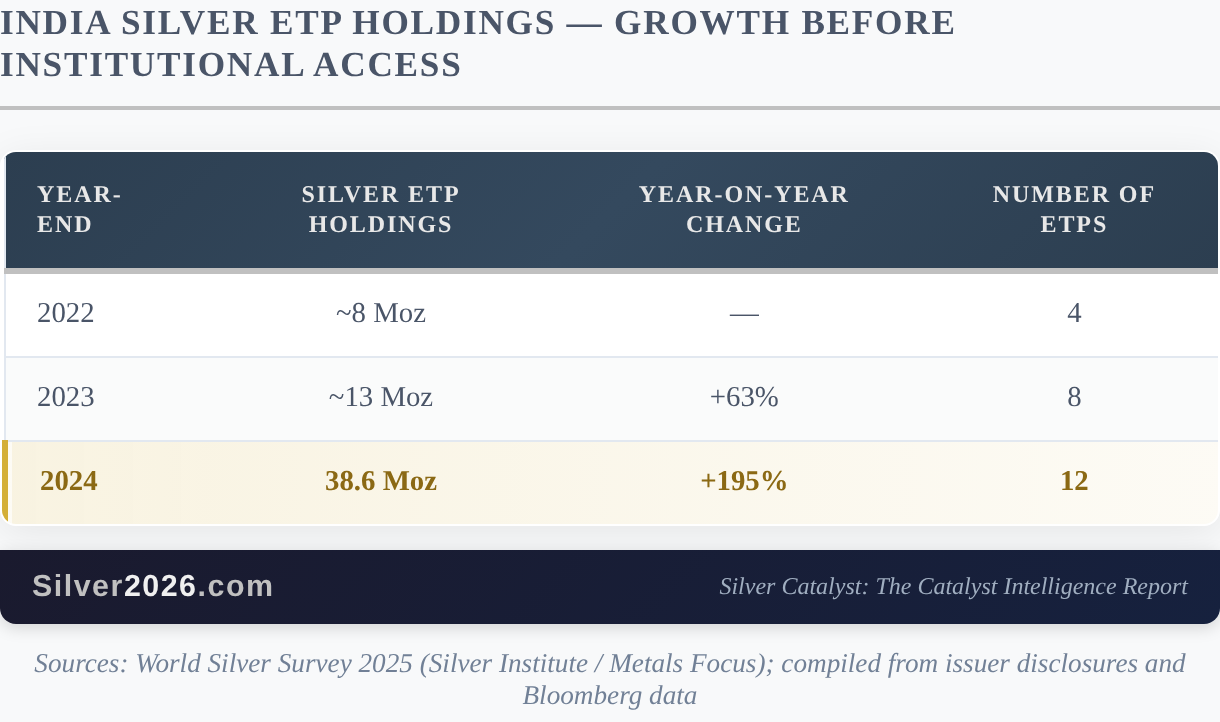
India is already, without any reform, the world’s most silver-intensive consumer market in terms of bullion and investment demand. Its silver bullion imports reached a record 247.4 Moz in 2024. Its silver ETF holdings grew approximately 195% year-on-year, from roughly 13 Moz at end-2023 to 38.6 Moz at end-2024 — nearly tripling between 2023 and 2024. Its domestic silver market runs on a cultural affinity for the metal with no close parallel in Western economies.
And yet, until today, India’s largest pool of institutional capital had no direct and scalable allocation pathway to silver ETFs within standard equity and hybrid fund structures.
As of April 1, 2026, that changed.
What SEBI Changed, and Why It Matters
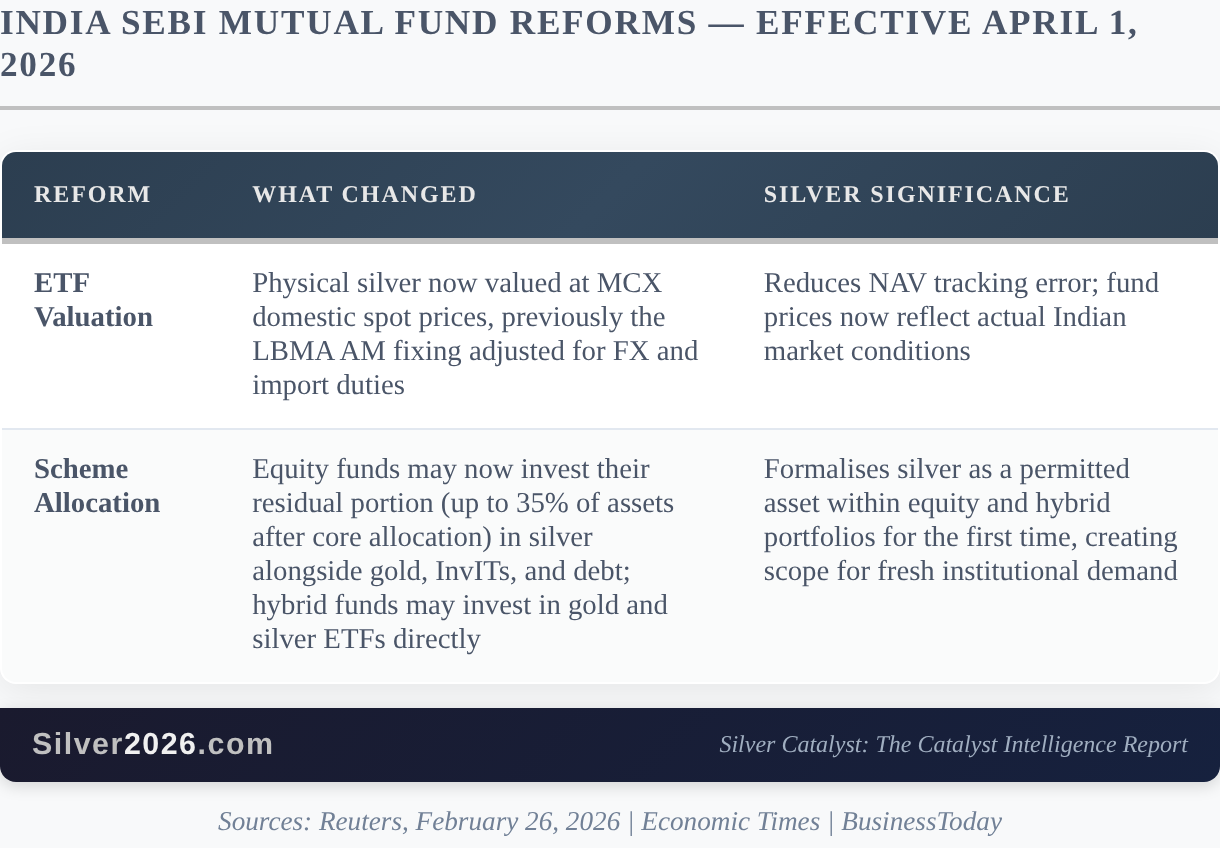
India’s Securities and Exchange Board of India formally implemented two interlocking reforms today that restructure how Indian mutual funds can access silver.
Sources: Reuters — India revamps mutual fund rulebook, opens room for higher gold and silver exposure (February 26, 2026); Economic Times — How SEBI’s new rule allowing mutual funds to hold more gold and silver may impact investors
The valuation change is technical but meaningful: a fund priced off the London benchmark carried a persistent gap versus what silver actually traded at in Mumbai. That gap was a structural deterrent to institutional adoption. Removing it closes an arbitrage that made silver ETF investing unnecessarily imprecise for Indian fund managers.
The allocation change is the one that matters structurally.
India’s mutual fund industry holds approximately ₹82 trillion (approximately $950 billion at current exchange rates) in assets under management as of February 2026. Equity and hybrid schemes represent the dominant category. Prior to this reform, those schemes could not include silver in their allocations at all. The reform changes that, though the access is specifically through the residual portion of each fund’s portfolio: the share remaining after core equity or hybrid allocation requirements are met, capped at 35%, and shared with gold, InvITs, and debt as competing options within that bucket.
To illustrate the potential scale across the full industry:
- A 0.1% allocation from equity/hybrid AUM into silver ETFs implies roughly $950 million of new silver ETF demand, approximately 13 Moz at current prices
- A 0.5% allocation implies roughly $4.75 billion, approximately 65 Moz at current prices
- A 1.0% allocation implies roughly $9.5 billion, approximately 130 Moz at current prices
These figures illustrate potential scale, not immediate flows — actual allocations will depend on fund manager adoption and may develop gradually over time. These estimates are based on total AUM for simplicity; actual allocation capacity is lower, as silver must compete within the residual allocation bucket alongside gold, InvITs, and debt. Analysts cited in the Economic Times note that most equity funds are unlikely to approach the 35% residual limit, and will likely use precious metals exposure selectively and tactically rather than as a permanent allocation.
Against the sixth consecutive structural deficit projected at 67 Moz by Metals Focus and the Silver Institute, even the most conservative of these scenarios is meaningful relative to the current structural deficit.
The Growth That Was Already Happening
What makes this reform significant is the baseline it builds on. Indian retail investors were already driving rapid silver ETP expansion before institutional channels opened:
Sources: World Silver Survey 2025 (Silver Institute / Metals Focus); compiled from issuer disclosures and Bloomberg data
That nearly threefold growth between 2023 and 2024, and nearly five-fold over two years, came entirely from retail investors and existing fund categories that were already permitted to hold silver. The institutional equity and hybrid fund segment was not contributing to any of it.
Today’s SEBI reform adds a new layer on top of a base that was already growing at 63% annually before 2024, then surged 195% in 2024 alone. The question is not whether institutional capital will eventually find its way into silver through this channel. The question is how quickly fund managers act on a mandate they did not have yesterday.
Why Institutional Flow Is Structurally Different
Retail silver demand in India is seasonal and episodic. Wedding seasons drive jewelry and silverware purchases. Festival periods drive coin and bar buying. That demand is real and large (247.4 Moz in 2024 imports) but it oscillates with the calendar.
Institutional allocation mandates work differently. When a fund’s investment policy is updated to include silver ETFs, that allocation tends to appear as a proportion of AUM and rebalance mechanically over time. It does not turn off when the festival season ends. It does not disappear when sentiment weakens in a correction. The monthly AMFI flow data, which tracks mutual fund allocation across asset classes, will be the first observable signal of whether fund managers are implementing the new rules or waiting to see how the initial cohort performs.
The structural significance is not that Indian institutions will immediately pour $9.5 billion into silver ETFs. It is that a channel now exists that did not exist yesterday, in the one market that combines the world’s largest physical silver consumption base with a rapidly growing institutional asset management industry.
The SEBI reform is one piece. The convergence of six catalysts in the next fifteen days is the full picture.