

Lately, Indian investors are increasingly looking beyond domestic tech names to capture global growth.
And when it comes to global tech exposure, nothing quite compares to Nasdaq. It’s home to some of the world’s most powerful companies like Apple, Microsoft, Nvidia, Alphabet, and Meta.
For Indian retail investors, the good news is that you no longer need a foreign brokerage account or complex paperwork to ride the Nasdaq wave.
A growing number of Nasdaq-linked mutual funds in India now offer a seamless, rupee-denominated gateway to the world’s most celebrated tech index. What’s more, they come with the added convenience of SIPs, tax efficiency, and SEBI regulation.
With AI-driven growth continuing to reshape industries and the US tech sector showing renewed momentum, the case for adding Nasdaq exposure to your portfolio has never been stronger.
But with multiple fund options, choosing the right one can be overwhelming.
Keeping that in mind, let’s look at the top 5 Nasdaq mutual funds in India.
#1 Motilal Oswal Nasdaq 100 Fund of Fund (FoF)
When it comes to investing in the Nasdaq 100 through Indian mutual funds, Motilal Oswal Nasdaq 100 FoF is often the first name that comes to mind.
Launched in November 2018, this fund has been one of the earliest vehicles for Indian investors seeking systematic exposure to US tech giants.
This is a Fund of Fund (FoF) structure, meaning it doesn’t directly buy Nasdaq stocks. Instead, it invests its entire corpus into the Motilal Oswal Nasdaq 100 ETF, which in turn tracks the Nasdaq 100 index.
The fund’s portfolio mirrors the Nasdaq 100 index, giving you indirect ownership in some of the world’s most valuable companies including Apple, Microsoft, Nvidia, Meta, Alphabet, Amazon, and Tesla.
| Key Fund Details | |
| Parameter | Details |
| Fund House | Motilal Oswal Mutual Fund |
| Launch Date | November 29, 2018 |
| Fund Type | Fund of Fund (International – Equity) |
| AUM | Rs 5,987 Cr (as of April 2026) |
| NAV (Direct) | Rs 61.88 (as of April 24, 2026) |
| Expense Ratio (Direct) | 0.22% |
| Minimum SIP | Rs 500 |
| Minimum Lumpsum | Rs 500 |
| Exit Load | 1% if redeemed within 15 days; Nil thereafter |
| Risk Level | Very High |
| Fund Managers | Swapnil P Mayekar, Rakesh Shetty, Dishant Mehta |
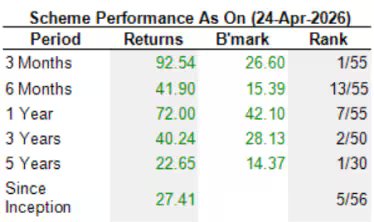
Coming to its returns performance, the fund has a good track record. Over 5 years, the fund ranks first in its category, having delivered 22.7% CAGR returns.

Data Source: Ace MF
But this has slightly higher volatility as its standard deviation is 1.3.
Investors must not forget the fact that it’s an FoF, so it carries a slightly layered cost structure (expense ratio of the FoF + the underlying ETF).
But the fund has beaten its benchmark over different time periods, so it remains a worthy candidate for investors looking for a simple, SIP-friendly, no-hassle entry into the Nasdaq 100 ecosystem.
#2 ICICI Pru NASDAQ 100 Index Fund(G)
Second on the list is ICICI Pru Nasdaq 100 Index fund.
Launched in October 2021, it brings a slightly different structural approach to the table, and that difference matters for cost-conscious investors.
The ICICI Prudential Nasdaq 100 Index Fund directly invests in the securities that make up the Nasdaq 100 Index.
This means it aims to replicate the index performance with minimal tracking error, without the extra layer of routing through an ETF.
| Fund Details | |
| Parameter | Details |
| Fund House | ICICI Prudential Mutual Fund |
| Launch Date | October 18, 2021 |
| Fund Type | Index Fund (International – Equity) |
| AUM | Rs 2,773 Cr (as of April 2026) |
| NAV (Direct) | Rs 21.54 (as of April 20, 2026) |
| Expense Ratio (Direct) | 0.51% |
| Minimum SIP | Rs 100 |
| Minimum Lumpsum | Rs 1000 |
| Exit Load | Nil |
| Risk Level | Very High |
| Fund Managers | Sharmila D’Silva, Nitya Mishra |
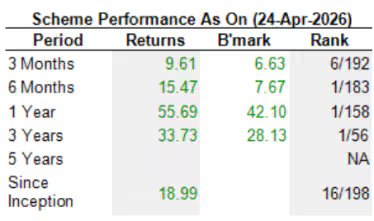
Over 3 years, the fund ranks first in its category, having delivered 33.7% CAGR returns.
It even ranks first in shorter time frames like 6 months and a year.

Data Source: Ace MF
The fund’s standard deviation is 1.1, while its beta is 1. This reflects its nature as a pure passive index fund that closely tracks market movement rather than attempting to outperform it.
The fund typically maintains a low expense ratio and portfolio turnover, making it a cost-effective option for investors.
But investors should note that this is a relatively young fund (launched in 2021), and it lacks a 5-year return track record that seasoned investors prefer for comparison.
#3 Navi Nasdaq100 US Specific Equity Passive FOF
Third on the list is Navi Nasdaq100 US Specific Equity Passive FOF.
In a space dominated by the big-name AMCs, Navi Mutual Fund has quietly carved out a case for itself with one of the lowest expense ratios among all Nasdaq-linked mutual funds in India.
Launched in March 2022, this fund appeals to cost-conscious, long-term passive investors who doesn’t want to overpay for Nasdaq 100 exposure.
Like the Motilal Oswal offering, this is a FoF structure but with a key twist. Instead of routing money through a domestically listed Nasdaq ETF, the fund’s top holding is the Invesco Nasdaq 100 ETF (a US-listed ETF), which constitutes 99.84% of the portfolio.
This means the fund gives you access to a globally recognised, US-domiciled ETF, offering arguably purer and more liquid underlying exposure to the Nasdaq 100.
| Fund Details | |
| Parameter | Details |
| Fund House | Navi Mutual Fund |
| Launch Date | March 23, 2022 |
| Fund Type | Fund of Fund (International – Equity) |
| AUM | Rs 991 Cr (as of April 2026) |
| NAV (Direct) | Rs 22.52 (as of April 22, 2026) |
| Expense Ratio (Direct) | 0.16% |
| Expense Ratio (Regular) | 0.30% |
| Minimum SIP | Rs 100 |
| Minimum Lumpsum | Rs 100 |
| Risk Level | Very High |
| Fund Manager | Ashutosh Shirwaikar |
Data Source: Ace MF
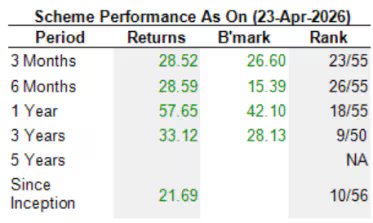
Coming to its returns, the fund has beaten the benchmark across time frames, but its rank trails behind many other funds.

Data Source: Ace MF
The fund has one of the lowest expense ratios in the Nasdaq MF category in India at just 0.16% (Direct Plan).
Navi is a relatively new AMC, but its performance has been strong. Launched I 2022, it has no 5-year return track record yet.
It’s a worthy candidate for investors who are highly cost-conscious and want to maximise returns by minimising the expense drag.
#4 Invesco India – Invesco EQQQ NASDAQ-100 ETF FoF
Fourth on the list is Invesco’s offering.
Among all the Nasdaq-linked mutual funds available in India, the Invesco India – Invesco EQQQ Nasdaq 100 ETF FoF stands out for one very distinctive reason: It doesn’t route your money through an Indian ETF or a US-listed ETF.
Instead, it takes a uniquely international path, investing in a Europe-domiciled ETF, making it a genuinely differentiated option in this category.
This is a Fund of Fund (FoF). The scheme seeks to generate returns by investing predominantly in units of the Invesco EQQQ Nasdaq-100 UCITS ETF, an overseas ETF that seeks to provide investment results corresponding to the price and yield performance of the Nasdaq-100 Notional Index (Net Total Return) in USD.
The EQQQ is Invesco’s flagship Nasdaq 100 ETF listed on the London Stock Exchange, one of Europe’s largest and most liquid Nasdaq 100 tracking instruments.
| Fund Details | |
| Parameter | Details |
| Fund House | Invesco India Mutual Fund |
| Fund Type | Fund of Fund (International – Equity) |
| AUM | Rs 396–416 Cr (as of April 2026) |
| NAV (Direct) | Rs 22.79 (as of April 16, 2026) |
| Expense Ratio (Direct) | 0.16% |
| Expense Ratio (Regular) | 0.40% |
| Risk Level | Very High |
| Fund Manager | Abhisek Bahinipati |
| Underlying ETF | Invesco EQQQ Nasdaq-100 UCITS ETF (London Stock Exchange) |
| Benchmark | Nasdaq-100 Notional Index Net Total Return |
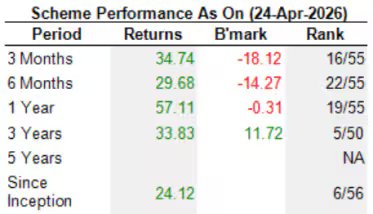
Coming to its returns, the performance has largely remained stable compared to its benchmark and peers.
Over 3 years, the fund has delivered 33.8% returns on a CAGR basis.

Data Source: Ace MF
It has a standard deviation of 1.1 and its beta is 0.1.
The fund house and the underlying ETF share the same global brand (Invesco), which brings a level of strategic alignment and transparency not often seen in FoF structures.
Like most funds in this category, it doesn’t yet have a 5-year return track record, limiting long-term backtesting.
Still, it’s a worthy candidate for investors looking for structural diversity in their portfolio and wanting something beyond the mainstream.
#5 Axis NASDAQ 100 US Specific Equity Passive FOF
Last on the list is Axis Nasdaq 100 US Specific Equity Passive FoF.
This is a dark horse with the best risk-adjusted performance in this list. The Axis NASDAQ 100 US Specific Equity Passive FoF is the smallest fund in this roundup by AUM, but it has an impressive statistical profile.
It was launched in November 2022 for investors who care about risk-adjusted returns.
This is a Fund of Fund (FoF) that takes a more flexible approach compared to its peers. It’s an open-ended scheme investing in units of ETFs focused on the Nasdaq 100 TRI.
It aims to replicate the performance of the Nasdaq 100 TRI over the long term, subject to tracking error.
Unlike some peers that lock into a single overseas ETF, this fund invests across overseas ETFs that track the Nasdaq 100, giving the fund manager the flexibility to optimise across available instruments for the best possible tracking and cost efficiency.
| Fund Details | |
| Fund House | Axis Mutual Fund |
| Launch Date | November 01, 2022 |
| Fund Type | Fund of Fund (International – Equity) |
| AUM | Rs 180.64 Cr (as of March 31, 2026) |
| NAV (Direct) | Rs 26.29 (as of April 18, 2026) |
| Expense Ratio (Direct) | 0.29% |
| Expense Ratio (Regular) | 0.63% |
| Minimum SIP | Rs 100 |
| Risk Level | Very High |
| Fund Manager | Krishnaa Narayan (since March 2024) |
| Benchmark | Nasdaq 100 TRI (INR) |
Coming to its performance, the fund has generated 33% CAGR returns over the past 3 years, while over a year, returns stand at 55.5%.
It has the lowest standard deviation among all 5 funds we discussed, making drawdowns comparatively more manageable.
Also, unlike single-ETF FoFs, the fund can allocate across various overseas ETFs, enabling better cost and tracking optimization. It’s a candidate for investors who prioritise quality of returns.
Conclusion
The Nasdaq 100 has the most transformative companies in the world. From AI and cloud computing to EV and biotechnology, the companies housed within the Nasdaq 100 are quite literally writing the future.
In 2026, Indian investors have never had it easier to be a part of that story. As always, investors looking at any of these should not just chase returns but look at risk too.
A fund that delivers slightly lower returns with significantly less volatility may actually serve your long-term needs better than one that swings wildly in both directions.
Also, the Nasdaq 100 can be intensely volatile in the short run: drawdowns of 20-30% are common during global risk-off events.
These funds are best held for a minimum of 5-7 years to ride out the cycles and capture the full power of compounding.
Happy investing.
Disclaimer: This article is for information purposes only. It is not a stock recommendation and should not be treated as such. Learn more about our recommendation services here…
The website managers, its employee(s), and contributors/writers/authors of articles have or may have an outstanding buy or sell position or holding in the securities, options on securities or other related investments of issuers and/or companies discussed therein. The content of the articles and the interpretation of data are solely the personal views of the contributors/ writers/authors. Investors must make their own investment decisions based on their specific objectives, resources and only after consulting such independent advisors as may be necessary