

The technology sector remains a powerful engine of economic growth and innovation, constantly reshaping how we live, work, and interact. For investors seeking exposure to this dynamic landscape, Technology Exchange-Traded Funds (ETFs) offer a compelling solution. These funds provide diversified access to a basket of tech companies, ranging from semiconductor giants and software leaders to internet innovators and hardware manufacturers, thereby mitigating the risk of investing in individual tech stocks.
This year, technology continues to be at the forefront of market discussions. Key themes like artificial intelligence (AI) proliferation, cloud computing expansion, cybersecurity demands, and the evolution of the Internet of Things (IoT) are driving significant investment and potential growth. Additionally, shifts in macroeconomic conditions and valuations may create specific opportunities within the sector. This makes monitoring leading Technology ETFs particularly relevant.
Below, we’ll examine a selection of popular and well-regarded Technology ETFs, highlighting their key characteristics to help you make informed investment decisions. We will consider factors such as expense ratios, top holdings, and reasons to consider each ETF.
1. Technology Select Sector SPDR Fund (XLK)
- Expense Ratio: 0.13%
- Top Holdings: Microsoft Corp, Apple Inc, NVIDIA Corp, Broadcom Inc, Advanced Micro Devices Inc.
- Why Consider It? XLK is one of the largest and most liquid technology ETFs, tracking the technology stocks within the S&P 500 Index. It offers highly concentrated exposure to the biggest names in U.S. tech, making it a direct play on the performance of industry giants. Its extremely low expense ratio is a major advantage.
2. Vanguard Information Technology ETF (VGT)
- Expense Ratio: 0.10%
- Top Holdings: Microsoft Corp, Apple Inc, NVIDIA Corp, Broadcom Inc, Salesforce Inc
- Why Consider It? VGT tracks a broader index (MSCI US Investable Market Information Technology 25/50 Index), including large, mid, and small-cap U.S. technology stocks. While still dominated by mega-caps, it offers slightly more diversification across the sector than XLK. Its very low expense ratio makes it another cost-effective core holding for tech exposure.
3. Invesco QQQ Trust (QQQ)
- Expense Ratio: 0.20%
- Top Holdings: Microsoft Corp, Apple Inc, NVIDIA Corp, Amazon.com Inc, Meta Platforms Inc, Broadcom Inc
- Why Consider It? QQQ tracks the Nasdaq-100 Index, which comprises 100 of the largest non-financial companies listed on the Nasdaq. While heavily weighted towards technology, it also includes significant holdings in communication services (like Meta, Google) and consumer discretionary (like Amazon, Tesla). It’s often used as a proxy for large-cap growth and innovation, not just pure tech.
- Expense Ratio: 0.46%
- Top Holdings: Microsoft Corp, Apple Inc, NVIDIA Corp, Taiwan Semiconductor Manufacturing Co Ltd, ASML Holding NV
- Why Consider It? IXN offers exposure to the technology sector on a global scale by tracking the S&P Global 1200 Information Technology Sector Index. This differentiates it by including major international tech companies alongside U.S. giants, providing broader geographical diversification within the tech theme.
5. First Trust Dow Jones Internet Index Fund (FDN)
- Expense Ratio: 0.52%
- Top Holdings: Amazon.com Inc, Meta Platforms Inc, Salesforce Inc, Alphabet Inc, Palo Alto Networks Inc
- Why Consider It? FDN focuses specifically on the internet sub-sector of technology, tracking companies that generate significant revenue from online activities. It often employs a modified weighting scheme, potentially giving more influence to mid-sized internet players compared to pure market-cap weighting. It’s a targeted play on e-commerce, social media, cloud services, and online advertising leaders.
Selecting the right Technology ETF requires careful analysis of holdings, costs, and performance. InvestingPro provides investors with powerful tools for evaluating Technology ETFs:
- Access in-depth analysis and detailed metrics for a vast universe of ETFs, including the technology funds highlighted.
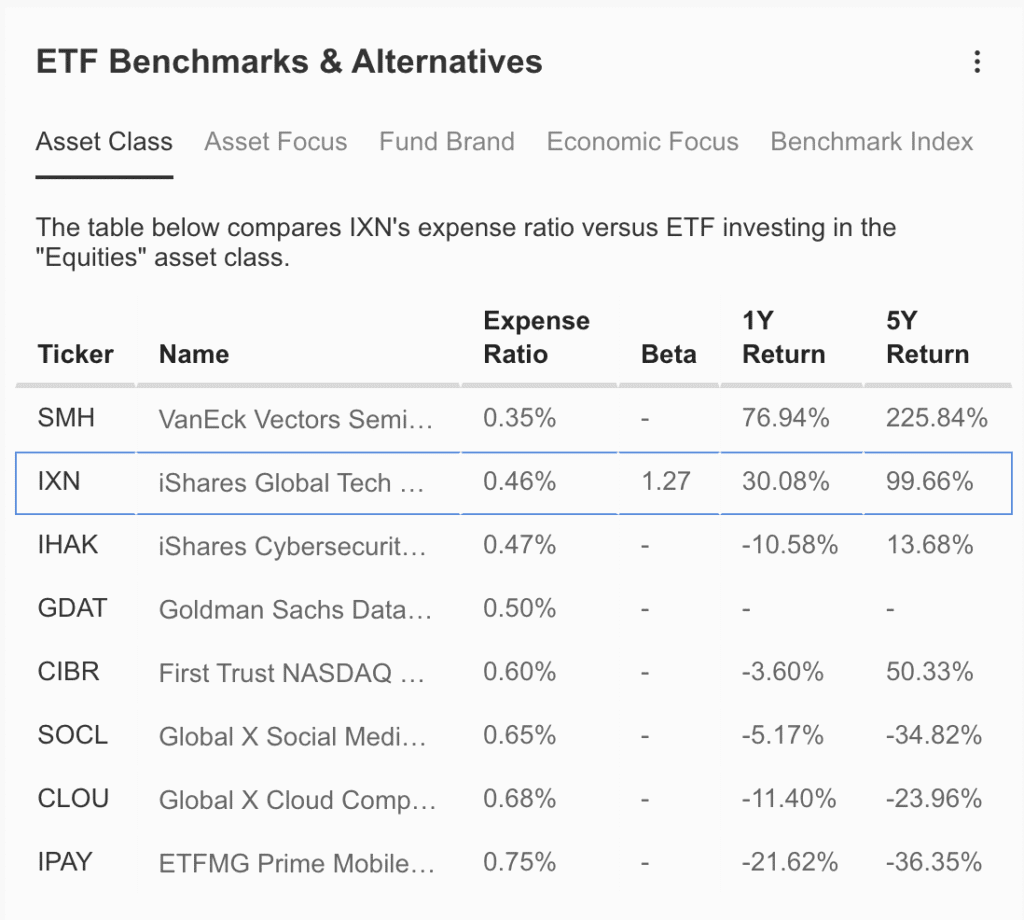
- Easily compare key data points like expense ratios, historical returns (1-year, 5-year, etc.), sector breakdowns, and top holding concentrations side-by-side.
- Analyze specific sub-sector exposures (e.g., semiconductors, software, internet) within each ETF to ensure alignment with your investment thesis.
- Utilize sophisticated screening tools to discover other Technology ETFs based on custom criteria such as expense ratio limits, geographical focus (US vs. Global), or specific industry exposure.
Make more informed technology investment decisions by leveraging the comprehensive data and analytical capabilities of InvestingPro.
Investing in Technology ETFs can be a core part of a growth-oriented strategy. However, it’s crucial to assess your financial goals, risk tolerance, and time horizon before investing.
Potential Benefits
- High Growth Potential: Access to companies driving innovation and benefiting from long-term secular growth trends like digitalization, AI, and cloud computing.
- Exposure to Innovation: Invests in companies at the forefront of technological advancements that are transforming industries.
- Diversification within Tech: Spreads risk across various technology sub-sectors and companies, reducing single-stock risk within the sector.
- Strong Historical Performance: The technology sector has often delivered strong returns over the long term (though past performance is not indicative of future results).
Potential Risks
- Higher Volatility: Technology stocks can be more volatile than the broader market, subject to larger price swings based on earnings, news, and market sentiment.
- Valuation Risk: Tech stocks often trade at higher valuation multiples (like P/E ratios). If growth expectations are not met or interest rates rise significantly, these valuations can contract sharply.
- Regulatory Scrutiny: Large technology companies increasingly face regulatory pressures globally regarding antitrust, data privacy, and content moderation, which could impact future growth and profitability.
- Concentration Risk: Many broad Technology ETFs are heavily concentrated in a few mega-cap stocks (like Apple and Microsoft), meaning the ETF’s performance can be disproportionately affected by these top holdings.
Choosing the right Technology ETF requires careful analysis and consideration of several factors. Here are some essential steps to help you find the top Technology ETFs for your investment needs:
1. Analyze Holdings
- Look closely at the underlying companies and sub-sector weights. Does the ETF focus broadly on tech (XLK, VGT), include tech-adjacent sectors (QQQ), target a specific niche (FDN), or offer global exposure (IXN)? Understand the concentration – how much weight is in the top 10 holdings? Ensure the specific exposure aligns with your goals. Use InvestingPro to gain insights into sector allocation, top holdings, and diversification metrics.
2. Check Expense Ratios
- Lower costs directly translate to higher net returns over time. Technology ETFs range from very cheap (XLK, VGT) to moderately expensive (FDN, IXN). Compare fees carefully, balancing cost against the ETF’s specific strategy, holdings, and liquidity. Use tools like InvestingPro to efficiently assess and compare expense ratios across different Technology ETFs.
3. Review Performance and Liquidity
- Examine historical performance to understand how the ETF behaved during different market cycles (e.g., tech booms, downturns, rising rate environments). Remember, past performance is not a future guarantee. Critically, ensure the ETF has high trading volume (liquidity) and tight bid-ask spreads for easy and cost-effective trading. Within InvestingPro you can find and compare performance across ETF benchmarks.
4. Understand the Theme
- Clearly identify the ETF’s specific theme. Is it U.S. large-cap tech (XLK)? Broader U.S. tech (VGT)? Nasdaq-100 growth/innovation (QQQ)? Global tech (IXN)? Or a sub-sector like the internet (FDN)? Matching the ETF’s theme to your investment thesis is crucial for achieving your desired exposure.
What is a Technology ETF?
A Technology ETF is an exchange-traded fund that primarily invests in stocks of companies within the technology sector. This includes sub-sectors like software & services, semiconductors & equipment, hardware & storage, and sometimes internet-related businesses.
What’s the main difference between XLK and QQQ?
XLK specifically tracks the technology sector stocks within the S&P 500. QQQ tracks the Nasdaq-100 Index, which is heavily weighted in tech but also includes significant non-tech companies from sectors like communication services and consumer discretionary. QQQ is broader than just pure tech.
Are Technology ETFs suitable for all investors?
Technology ETFs can be a core holding for growth-oriented investors, but their higher volatility means they may not be suitable for those with a low-risk tolerance or short investment horizons. Diversification across asset classes is still important.
What drives the performance of Technology ETFs?
Performance is driven by factors like corporate earnings growth, innovation cycles (e.g., AI, cloud), product releases, interest rate environments (which affect valuations), semiconductor cycles, and overall economic health influencing tech spending.
Should I choose a US-focused or Global Technology ETF?
This depends on your investment view. US-focused ETFs (XLK, VGT, QQQ, FDN) concentrate on the dominant U.S. tech market. A global ETF like IXN adds diversification by including major international tech players, potentially reducing country-specific risk but also introducing currency risk.