
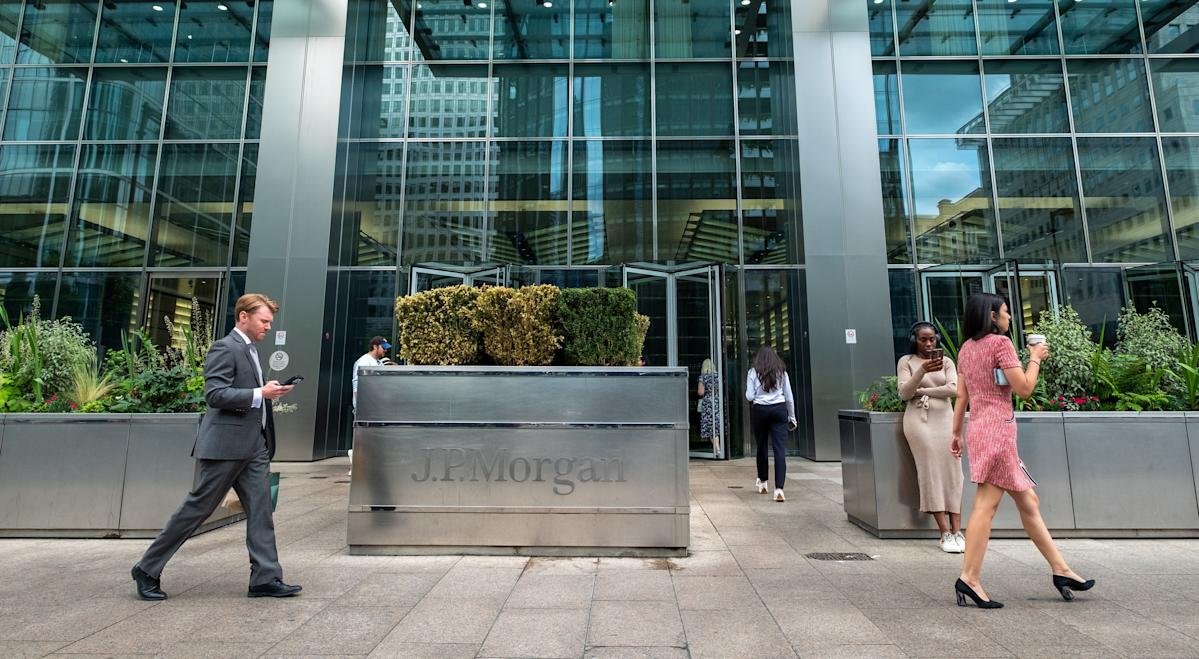

Image of a JPMorgan building with people walking in front of the signage.
Exchange-traded funds (ETFs) are popular types of investments. When you buy shares in an ETF, you gain access to a basket of stocks, bonds and other assets. They’re great tools for diversifying your portfolio because your money goes toward a group of investments, not just one stock or bond (1).
ETFs are only increasing in popularity. Global ETF assets under management (AUM) hit $14.6 trillion in 2024, then $19.5 trillion in 2025. Now, over a third of executives surveyed by the PwC expect ETF AUM to reach at least $35 trillion by June 2030 (2).
Must Read
-
Robert Kiyosaki issues grim warning for baby boomers. Many could be ‘wiped out’ and homeless ‘all over’ the country. How to protect yourself now
JPMorgan says this rapid growth, along with other trends and regulations, will lead to more technology in ETF trading. Here are three ETF changes to keep an eye out for in the next year or so (3).
1. ETF demand and new regulations are leading to automation
Not only is there rapidly growing demand for ETFs, but regulations regarding ETF trade reporting are changing in 2026. For example, the Financial Industry Regulatory Authority (FINRA) now requires trade reporting facilities (TRFs) to open at 4 a.m. ET, beginning March 30. Previously, they opened at 8 a.m. ET. (4)
Then, trades executed between 4 a.m. and 8 p.m. ET must be reported in real time, which realistically means within 10 seconds (5). These are just a couple of examples of regulatory changes.
“As markets and regulatory requirements get more complex, the ability to adhere to them can really only be satisfied by a technological platform, as it becomes too challenging to manage that manually,” Matthew Legg, global head of Delta One and ETF sales at JPMorgan, said in the institution’s report (6).
To help automate ETF trades, authorized participants — financial institutions with the right to redeem or create ETF shares — are using proprietary Order Management Systems (OMSs), which integrate AI and machine learning algorithms. These are digital platforms that merge the full lifecycle of an ETF order into one place (7).
These new regulations and advanced automated tools mean you can trade ETFs during more hours of the day and immediately see the results.
Read More: Almost 50 with no retirement savings? Here’s why you shouldn’t panic
2. Active ETFs are gaining popularity
Of all the new ETFs introduced to the market in 2025, 83% were active ETFs (8).
When you think of an exchange-traded fund, your mind might go to what’s known as a “passive ETF.” This type is meant to track a certain market index, such as the S&P 500. Active ETFs, on the other hand, work to outperform the market index (9).
Active ETF managers use research and market data to make investment decisions. Their holdings fluctuate more than passive ETFs’ do (10).
An active ETF may sound more like a mutual fund. However, the fee structure is still different, ETFs don’t have minimum initial investments and ETFs can be more tax-efficient. Also, like passive ETFs, active ones trade throughout the day. Mutual funds only trade at the end of the day (11).
Since active ETFs are more intricate than passive ones, companies will need to use more technology to manage them effectively.
“As new products come out in the active ETFs space, including new underlying assets, new tech capabilities need to be developed. This will keep pushing out the target for what is required for electronification,” Legg told JPMorgan (12).
With a higher number of active ETFs entering the market, you have more investment options and more tools for diversifying your portfolio. You might prefer an ETF over a mutual fund due to lower fees and potential tax benefits, but still want your investment to outperform an index.
3. Tokenized ETFs could be the future
A tokenized ETF is a digital representation of a regular ETF. Shares are recorded as tokens on a blockchain. It basically combines a traditional investing tool with the modern-day blockchain, which you may be familiar with as the ledger used for creating and storing cryptocurrency (13).
The JPMorgan report explains that there are two types of tokenized ETFs: The first is the synthetic tokenized ETF, which is a digital token that reflects the performance of a real-world ETF. It uses a derivative contract rather than holding the real asset, so the returns might be a little different than if you invested in a regular ETF (14).
The second is a native tokenized ETF, which involves the share going directly to the blockchain to become an on-chain token and that token is used as the security. Native tokenized ETFs are still in their experimental stage, though (15).
How could tokenized ETFs benefit you? There are several potential perks — the main one being that tokenization opens ETFs up to 24/7 trading via the blockchain, so you aren’t limited to trading only when the stock exchange is open (16).
Tokenization could also make it more affordable to invest in ETFs. These funds have become more expensive as demand rises, but tokenized ETFs allow for fractional ownership, so you can buy just part of a share. The automation technology that comes with tokenization could also lower custodian fees (17). This means that ETFs may now have a lower barrier to entry for a greater number of people considering this investment vehicle.
What To Read Next
Join 250,000+ readers and get Moneywise’s best stories and exclusive interviews first — clear insights curated and delivered weekly. Subscribe now.
Article Sources
We rely only on vetted sources and credible third-party reporting. For details, see our ethics and guidelines.
Fidelity (1),(9); PwC (2),(13); JPMorgan (3),(6),(8),(10),(12),(14),(15); Federal Register (4); InvestmentNews (5); Manhattan Associates (7); Charles Schwab (11); TD Securities (16),(17)
This article provides information only and should not be construed as advice. It is provided without warranty of any kind.