

The rapid growth of active ETFs has transformed how investors build portfolios. What began as a low-cost way to track traditional stock and bond indexes has evolved into an investment vehicle capable of delivering sophisticated strategies once reserved for institutions and wealthy individuals. Active ETFs have made everything from private credit exposure and options-based income to alternative investment strategies more accessible.
And now we can add autocallable notes to that list.
Traditionally issued by banks as structured notes, autocallables offer potentially substantial income tied to the performance of an underlying stock or market index. Their appeal lies in the ability to generate high coupon payments even when stocks aren’t rising, providing investors with an alternative to traditional bonds and dividend-paying equities. Given rising volatility and growing uncertainty, autocallables hold considerable appeal for income seekers.
What Are Autocallables?
Wall Street loves new products that generate revenue while reducing risk, and that’s the environment in which autocallables were created.
Autocallables are structured investments designed to generate income based on the performance of an underlying asset, typically a stock market index.
Unlike traditional bonds, which pay interest based on an issuer’s borrowing obligations, autocallables generate conditional income through embedded derivatives.
Their defining feature is a predetermined set of conditions that govern when investors receive income, when the investment may be redeemed, and how much principal they ultimately recover.
A typical autocallable includes a coupon rate, an underlying reference index, a downside barrier, and an automatic redemption provision.
For example, consider a hypothetical autocallable offering a 12% annual coupon linked to the S&P 500, with a coupon barrier set 30% below the index’s starting level.
If the index remains above that threshold on scheduled observation dates, the investor receives the applicable coupon, meaning the market doesn’t need to rise for income to continue.
If the index falls below the coupon barrier, payments may stop until conditions improve. Some structures include unconditional coupons, so the precise terms matter.
The principal barrier introduces another important consideration.
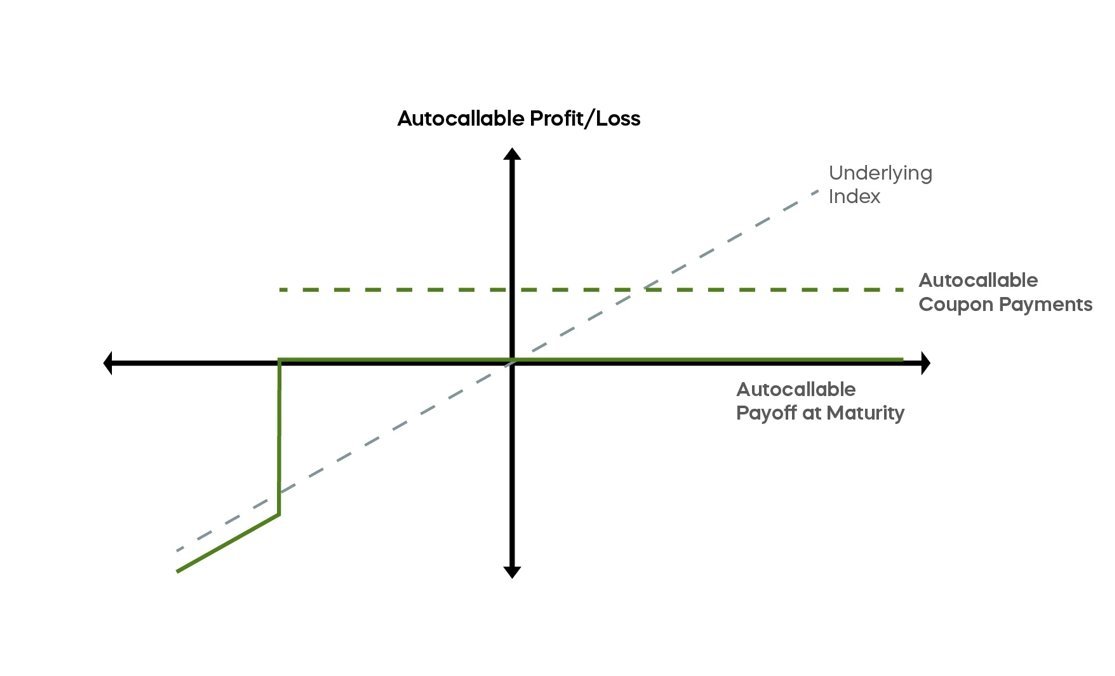
If the index finishes above its specified downside barrier at maturity, the investor generally receives the original principal. If it finishes below that barrier, however, principal losses may reflect the full decline in the underlying index rather than only the amount below the barrier.
This chart from ProShares shows the basic mechanics and profit/loss profile of an autocallable note.
The question is why bother with autocallables when several other income asset classes are available to investors.
The biggest attraction is the income potential substantially above what conventional bonds or dividend-paying stocks typically offer—as much as 15%, according to MarketWatch.
Fed rate hikes have put traditional fixed-income investments back in the crosshairs of interest-rate risk, while dividend strategies remain dependent on corporate earnings and distribution policies.
Autocallables take a different approach, generating income primarily from equity-linked derivative structures rather than bond coupons. An autocallable strategy may continue generating income even if the index declines moderately, provided its payment conditions remain satisfied, and its income can be less directly tied to interest-rate movements than conventional bond income.
An added benefit is that autocallables carry lower overall volatility than equities and a risk profile similar to the investment-grade bond market.
Invest in Autocallables Through ETFs
The asset class was once reserved for high-net-worth investors and institutional portfolios, but the active ETF revolution has changed that, giving investors of all sizes access to autocallables.
According to MarketWatch, assets in U.S.-listed autocallable ETFs grew from approximately $580 million in late 2025 to $4.8 billion by September 2026. More are set to launch over the coming quarters, with major ETF issuers like BlackRock and J.P. Morgan announcing plans.
The strategies among these new ETFs vary meaningfully. Some use laddering—maintaining exposures initiated at different times rather than establishing every autocallable position at the same market level—which may help smooth income and reduce timing concentration. Others buy a single note and automatically roll it at maturity. Some funds are fully active, while others rely on systematic or fundamental indexing to achieve their goals.
Building Autocallable ETFs Into an Income Portfolio
With investors of all sizes now able to access autocallables, it makes sense to consider them as part of a portfolio. Autocallable ETFs are generally best treated as complementary income holdings rather than substitutes for core bonds, dividend stocks, or cash.
For investors already holding Treasuries, investment-grade corporate bonds, and dividend-paying equities, a modest autocallable allocation could introduce an additional income source with a distinct payoff structure.
Autocallable Active ETFs
These active ETFs were selected based on their exposure to the autocallable market and are sorted by year-to-date total return, which ranges from 6.7% to 15%. They carry expenses between 0.79% and 0.86%, AUM between $51M and $1.4B.
| Ticker | Name | AUM | YTD Total Ret (%) | Yield (%) | Exp Ratio | Security Type | Actively Managed? |
|---|---|---|---|---|---|---|---|
| CAIQ | Calamos Nasdaq Autocallable Income ETF | $391M | 15.3% | 0% | 0.86% | ETF | Yes |
| CAIE | Calamos Autocallable Income ETF | $1.4B | 11.9% | 14% | 0.86% | ETF | Yes |
| ACEI | Innovator Equity Autocallable Income Strategy ETF | $51M | 8% | 12.8% | 0.79% | ETF | Yes |
| ACII | Innovator Index Autocallable Income Strategy ETF | $143M | 6.7% | 9.8% | 0.79% | ETF | Yes |
The emergence of autocallable ETFs reflects how dramatically the ETF industry has evolved.
Strategies that once required substantial capital, specialized knowledge, and direct relationships with structured-product issuers are now available through ordinary brokerage accounts.
That accessibility is meaningful, particularly for income-focused investors looking beyond conventional bonds and dividend stocks.
Autocallable ETFs can potentially generate substantial income during flat or moderately declining markets, while laddered structures and professional portfolio management simplify what was previously a complicated investment process.
Bottom Line
For investors who understand those tradeoffs, autocallable ETFs may become a useful addition to diversified income portfolios. Their greatest value lies not simply in the promise of unusually high yields, but in the opportunity to access a distinct income strategy through the convenience of an ETF.